
The Lasting Impact of Smoke and Odors After a Kitchen Fire
Flames are extinguished in minutes. Smoke damage settles in for the long haul.
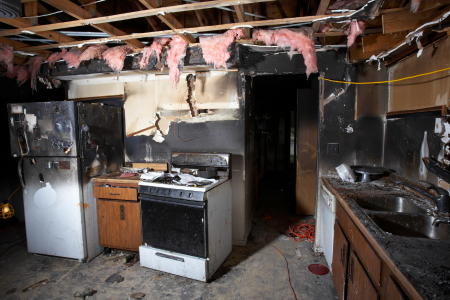
When a kitchen fire is contained, attention shifts to what’s visibly burned — cabinets, countertops, appliances, and flooring. Insurance documentation begins. Debris is removed. The space starts to look manageable again. What is less obvious is how far smoke and odor have already traveled. The combustion process releases microscopic particles that move through air pathways, into structural cavities, and across surfaces well beyond the point of ignition.
The visible burn area rarely defines the true scope of damage. Smoke does.
How Smoke and Odor Spread Beyond the Kitchen
A kitchen contains a concentrated mix of materials that produce complex smoke residue when burned: food proteins, cooking oils, plastics, wiring insulation, laminates, paint finishes. Each releases a distinct particulate signature. As these particles cool, they adhere to cooler surfaces throughout the structure — walls, ceilings, framing, insulation, HVAC ductwork, and soft furnishings.
Three structural factors influence how smoke damage expands:
- Airflow patterns – HVAC systems, exhaust fans, and natural pressure differences move smoke horizontally and vertically through a property.
- Material porosity – Drywall, wood, carpet padding, and fabrics absorb odor particles into microscopic voids.
- Temperature differentials – Smoke follows thermal gradients, settling in cooler zones and concealed spaces.
That is why a kitchen fire can leave bedrooms, closets, and attic spaces smelling of smoke despite no visible flame contact. Odor is not a surface issue. It is contamination embedded in building materials.
Without proper remediation, those particles continue to oxidize. Humidity shifts reactivate odor. Warm weather intensifies smell. Occupants describe it as smoke “coming back,” when in reality, residue was never fully removed.
Why Surface Cleaning Is Not Enough
It is common to assume that wiping walls, repainting, or running air fresheners will resolve smoke odor. Those measures address surface appearance, not embedded contamination.
Smoke residue bonds chemically to materials. In some cases, it becomes acidic, accelerating corrosion of metal components and degrading finishes. HVAC systems can redistribute lingering particles if ductwork is not inspected and cleaned. Insulation may require removal if saturation is extensive. Even cabinetry interiors can retain odor long after exterior surfaces appear clean.
Effective smoke and odor remediation requires:
- Identification of smoke travel patterns
- Removal of irreversibly damaged materials
- HEPA air filtration to capture airborne particulates
- Targeted cleaning agents designed for soot removal
- Advanced deodorization methods such as thermal fogging or hydroxyl treatment
- Inspection and cleaning of ventilation systems
Skipping any of these steps increases the risk of recurring odor, indoor air quality concerns, and secondary property damage.
Kitchen fires are among the most common residential fire events nationwide. They are also among the most underestimated in terms of smoke spread. Because the ignition source is often contained to one appliance or cooking area, property owners may assume the damage is limited. In reality, smoke follows airflow, not cabinetry lines.
The Long-Term Consequences of Incomplete Smoke Remediation
When smoke and odor damage are not fully addressed, the consequences extend beyond smell:
- Persistent indoor air contamination
- Reduced HVAC efficiency
- Discoloration bleeding through new paint
- Diminished property value
- Occupant discomfort and health complaints
In commercial environments, odor can affect customer perception and operational continuity. In residential properties, lingering smoke disrupts daily living long after visible repairs are completed.
The true benchmark of fire restoration is not whether charred materials have been replaced. It is whether the structure has been returned to a clean, stable indoor environment.
Smoke and odor damage demand technical remediation, disciplined sequencing, and material-specific cleaning protocols. Nationally recognized restoration standards emphasize source removal before deodorization for this reason. Addressing odor as an afterthought leads to repeated problems. Addressing it as contamination produces durable results.
When a kitchen fire occurs, response speed and remediation quality matter. AdvantaClean approaches smoke and odor damage as a comprehensive structural issue, not a cosmetic concern. If your property has experienced a fire, contacting AdvantaClean promptly helps prevent long-term smoke damage and recurring odor issues that surface months later.