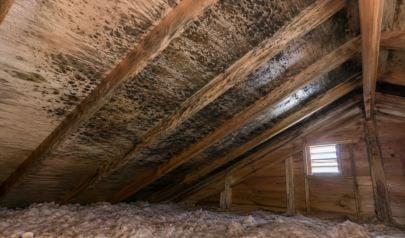
Georgia homes develop mold problems that homes in drier climates rarely do. Kennesaw, Acworth, and Cartersville sit in a humid subtropical zone where summer humidity regularly exceeds 70 percent even on dry days. Dense tree canopy, crawl spaces above moisture-retaining red clay, and summer storms dumping two inches in ninety minutes create conditions where mold thrives year-round.
Most mold problems in this region start quietly. A slow roof leak after a spring hailstorm, a crawl space vapor barrier that failed three seasons ago, or an HVAC condensate line dripping behind a wall for weeks. By the time occupants notice, usually from the distinctive musty smell or visible growth on a wall, the colony is well established.
What Mold Remediation Is and Is Not
Bleach and a scrub brush are not mold remediation. Surface treatment on porous materials like drywall and wood framing doesn't reach where the growth lives. It disturbs spores and spreads them to unaffected areas.
Professional remediation starts with containment. Plastic sheeting and negative air pressure isolate the work area. HEPA filtration runs continuously. Affected materials are removed in sealed bags. Post-remediation testing by an independent industrial hygienist confirms completion. The goal is to return mold to normal background levels and remove the conditions that caused elevated growth.
The Areas That Most Often Need Attention in This Region
Crawl Spaces
Unconditioned crawl spaces in Kennesaw and Acworth homes are consistent sources of mold activity. Ground moisture evaporates upward, condenses on cooler structural members, and creates a persistent wet-dry cycle on floor joists and subfloor sheathing. When a vapor barrier is absent or damaged, this cycle accelerates. Over a few years, wood-decaying fungi establish themselves and structural integrity and air quality begin to decline.
Remediation in a crawl space typically involves removing contaminated insulation, treating affected structural wood, and encapsulating the crawl space with a reinforced vapor barrier. Without addressing the moisture source, retreating the same space in a few years becomes likely.
Attics
Attics develop mold for different reasons. Most often it is a ventilation failure. Either the ridge or soffit vents are blocked, or bathroom exhaust fans route into the attic instead of through it to the exterior. Hot, humid air from the house rises and gets trapped. On cooler roof decking, it condenses. After a few Georgia summers of this cycle, the underside of the roof sheathing develops widespread surface mold often not visible until the attic is inspected.
Cartersville properties with older construction sometimes have attic ventilation configurations that were never code-compliant. These require both remediation and a ventilation correction.
Wall Cavities After Water Events
Any home that experienced water intrusion and was not fully dried within 48 to 72 hours carries a mold risk in affected wall cavities. If you've had a water event and drying was never verified with moisture readings, an inspection is worthwhile.
When You Need Testing and When You Don't
Visible mold growth larger than about ten square feet generally does not need testing before remediation. The growth itself is the finding. Testing is most useful when there is no visible mold but occupants experience symptoms, when a musty odor persists without an identified source, or when post-remediation clearance needs verification for real estate transactions or insurance documentation.
A professional inspection with moisture readings is the right starting point before investing in testing.
Frequently Asked Questions About Mold Remediation
How long does mold remediation take? A contained room-level remediation typically takes one to three days. Crawl space projects depend on square footage and access. Full-building events can take a week or more. The timeline depends on the initial assessment.
Do I need to leave my home during remediation? For small contained projects, occupancy is often possible. For larger work in primary living spaces, temporary relocation is advisable. The crew will advise you based on the scope.
Will mold come back after remediation? Remediation removes existing growth and contaminated materials. Whether mold returns depends entirely on resolving the underlying moisture issue. Remediation without moisture control is a temporary fix. A quality contractor addresses both.
Is mold covered by homeowners insurance? Mold from a sudden covered water event is often covered. Mold from ongoing maintenance neglect typically is not. Documenting the cause of the water intrusion matters.
The Right Call Is an Honest Assessment First
Not every musty smell is a major remediation project. Some are minor surface issues in a confined area addressed quickly. Others, especially in crawl spaces or attics developing for years, are more extensive. Either way, you need an accurate picture before making a good decision.
AdvantaClean of Kennesaw provides mold inspections and full remediation services across Kennesaw, Acworth, and Cartersville. The assessment is the starting point. It gives you an honest scope of what is there and what it takes to fix it properly. We are available 24 hours a day if you need to reach us after a storm or sudden discovery.
Find us at our AdvantaClean of Kennesaw Google Business Profile or call (470) 887-9171 to schedule an inspection.