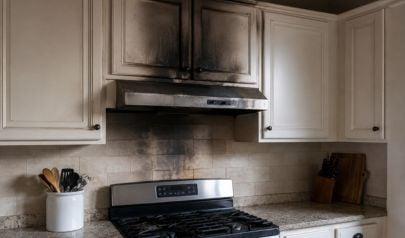
The kitchen fire started with a grease flare on a Friday evening. The homeowner controlled it within minutes. The fire department wasn't called. It was a small fire, with a few feet of cabinet damage, some scorching on the hood vent, and a section of drywall that needed removal.
By Sunday, two rooms from the kitchen, every fabric surface in the living room smelled like smoke. By Monday, the HVAC had circulated the odor throughout the house. What began as a localized event became a whole-home problem.
That trajectory is one of the most misunderstood aspects of fire damage. The visible burn area is one thing. What smoke does to a structure in the hours and days after the fire often requires more work than the burn itself.
How Smoke Damage Actually Behaves
Smoke is not just an odor. It is a combination of carbon particles, volatile organic compounds, and chemical residues that deposit on surfaces and penetrate porous materials. Drywall, insulation, upholstered furniture, carpeting, and even clothing in closed closets can carry smoke residue after a fire in a nearby room.
Smoke behavior inside a structure depends on the materials burned, the fire's temperature, and how long it takes to ventilate the space. Wet smoke residue from low-heat, slow-burning fires is hardest to clean because it smears and penetrates deeply. Dry smoke from fast, high-heat fires leaves a powdery residue but still requires professional treatment to remove.
HVAC systems complicate matters. In Buford, homes with forced-air heating and cooling can pull smoke through return vents and redistribute particulates far beyond the fire's origin. Many homeowners don't realize the ductwork itself must be evaluated and cleaned during restoration.
The Fire Restoration Process
Our crew approaches fire damage restoration as a sequence, not a single event. The initial assessment determines the full scope of affected materials, both visible and hidden. Smoke residue testing identifies the fire type and which cleaning methods will be effective for each surface.
Structural cleaning follows. Walls, ceilings, cabinetry, and any surfaces with smoke or soot deposits are carefully cleaned. Restorable materials are treated with professional-grade techniques and appropriate chemicals. Materials that cannot be restored to pre-loss condition are documented for removal and replacement.
Odor neutralization is the stage that most concerns homeowners, and rightly so. Masking odor is not the same as eliminating it. Our process uses hydroxyl generators and other methods that break down smoke molecules chemically rather than masking them with fragrance.
Throughout the process, we document everything for your insurance claim, including photos, moisture readings, air quality readings, and written scope documentation for all affected areas.
Frequently Asked Questions
Can smoke damage spread even if the fire was small?
Yes. Smoke can travel through HVAC systems, wall cavities, and open doorways. Even a small kitchen fire can leave odor and residue throughout multiple rooms in the home.
How soon should smoke damage be cleaned?
Smoke damage should be addressed promptly. The longer the smoke residue remains on surfaces, the more difficult it becomes to remove. Odors can also penetrate deeper into porous materials over time.
Will the smoke odor go away on its own?
In most cases, no. Air fresheners and open windows may temporarily reduce the smell, but professional odor removal is usually needed to fully eliminate smoke particles embedded in drywall, insulation, furniture, and carpet.
Does homeowners' insurance cover smoke damage?
Many homeowners' insurance policies cover smoke damage from a sudden fire event. Coverage depends on the details of the policy and the cause of the fire, but proper documentation can help support the claim.
Working with Property Insurance After a Fire
A fire claim, even a minor one, involves many moving parts. The adjuster's estimate and the actual restoration scope often do not align initially. Our team works directly with insurance carriers and adjusters and provides detailed documentation to support a complete and accurate claim.
Homeowners across Buford, Norcross, and Peachtree Corners have found that involving a restoration professional early in the claims process often leads to a smoother settlement. We're not claims adjusters, but we know how to communicate the full scope of fire damage in language carriers understand.
Don't Wait to Call
One of the biggest cost drivers in fire restoration is delay. Smoke residue becomes harder to remove the longer it sits. Odor penetrates deeper into porous materials over time. If a fire occurred in your home, even a minor one, a professional assessment within 24 to 48 hours can make a meaningful difference in both restoration and the claim.
AdvantaClean of Norcross and Buford is ready to help. We serve Buford, Johns Creek, Norcross, and Peachtree Corners with fire damage restoration, smoke cleanup, and full structural drying and odor elimination.
Reach our team at (470) 819-2070, online at advantaclean.com/norcross-ga, or find us on Google.