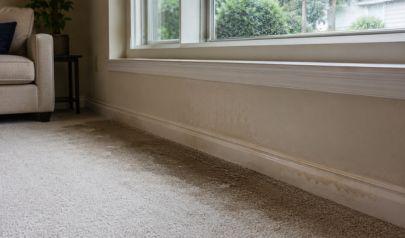
A thunderstorm began around 2 p.m., typical for a July Tuesday. After it passed through Norcross, the family room floor of a home near Graves Road was soaked. A backed-up window well and misdirected gutter downspout sent water toward the foundation. What appeared to be a damp carpet revealed a more significant issue within the wall cavity.
This scenario is common in Gwinnett County. Georgia's red clay soil absorbs water slowly and, when saturated, redirects runoff into the lowest areas of your home.
What's Happening Inside the Walls
The most overlooked aspect of water damage is not the visible puddle, but what occurs within the first 24 to 48 hours inside the structure. Water entering through a compromised foundation, failed window seal, or floor drain moves beyond the surface, seeping into drywall, subfloor panels, and wall cavities with limited air circulation.
By the time odors or discoloration appear, materials have often been wet long enough to deteriorate. In crawl space homes, common in older Norcross neighborhoods, moisture can also move upward through the floor system.
The drying process begins as soon as water contacts materials. The longer they remain wet, the more time is needed for drying and the greater the risk of secondary damage.
How the Drying Process Actually Works
Many assume restoration only involves mopping and using fans. In reality, the process is much more precise.
Our team starts by moisture-mapping using thermal imaging and calibrated meters to measure moisture in materials such as drywall, hardwood, and OSB subflooring. This identifies both visible and hidden water migration.
We then deploy commercial drying equipment, such as high-capacity dehumidifiers, strategically placed air movers, and, when needed, desiccant units for materials requiring lower vapor pressure. We monitor and log readings daily to provide your insurance adjuster with accurate documentation of conditions and drying progress.
Documentation is essential. Many homeowners in Norcross and Peachtree Corners discover that insurance claims without drying logs are difficult to process. We ensure you have the necessary records.
The Georgia Summer Factor
Norcross experiences a humid subtropical climate, with outdoor humidity often between 70 and 90 percent from late spring through early fall. This high humidity affects restoration, requiring equipment to work harder and potentially extending drying timelines compared to drier climates.
Our technicians incorporate local humidity into the drying plan from the start. Equipment sizing, placement, and monitoring frequency are tailored to current conditions rather than using a standard approach.
Frequently Asked Questions
How quickly should water damage be addressed?
Water damage requires immediate attention. The first 24 to 48 hours are critical, as drywall, insulation, wood, and flooring can deteriorate quickly. Prompt action also helps prevent mold growth.
Will homeowners insurance cover water damage?
Insurance coverage depends on the source of the water. Sudden issues like burst pipes or appliance failures are often covered, while long-term leaks or flooding from outside sources may not be. Proper drying documentation can help support your claim.
How long does the drying process take?
Most water-damage drying projects take between three and five days, but severe cases can take longer depending on the amount of water, the materials involved, and the humidity outside.
Can a wet carpet be saved?
In some cases, yes. Carpet affected by clean water from a supply line or rain intrusion may be salvageable if it is dried quickly. Carpet contaminated by sewage or long-term standing water often needs to be removed.
What Homeowners Should Do First
If you're dealing with standing water or a soaked floor after a storm, a few things can help before our team arrives. If the water source is still active, such as a broken pipe or a backed-up drain, address the source if it's safe to do so. Move belongings off wet flooring if possible. Avoid running ceiling fans in a flooded area, as they can pull mold spores that may already be present and spread them throughout the space.
Don't pull up wet carpet yourself unless you know what's underneath. In some cases, the carpet is acting as a temporary barrier over a subfloor that needs to be assessed before it's disturbed.
Serving Norcross and the Surrounding Area
AdvantaClean of Norcross and Buford works with homeowners across Norcross, Buford, Johns Creek, and Peachtree Corners. When water damage hits, whether it's a burst supply line at 3 a.m. or a slow leak that's finally become impossible to ignore, our local team responds fast and works with your schedule and your insurance company throughout the process.
Call us at (470) 819-2070, visit us at advantaclean.com/norcross-ga, or find us on Google. We're your neighbors, and we know what Georgia storms can do to a home.