Living in the Pacific Northwest means accepting certain things: rain from October through May, moss on every roof, and yes, mold. In Bellevue, Shoreline, and Kirkland, mold in homes is far more common than most neighbors let on. Here is what you actually need to know.
Out here on the Eastside, we talk about the rain like it is an old friend. We embrace the gray and wear waterproof layers in July, just in case. What we do not talk about quite as openly is what all that moisture does inside our homes, specifically behind the drywall, under the floors, and in the crawl spaces that most of us haven't checked since we moved in.
Mold is genuinely common in Pacific Northwest homes. This isn't fearmongering; it is just geography and climate working against us. Bellevue, Kirkland, Shoreline, Bothell, and Mercer Island all sit in a region with sustained rainfall, elevated year-round humidity, and temperature patterns that create exactly the conditions mold needs to establish itself and spread. If you haven't found mold in your home yet, you may simply haven't looked in the right places.
Why Eastside Homes Are So Vulnerable
The Pacific Northwest doesn't have dramatic freeze-thaw cycles that crack foundations the way the Midwest does, but it has something arguably more persistent: continuous dampness.
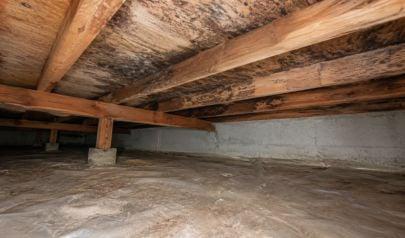
Mid-Century and Older Homes: Crawl spaces under Shoreline and Bothell homes, many built in the mid-20th century, often have dirt floors, aging vapor barriers (or none at all), and ventilation that was never adequate for modern energy efficiency standards.
Moisture from the ground migrates upward through the soil and into the crawl space air. The wood framing above absorbs it, and the subfloor above that absorbs it too. Over years, that moisture cycling creates an environment where mold doesn't just visit; it moves in. Homeowners often notice it first as a musty smell in a room with no obvious source, or as a family member who seems to have chronic sinus issues every winter.
Newer Construction: In newer homes in Bellevue and Kirkland, the issue is sometimes the opposite problem. Tight modern construction, which is great for energy efficiency, traps indoor moisture if ventilation isn't balanced correctly. Steam from showers and cooking, moisture from plants and fish tanks, and condensation on cold exterior walls in winter all have to go somewhere. In a well-sealed home, it often ends up in wall cavities.
The Top 4 Places Mold Hides in PNW Homes
After years of mold inspections across the Eastside, certain spots show up again and again:
-
Crawl Spaces: This is the single most common location for serious mold growth in this region. Inadequate vapor barriers, standing water after rain events, and minimal airflow create a mold environment that can be extensive before anyone knows it is there. Crawl space mold doesn't stay in the crawl space. Spores travel upward into living areas through gaps and penetrations in the subfloor.
-
Behind Bathroom Tile and Drywall: Grout and caulk fail over time, allowing water to get behind tile. Once moisture reaches the drywall backer, mold can grow for months before any surface sign appears. By the time you see staining or smell something, the colony is usually well established.
-
Attics and Roof Assemblies: Inadequate attic ventilation combined with humid Pacific Northwest winters is a recipe for condensation on roof sheathing. Moss on your roof isn't just an aesthetic issue; it signals moisture retention that can translate to attic mold. Mercer Island and Bellevue homes with mature tree canopy overhead tend to see this more than average.
-
Around Windows and Exterior Walls: Failed window seals and aging siding on Bothell and Shoreline homes allow moisture to infiltrate wall cavities. The exterior may look fine while mold builds up inside. Peeling interior paint near windows, soft drywall, and a musty smell in the corner of a room are all telling signs.
What Professional Mold Remediation Actually Looks Like
Professional mold remediation isn't spraying bleach and calling it done. That approach kills surface mold and leaves the root structure intact. Within weeks, and sometimes days, you are right back where you started.
Real remediation follows a strict strategic process:
-
Inspection and Testing: A thorough assessment is conducted to understand what you are dealing with and where the mold is located.
-
Containment: The area is sealed off to keep spores from spreading during removal work.
-
Removal: Affected materials, often drywall, insulation, and sometimes structural wood, get removed properly and disposed of.
-
Treatment and Drying: Remaining surfaces are treated and dried to conditions where mold cannot re-establish.
-
Moisture Control: The final step is addressing the original moisture source, because without that, any remediation is temporary.
AdvantaClean of the Eastside follows IICRC standards for mold remediation. Every crew member is certified, and the work is documented throughout. For Kirkland and Bellevue homeowners dealing with a significant mold problem, that documentation matters for disclosure purposes and for insurance claims.
A Note on DIY Mold Removal
For a small patch of surface mold, such as a spot around a bathroom caulk line, careful DIY treatment with appropriate products and ventilation can be reasonable.
Important Safety Note: For anything in a crawl space, behind walls, in an attic, or covering more than a few square feet, DIY work creates more risk than it resolves.
Disturbing mold without proper containment spreads spores through HVAC systems and into living areas. The exposure risk during unprotected removal is real, and the likelihood of incomplete treatment is high. If you are not sure whether what you've found is minor or significant, get an inspection first.
You Don't Have to Live With It
Neighbors across Bellevue, Shoreline, Kirkland, Bothell, and Mercer Island have dealt with mold problems and gotten past them. It is more manageable than it feels when you first find it, as long as you work with someone who actually knows what they are doing in Pacific Northwest homes.
AdvantaClean of the Eastside offers mold inspections and full remediation services across the Eastside. Give us a call and let's figure out what you are dealing with together. There is no pressure and no scary upselling, just straight answers from people who have seen the inside of a lot of Pacific Northwest homes.
-
Company: AdvantaClean of the Eastside
-
Phone: (425) 649-0600