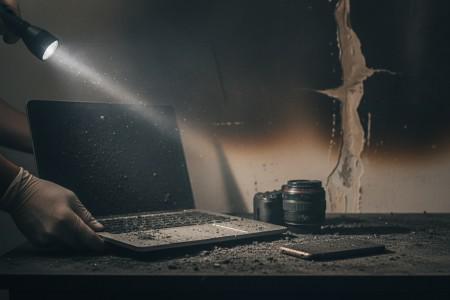
After a fire, the flames are only part of the story. Once the firefighters leave and the smoke clears, you're left surveying what's left—and that's when you notice the fine, greasy film coating everything. Your television, computer, stereo, gaming console, and kitchen appliances all wear a layer of soot. The question hits hard: are they ruined? For homeowners in Fort Lauderdale, Hollywood, Plantation, and across Broward County who've experienced fire, understanding what happens to electronics after smoke exposure—and whether they can be saved—is critical to recovery.
What fire smoke does to electronics
Smoke damage to electronics isn't like smoke damage to furniture or walls. Electronics are uniquely vulnerable because of what they are: complex assemblies of metal, plastic, and circuit boards with tiny gaps and sensitive components.
The composition of soot
Fire smoke contains partially burned particles from whatever burned: wood, plastics, fabrics, synthetic materials, chemicals. This creates soot that is:
-
Oily and sticky: It adheres aggressively to surfaces
-
Acidic: It continues corroding materials long after the fire
-
Conductive: It can create unintended electrical pathways
-
Microscopic: Particles small enough to penetrate tight spaces
Soot is a serious problem following Fort Lauderdale fires precisely because of these corrosive and conductive properties.
Three types of damage
Corrosion damage: The acidic compounds in soot begin eating away at metal components immediately. Circuit board traces, connector pins, and solder joints all suffer. This corrosion continues until the soot is neutralized and removed.
Electrical damage: Conductive soot creates bridges between circuits that should remain isolated. When power is restored, these bridges can cause shorts, destroying components instantly.
Mechanical damage: Soot infiltrates moving parts—fans, hard drives, optical drives, switches. The oily residue causes friction, sticking, and eventual failure.
The urgency factor: Why time matters
Every hour counts when electronics are exposed to smoke damage.
The corrosion clock
Corrosion begins the moment soot lands on metal surfaces. Within hours, microscopic damage starts. Within days, visible tarnishing appears. Within weeks, permanent etching and component failure become likely.
The hardening process
Soot doesn't stay as it lands. Heat, humidity, and time cause it to bake onto surfaces, becoming increasingly difficult to remove. Florida's humidity accelerates this process, as moisture in the air combines with soot to create acidic compounds that etch surfaces faster.
The power-up danger
The most dangerous moment comes when someone tries to turn on smoke-damaged electronics. Restoring power before cleaning allows conductive soot to create shorts, often destroying devices that might otherwise have been salvageable.
Can electronics be saved after smoke damage?
The answer depends on several factors. Many devices can be saved with prompt, professional intervention. Some cannot.
Factors that determine salvageability
Fire severity: Electronics in rooms that experienced direct flame are rarely salvageable. Those in rooms with smoke infiltration but no flame have much better odds.
Soot type: Different fires produce different soot. Protein fires (from cooking) produce particularly stubborn, greasy residue. Synthetic materials create corrosive chemical residues.
Exposure duration: Devices cleaned within days fare far better than those left for weeks.
Device type: Simple devices with sealed enclosures fare better than complex, vented electronics. A microwave might survive; a gaming console with cooling fans is more vulnerable.
Power status: Devices that were off and unplugged during the fire have better survival odds than those that were running.
What can typically be saved
-
Televisions (especially LED/LCD, less so older plasmas)
-
Desktop computers (components can be cleaned individually)
-
Monitors
-
Audio equipment
-
Kitchen appliances (with sealed electronics)
-
Gaming consoles (with professional cleaning)
What's harder to save
-
Devices that were operating during the fire
-
Electronics with internal cooling fans that drew smoke inside
-
Items with open ventilation grilles
-
Older devices with exposed circuit boards
-
Items heavily coated with oily, protein-based soot
Why DIY cleaning destroys electronics
The instinct to "clean it yourself" is strong. But electronics require specialized approaches that DIY methods completely miss.
The wrong tools
Household cleaners, wipes, and sprays damage electronics. They leave residues, fail to neutralize acids, and can push contaminants deeper into components. Water causes additional corrosion.
The disassembly problem
Proper electronics cleaning requires partial or complete disassembly. Soot hides inside—under keycaps, inside power supplies, between circuit board layers. Without disassembly, you're only cleaning the surface while internal contamination continues corroding.
The static danger
Improper handling creates electrostatic discharge that can destroy sensitive components. Professionals use anti-static workstations and grounding techniques.
The incomplete fix
Even if visible soot is removed, invisible acidic residues remain. These continue corroding until neutralized with appropriate chemical treatments. Professional fire damage restoration includes neutralizing these residues, not just wiping surfaces.
The professional electronics restoration process
When you entrust electronics to restoration professionals, here's what happens:
Assessment and documentation
Each item is evaluated, photographed, and documented. Technicians determine whether restoration is cost-effective compared to replacement.
Controlled disassembly
Devices are carefully taken apart in clean, static-controlled environments. Components are separated and organized.
Specialized cleaning methods
Professionals use multiple techniques depending on contamination type:
-
HEPA vacuuming: Removes loose dry soot
-
Compressed air: Blows particles from tight spaces
-
Solvent cleaning: Specialized electronics-grade solvents dissolve oily residues without damaging components
-
Ultrasonic cleaning: Circuit boards and small parts are immersed in cleaning solutions with ultrasonic agitation that reaches every microscopic crevice
-
Contact cleaning: Individual connectors and contacts are manually cleaned
Neutralization
Acidic residues are chemically neutralized to stop ongoing corrosion. This step is critical for long-term reliability.
Drying and baking
Components are thoroughly dried in controlled environments, sometimes using low-temperature baking to drive moisture from hidden areas.
Reassembly and testing
Devices are reassembled and tested for functionality. Testing often reveals issues that require component-level repair.
Data recovery priority
For computers and storage devices, data recovery is prioritized before extensive cleaning begins. Just as with water damage emergencies, the order of operations matters tremendously.
What you should do immediately after fire smoke exposure
DO NOT:
-
Do not turn anything on to "see if it still works"
-
Do not plug in any smoke-exposed devices
-
Do not attempt DIY cleaning with household products
-
Do not wipe surfaces with dry cloths (this grinds soot in)
-
Do not store devices in hot areas like garages (heat accelerates corrosion)
DO:
-
Document everything: Photograph each item and its condition for insurance
-
Isolate devices: If possible, place items in sealed plastic bags to prevent further contamination and handling
-
Contact your insurance: Report electronics as part of your claim
-
Find certified professionals: Look for electronics restoration specialists, not general cleaners
-
Act quickly: The first 48-72 hours are critical
Insurance considerations for fire-damaged electronics
Documenting value
For insurance claims, you need proof of what you owned. Photos, receipts, model numbers, and serial numbers all help. If you lack receipts, find current retail prices for comparable models.
Replacement cost vs. actual cash value
Understand your policy. Replacement cost coverage pays to replace items at today's prices. Actual cash value deducts depreciation, paying less for older items.
Restoration vs. replacement
Insurers may prefer restoration when cost-effective. Professional restoration often costs 30-50% of replacement while preserving your actual devices and data.
The claims process
-
List all affected electronics with descriptions and estimated values
-
Provide documentation photos
-
Obtain restoration estimates if pursuing that route
-
Don't discard anything until the claims process completes
Special concerns for different devices
Computers and data
Your computer contains irreplaceable data. Professional restorers prioritize data recovery before cleaning. Even if the computer can't be saved, the hard drive may be removable and recoverable.
Televisions
Modern LED/LCD TVs are somewhat sealed but still vulnerable. Vents on the back allow smoke entry. Professional cleaning can often save them if addressed quickly.
Kitchen appliances
Refrigerators, ovens, microwaves, and dishwashers all contain electronics. Smoke can infiltrate control panels and internal components. Appliances that were running during the fire face higher risk.
Audio equipment
Speakers, receivers, and amplifiers contain magnets, coils, and sensitive components. Soot on speaker cones affects sound quality and can cause deterioration.
Gaming consoles
PlayStations, Xboxes, and Nintendo Switches have complex internal layouts with cooling fans that actively drew smoke during the fire. They require thorough disassembly.
Smart home devices
Voice assistants, smart speakers, and connected devices have multiple circuit boards and microphones/speakers that trap soot.
Prevention for the future
Create an inventory
Document your electronics now—photos, model numbers, serial numbers, purchase dates, and values. Store this information digitally and off-site.
Use surge protectors
Quality surge protectors offer some protection, but they won't prevent smoke damage. They do help with electrical issues after restoration.
Consider rider coverage
High-value electronics may need scheduled personal property coverage beyond standard policies.
Store critical data in the cloud
Regular cloud backups mean that even if devices are lost, your photos, documents, and files survive.
Frequently asked questions about fire-damaged electronics
Will my homeowner's insurance cover fire-damaged electronics?
Yes, standard homeowner's policies typically cover electronics damaged by fire. Coverage limits apply, so check your policy for sub-limits on electronics.
Can smoke-damaged electronics cause fires later?
Possibly. Corroded components, conductive residues, and damaged insulation can create electrical faults. Professional cleaning and testing are essential before reuse.
How long does smoke damage take to ruin electronics?
Corrosion begins immediately and accelerates. Within days to weeks, permanent damage occurs. Professional intervention within the first 48-72 hours offers the best outcome.
Is it safe to use electronics that smell like smoke after cleaning?
No. Odor indicates residues remain. Professional cleaning should eliminate smoke odor. If you still smell smoke, contaminants remain.
Can I clean my TV with a damp cloth?
Never. Liquid can seep into seams and cause additional damage. Soot requires specialized cleaning approaches that won't drive contamination deeper.
What about electronics in other rooms not directly affected by fire?
Smoke travels throughout the home. Electronics in rooms without flames may still have soot infiltration, especially through HVAC systems and open vents.
Are there electronics that should never be restored?
Some items—especially older, inexpensive electronics—may cost more to restore than replace. Medical devices require special consideration and may need replacement for safety.
The bottom line: Don't give up yet
Discovering your electronics coated in soot after a fire is disheartening. But many devices can be saved with prompt, professional intervention. The key factors are speed, proper handling, and working with specialists who understand both electronics and smoke damage.
Your television, computer, and other devices represent significant investment—and your computer holds irreplaceable memories and data. Before writing them off, seek professional assessment. The cost of restoration often compares favorably to replacement, and the peace of mind from knowing your devices are truly clean and safe is invaluable.
Need help with fire-damaged electronics in South Florida?
If your Fort Lauderdale area home has experienced fire damage, don't wait to address your electronics. The team at AdvantaClean of Fort Lauderdale connects you with professional electronics restoration specialists who understand the unique challenges of smoke damage. We'll help assess what can be saved and guide you through the recovery process.
Protect your devices and your data. Request service online to start your restoration journey. Or visit us on Google Maps for our location and contact information. We're here to help you recover everything that matters—including the electronics that connect you to your world.