How much does mold remediation cost in South Florida?
Most South Florida homeowners looking up this question are trying to answer a more specific one: is the quote in front of me reasonable, and what am I actually going to end up paying?
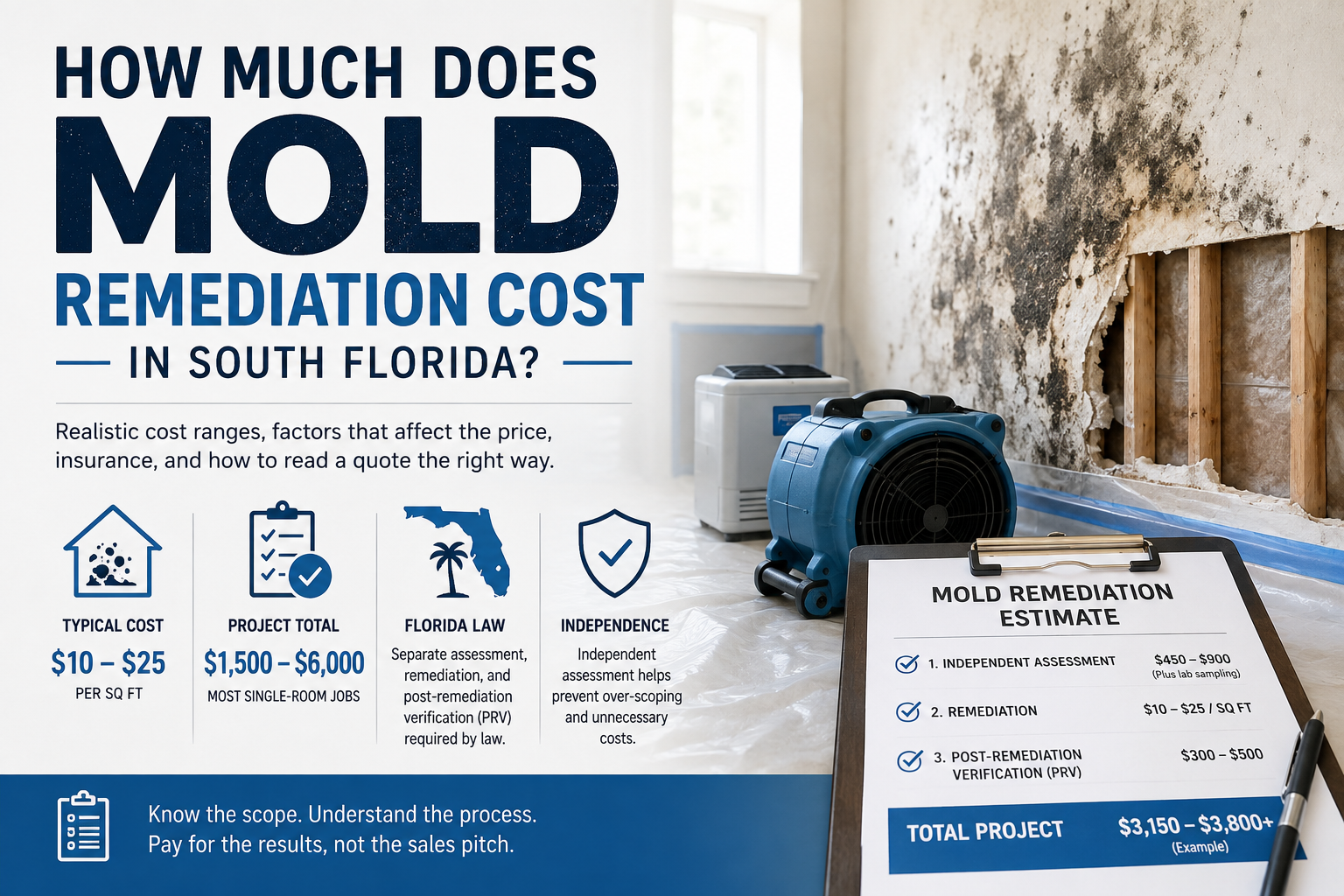
The short version is that mold remediation in Florida is priced by the contaminated square footage, typically $10 to $25 per square foot, and most single-room residential jobs land between $1,500 and $6,000. But that headline number leaves out something specific to Florida law that adds meaningfully to the total, and it is the reason many homeowners here feel blindsided by the final invoice.
This guide covers realistic cost ranges by project size, the factors that move the price, why small jobs expand, what insurance actually pays, and how to read a quote well enough to compare two of them fairly.
What mold remediation typically costs by project size
Remediation is priced against the contaminated area, not the square footage of your house. A 1,900 square foot home with 60 square feet of affected drywall is a 60 square foot job.
Small, isolated growth (under about 10 square feet): $500 to $1,500. Under a sink, behind a toilet supply line, one section of a closet wall. At this size Florida does not require a licensed remediator at all, so some of these are homeowner-manageable if the material is non-porous and the moisture source is fixed. Minimum job charges mean small jobs rarely hit the low end of the per-foot rate.
Single room, moderate growth: $1,500 to $6,000. A bathroom wall behind failed tile, a bedroom wall after a window leak, a laundry closet. This is where most residential jobs land. A 200 square foot room with moderate growth typically runs $2,000 to $5,000 including containment, removal, treatment, and clearance.
Multiple rooms or system involvement: $6,000 to $15,000. Growth that has spread across adjoining rooms, or that has reached the HVAC system. Duct and air handler contamination alone commonly runs $3,000 to $10,000 because of the specialized equipment and containment required.
Whole-house or severe contamination: $10,000 to $30,000+. Typically follows a major water event that went unaddressed through a storm season, or long-term undetected intrusion. Florida whole-house figures commonly cluster around the $17,000 mark.
By location in the home, published Florida ranges look roughly like this:
• Bathroom: $500 to $2,000 for surface-level growth, more when it extends behind tile or into plumbing walls
• Attic: $1,000 to $7,000, driven heavily by access difficulty and whether roof repairs are bundled
• Crawl space: $500 to $3,000, higher with encapsulation
• HVAC and ductwork: $3,000 to $10,000
• Whole house: $9,000 to $32,000
Attic and crawl space work is often priced hourly rather than by square foot, because the constraint is access rather than area. Working through a 24 inch attic hatch in a Florida August is slow.
The Florida cost most homeowners do not budget for
Here is the part that separates Florida from most of the country.
Under Florida Statute 468.8419, a licensed mold assessor generally cannot perform remediation on the same property they assessed within the previous 12 months, with limited exceptions, and a remediator generally cannot assess a property they remediated in that window. The rule exists to remove the conflict of interest where one company finds the mold, defines how bad it is, and then sells the cleanup.
The practical consequence is that a proper Florida mold job involves two separate companies and three line items:
1. Independent mold assessment: $450 to $900, plus roughly $50 to $120 per lab sample when sampling is warranted. This covers the walk-through, moisture mapping, thermal imaging, and a written protocol defining the scope of work.
2. Remediation: the per-square-foot number everyone quotes.
3. Post-remediation verification (PRV): $300 to $500, performed by the assessor rather than the remediator, confirming the work actually succeeded.
So a job quoted at $2,400 for remediation is realistically a $3,150 to $3,800 project all-in. That is not a contractor padding the bill. It is the statutory structure.
It is worth understanding why this is a feature rather than a tax. An independent assessment routinely pays for itself by preventing over-scoping, because the company writing the protocol has no financial interest in how large the remediation turns out to be. Homeowners who skip the independent assessment and accept a remediator’s own scope are the ones most likely to be sold work they did not need.
If a company offers to handle assessment and remediation as a single package on the same job, ask directly how they comply with 468.8419. You can verify any Florida license in about 30 seconds at MyFloridaLicense.com.
The factors that raise or lower the price
Beyond square footage, these are what move a quote up or down.
Location and accessibility. Surface growth on an accessible bathroom wall is the cheap end. Growth inside a wall cavity, in an attic reachable only through a small hatch, or in a crawl space is the expensive end, because most of the cost is labor and labor is slow in tight spaces.
Material type. Non-porous surfaces can often be cleaned in place. Porous materials — drywall, insulation, carpet padding, particleboard — generally have to be removed and replaced. A job that is mostly tile costs less than the same square footage of drywall.
HVAC involvement. This is the single biggest cost multiplier. Once growth reaches the air handler or ductwork, containment becomes far more complex and the system itself needs cleaning or component replacement.
Water category. Clean supply-line water (Category 1) is cheaper than sewage or long-standing storm intrusion (Category 3), which carries stricter disposal and antimicrobial requirements.
Containment level. Negative-pressure containment with HEPA scrubbing costs more than open-air work. It is also the difference between remediation and moving spores around, which is why unusually low quotes usually turn out to have skipped it.
Moisture source repair. Remediation does not fix the leak. Roof repair, plumbing work, or grading correction is separate, and if it is not done the mold returns.
Reconstruction. Also separate. A bid that includes new drywall, texture, paint, trim, and flooring will look two to three times higher than one that stops at passed clearance. This is the most common reason two quotes appear wildly different when they are actually pricing different work.
Florida-specific pressures. South Florida labor rates run above the state average. Ambient humidity extends drying time, which means more equipment days. Concrete block construction, common across Broward, is slower to remediate than wood frame. And after any named storm, regional demand spikes and pricing follows.
Why a small mold job can turn into a large one
Scope growth during a mold job is common enough that it is worth expecting rather than being surprised by. It happens for a few predictable reasons.
Visible growth is the edge of the colony, not the extent of it. What is visible on the room side of a wall is typically a fraction of what is on the cavity side. Once containment is up and the first section of drywall comes out, the actual affected area is often two to four times the original estimate.
The moisture source is usually still active. A quote written against visible growth assumes the water has stopped. If the roof is still leaking or the supply line is still weeping, the affected area keeps expanding while the job is being scheduled.
Materials fail inspection once exposed. Framing that looked fine from the room side can be soft. Insulation that appeared dry can be saturated. Subfloor under vinyl plank can be worse than the flooring suggested.
HVAC contamination gets discovered mid-job. If the system ran while growth was active, spores distributed through the ducts. This often is not confirmed until air sampling comes back, and it converts a single-room job into a whole-system job.
Hidden growth in adjacent areas. Water travels. A bathroom leak commonly affects the shared wall of the adjacent bedroom.
The way to limit this is to get a proper assessment with moisture mapping and thermal imaging before the remediation is scoped, rather than pricing off what is visible. Our signs of hidden mold guide covers what to look for before you even reach the quote stage.
What insurance usually covers and what it doesn’t
Florida mold coverage is among the most restrictive in the country, and misunderstanding it is how homeowners end up with unexpected out-of-pocket costs.
Mold sublimits are low. Most Florida homeowners policies cap mold remediation at a sublimit of $5,000 to $10,000, separate from and far below the dwelling limit. A mold endorsement, sometimes written as "Fungi, Wet Rot, and Bacteria" coverage, can raise the cap to $25,000 or $50,000, but only if it was purchased before the loss.
This matters because whole-house remediation in Florida routinely runs $10,000 to $30,000. A homeowner with a standard $10,000 sublimit and a $17,000 job is paying the difference regardless of how well the claim goes.
Mold is covered as a resulting loss, not on its own. A burst supply line is a covered peril, and the mold that grows from it can be covered up to the sublimit. A slow leak that went undetected for months is usually denied, because the carrier will argue it was not sudden and accidental. Long-term humidity or maintenance-related growth is almost never covered.
Flood is excluded entirely. Mold resulting from rising groundwater or storm surge requires NFIP flood insurance, which has its own limits and rules.
You have a duty to mitigate. Florida requires policyholders to take reasonable steps to limit further damage. Documenting that you acted promptly — you called for mitigation, started drying, and opened the claim — protects coverage. Delay gives the carrier grounds to reduce payment.
Timing is set by statute. Under Florida Statute 627.70131, for a property insurance claim the carrier must acknowledge a claim communication within 7 calendar days, begin investigation within 7 days of proof-of-loss, and pay or deny within 60 days of receiving notice of the claim. Separately, under Florida Statute 627.70132, you generally must give notice of a new or reopened claim within 1 year of the date of loss (18 months for a supplemental claim). Both sets of timeframes were shortened by SB 2-A in December 2022, and the one-year notice window is the one that most often costs homeowners money, because mold is so frequently discovered late.
For the emergency scenario where prompt drying is what keeps a water event from becoming a mold claim in the first place, see our emergency mold response guide. If you are in a condo, responsibility is split differently and the master policy may be involved; our condo water damage guide covers that structure.
How to get an accurate mold remediation quote
A quote you can actually compare has specific properties.
Insist on an on-site inspection. No legitimate Florida remediator prices a job over the phone. The scope depends on conditions that require moisture readings and, often, thermal imaging.
Get the scope in writing, itemized. "Treat mold in master bathroom" is not a scope. A real one names the areas, the square footage, the materials being removed, the containment method, the equipment deployed, and the disposal standard.
Confirm what is and is not included. Specifically: is reconstruction in this number? Is post-remediation verification included or separate? Is repair of the moisture source included? These three items account for most of the variance between competing quotes.
Get two or three bids on the same written scope. Comparing bids written against different scopes tells you nothing. If one company scoped 60 square feet and another scoped 180, you are comparing different jobs, not different prices.
Treat unusually low quotes as information. In Florida, any remediation over 10 square feet requires a DBPR licensed remediator under Statute 468.8411. Licensing, insurance, containment equipment, and disposal carry real costs. A quote well below the others usually means containment, HEPA filtration, or independent clearance testing was left out, and you find out when the mold returns.
Verify the license before signing. Thirty seconds on the DBPR lookup. Florida also requires licensed mold assessors to carry general liability coverage of at least $1 million.
For the full vetting framework, our guide to choosing a mold remediation company covers licensing, references, contracts, and warranty terms in detail. Our mold mitigation services overview covers what the process itself involves.
Frequently asked questions
How much does mold remediation cost per square foot in Florida?
Roughly $10 to $25 per square foot of contaminated area for standard work, and $15 to $30 for complex jobs involving wall cavity access, HVAC contamination, or difficult materials. That figure applies to the affected area, not your home’s total square footage.
What is the average total cost of mold remediation in South Florida?
Most single-room residential jobs fall between $1,500 and $6,000. South Florida tends to price at or above the state average because of higher urban labor rates, storm-related demand cycles, and construction types that are slower to remediate.
Why do I have to pay for a separate mold assessment in Florida?
Florida Statute 468.8419 generally prevents the same party from both assessing and remediating the same property within 12 months, which removes the conflict of interest in scoping. Budget $450 to $900 for the assessment plus $300 to $500 for post-remediation verification on top of the remediation itself.
Does homeowners insurance cover mold remediation in Florida?
Sometimes, and usually with a low cap. Most Florida policies carry a mold sublimit of $5,000 to $10,000 and cover mold only as a resulting loss from a covered sudden-and-accidental peril. Slow leaks, humidity-driven growth, and flood-related mold are typically excluded.
Is a cheap mold remediation quote a bad sign?
Usually. Florida requires a licensed remediator for any job over 10 square feet, and licensing, containment equipment, HEPA filtration, disposal, and clearance testing all carry real cost. A quote well below competing bids generally reflects work that was left out of the scope.
Does the remediation quote include repairing the wall afterward?
Often not. Remediation typically ends at passed clearance testing. Drywall replacement, texture, paint, trim, and flooring are usually a separate reconstruction line item, and this is the most common reason two quotes look very different.
Can I remediate a small amount of mold myself?
Florida does not require a licensed remediator below 10 square feet. Homeowner handling can be reasonable if the growth is on non-porous material, the area is small and accessible, the moisture source has been fixed, and nobody in the household has respiratory sensitivities. Anything on drywall, in the HVAC, or of uncertain origin should be assessed.
Will my costs be higher after a hurricane?
Generally yes. Named storms generate thousands of simultaneous claims across Broward, Miami-Dade, and Palm Beach counties, which tightens contractor availability and pushes pricing up regionally for weeks afterward.
Getting help
The most useful thing a South Florida homeowner can do before spending money on remediation is get an accurate picture of the actual extent of the problem. Pricing off visible growth is how a $2,000 job becomes a $6,000 one halfway through. AdvantaClean of Fort Lauderdale provides mold remediation and coordinates independent mold testing across Broward County, working within Florida’s licensing and assessment requirements. Request an on-site evaluation and a written, itemized scope you can compare against other bids.
AdvantaClean of Fort Lauderdale — 236 NE 33rd St, Oakland Park, FL 33334. Serving Fort Lauderdale, Oakland Park, Wilton Manors, Lauderdale-by-the-Sea, Pompano Beach, Deerfield Beach, Plantation, Davie, and Broward County. Call (754) 218-8070 or request service online. Emergency response available 24/7.
ABOUT THE AUTHOR
Mariano Llorian is the owner and qualifying agent of AdvantaClean of Fort Lauderdale (Innoveco LLC), 236 NE 33rd St, Oakland Park, FL 33334. He holds Florida license CBC1269223 (Certified Building Contractor), CAC1823910 (Class A Air Conditioning Contractor), and MRSR2683 (Mold Remediator), and is licensed for radon mitigation (R3039 / RB3040). Licenses are verifiable through the Florida DBPR license portal. He has spent more than a decade diagnosing moisture, mold, and HVAC failures in Broward and Miami-Dade buildings, from single-family homes to commercial build-outs.
Technically reviewed August 2026 against Chapter 468, Part XVI of the Florida Statutes, Florida Statutes 627.70131 and 627.70132 as amended by SB 2-A, and current South Florida remediation pricing.
Standards and sources referenced
• Florida Statute 468.8411 — Mold-Related Services, Definitions
• Florida Statute 468.8419 — Prohibitions; Penalties (assessor/remediator separation)
• Florida Statute 627.70131 — Insurer’s duty to acknowledge; investigation
• Florida Statute 627.70132 — Notice of property insurance claim (1-year deadline)