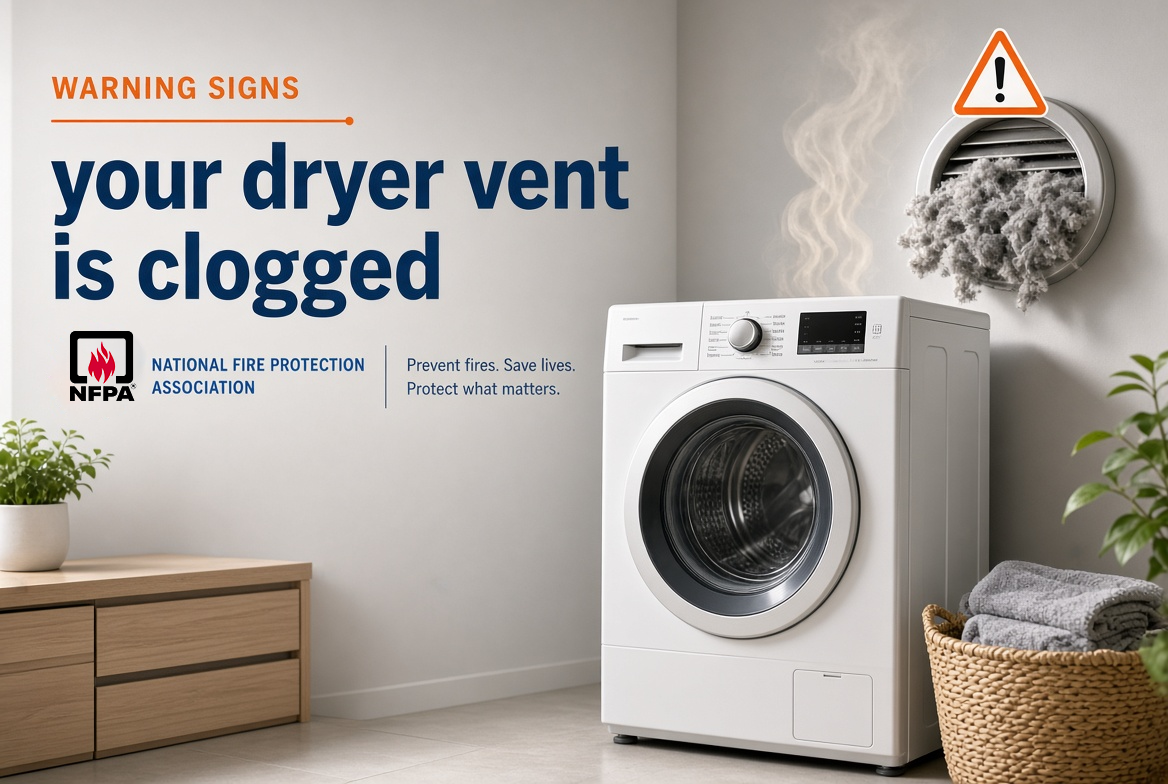
The dryer vent is one of the few systems in a house that becomes more dangerous the longer it is ignored, gives clear warning signs before it fails, and costs very little to maintain. Most homeowners still never touch it.
According to the National Fire Protection Association, U.S. fire departments respond to an estimated 13,000 to 16,000 home structure fires involving clothes dryers each year, causing roughly a dozen deaths, several hundred injuries, and hundreds of millions of dollars in property damage. The leading contributing factor is not a defective appliance or faulty wiring. It is failure to clean, which accounts for about a third of dryer fires and is associated with roughly half of the related deaths.
This guide covers the warning signs of a clogged vent, how a lint blockage actually ignites, the moisture problem that comes with it, how often to clean in a Florida climate, and when the job is worth handing to a professional.
Warning signs your dryer vent is clogged
Vent blockages develop gradually, which is why they are easy to miss. The signals below usually appear in roughly this order.
Clothes take more than one cycle to dry. The single most reliable early indicator. If a normal load regularly needs a second run, airflow is restricted. Act on this the first time you notice it, not the fifth.
Clothes come out hot to the touch. A properly vented dryer exhausts heat along with moisture. When the vent is blocked, heat stays in the drum. Fabric that is noticeably hot at the end of a cycle means the system is holding heat it should be expelling.
The dryer or the laundry area gets unusually warm. A dryer that heats the room around it is venting into the room, not outside.
A burning smell during operation. Treat this as urgent. It usually means lint is being heated close to its ignition point somewhere in the system. Stop using the dryer until the vent has been inspected.
No airflow at the exterior vent hood. Run the dryer and put your hand in front of the outside vent. You should feel strong, warm airflow. Weak, intermittent, or absent airflow confirms a blockage.
The exterior damper flap does not open. The hood flap should swing open when the dryer runs and fall closed when it stops. A flap that stays shut means the exhaust is not getting out. A flap stuck permanently open lets pests and rain in.
Visible lint around the outside hood. Lint escaping and collecting on the exterior siding means the duct behind it is loaded.
Lint accumulating on the screen faster than usual. When airflow drops, more lint drops out of suspension and lands on the screen instead of exiting the vent.
A musty or damp smell in the laundry area. Covered in more detail below. This is the moisture signal rather than the fire signal, and it is the one homeowners most often misread.
Scorching or discoloration on the wall behind the dryer. Anything resembling heat damage means the system has already been running hot for a long time. Stop using the dryer and call a professional.
How a blocked dryer vent can start a house fire
Understanding the ignition mechanism explains why this specific hazard is more dangerous than most homeowners assume.
Dryer lint is shed microfiber from clothing, much of it synthetic. It is extremely light, extremely dry after passing through heated air, and highly combustible. Fire investigators treat accumulated lint as a fuel source, not as debris.
A dryer running against a restricted vent produces two conditions at once. The heating element cycles longer because the moisture sensor is not seeing the load dry, and the heat that would normally leave with the exhaust stays inside the duct. Over hundreds of cycles, the lint packed inside that duct is repeatedly baked at elevated temperature.
Ignition typically begins as smoldering rather than open flame. A hot spot develops in the packed lint somewhere along the duct run, often at a bend where accumulation is heaviest. That smoldering can continue for a long stretch before producing visible smoke.
This is what makes dryer vent fires dangerous in a way that kitchen fires are not. The duct usually runs through wall cavities, ceiling spaces, or the attic. A fire that starts inside the duct starts inside the structure — behind drywall, with direct access to framing and insulation, and no smoke detector nearby. By the time smoke reaches a living space where someone can smell it, the fire has often already spread beyond the duct.
Three factors that raise the risk further:
• Flexible foil or plastic transition duct. Ribbed foil and plastic ducting traps far more lint than smooth rigid metal, and plastic can melt or burn. Current code calls for rigid or semi-rigid metal duct. Many older Florida homes still have the foil version behind the dryer.
• Crushed duct behind the appliance. When a dryer is pushed back against the wall, the transition duct is often crushed or kinked, creating a lint trap at the worst possible spot.
• Long runs with multiple bends. Each bend adds resistance and gives lint another place to settle.
The moisture problem most homeowners never consider
Fire is the risk that gets attention. In a Florida home, the moisture problem arrives first and does damage on a longer timeline.
Every load that goes into a dryer arrives holding a meaningful amount of water. The dryer’s job is to evaporate that water and push it outside as vapor. If the vent is blocked, disconnected, or terminating somewhere other than outdoors, all of that water is released into the laundry area or into the wall cavity the duct runs through.
Across a few hundred loads a year, that is a substantial and continuous moisture load introduced into a building envelope that is already fighting South Florida humidity. The results tend to show up as:
• A persistent damp or musty smell in the laundry room that cleaning does not resolve
• Peeling paint, soft drywall, or staining on the wall behind or beside the dryer
• Mold growth on the back of the dryer, on adjacent baseboards, or inside the laundry closet
• Elevated humidity readings in the laundry area compared to the rest of the house
• Warped or separating trim near the floor
Laundry closets are the worst case, because they combine a high moisture source with a small enclosed volume and almost no air circulation. If a laundry closet smells musty and the dryer vent has never been checked, those two facts are usually related.
Improperly terminated vents make this worse. A duct that exhausts into an attic, a garage, a crawl space, or a soffit rather than through a proper exterior hood is dumping hundreds of gallons of water vapor per year directly into the structure. This is a code violation and a common finding in older homes and in DIY laundry relocations.
If you are seeing moisture signals in the laundry area, our signs of hidden mold guide covers what to check, and our musty smell diagnostic guide helps trace the source.
How often you should clean your dryer vent in Florida
The standard national guidance is once a year. That is a reasonable floor, but several Florida-specific factors push many households toward a shorter interval.
Humidity extends drying cycles. Ambient humidity in Broward County means laundry starts wetter and dries slower than the same load in a dry climate. Longer cycles mean more runtime, more airflow through the duct, and more lint deposited per load.
Salt air corrodes exterior hardware. In coastal Fort Lauderdale, Pompano Beach, and Deerfield Beach, the metal damper flap on the exterior hood corrodes and seizes. A stuck-closed flap blocks exhaust; a stuck-open flap invites pests.
Pests nest year-round. There is no winter die-off here. Birds, wasps, and geckos routinely nest in exterior vent hoods, and a bird nest is one of the most complete blockages a vent can develop.
Condo and townhouse vent runs are long. Broward has enormous multifamily inventory, and interior units often have duct runs of 20 to 40 feet with multiple bends, sometimes terminating at a shared roof stack. These accumulate faster and are almost never cleaned, partly because responsibility between the unit owner and the association is unclear. If you own a condo unit, check your declaration; if the vent runs through common elements, coordinate with the association rather than assuming someone is handling it. Our condo water damage guide covers how that responsibility split generally works.
Practical intervals
• Annually for a typical household with a short, straight vent run
• Every 6 months for households of four or more, homes with shedding pets, condos or townhomes with long runs, or any home doing frequent towel and bedding loads
• Immediately at any of the warning signs above, regardless of when it was last done
Clean the lint screen before every load regardless. That is separate from vent cleaning and does not substitute for it.
DIY dryer vent cleaning versus hiring a professional
Some vent configurations are a genuinely reasonable homeowner job. Others are not, and the difference is mostly about the duct run.
Reasonable to do yourself when: the run is short (under roughly 8 feet), reasonably straight, exits through an adjacent exterior wall at ground level, and you can safely pull the dryer out and reach behind it. A rod-and-brush kit runs about $25 to $40, and with a shop vac the job takes under an hour.
The basic sequence: unplug the dryer (for gas dryers, shut off the gas and take extra care with the flexible connector), pull it out, disconnect the transition duct, vacuum the duct and the dryer’s exhaust port, run the brush through the full duct run from both ends where accessible, clean the exterior hood and free the damper flap, reconnect with a clamp rather than duct tape, and confirm strong airflow at the hood with the dryer running.
Worth hiring out when:
• The run exceeds about 10 feet or has more than one or two bends
• The vent terminates on the roof
• The duct runs through walls or ceilings with no access point
• You are in a condo or townhouse with a long or shared run
• There is evidence of pest nesting
• You find foil or plastic duct that should be replaced with rigid metal
• There is any burning smell, scorching, or heat damage
• It has never been done and the home is more than a few years old
Professionals use rotary brush systems on powered drives with vacuum collection, which clears packed lint at bends that hand rods cannot reach, and they can inspect the full run and the termination. Residential dryer vent cleaning generally runs somewhere in the range of $100 to $250 in South Florida, higher for roof terminations or unusually long runs.
Two things not worth doing: using a leaf blower to force lint through the duct (it packs blockages tighter and can separate joints), and sealing duct connections with duct tape, which fails under heat. Use foil tape or clamps.
For general maintenance practices between cleanings, our dryer vent maintenance guide covers the routine side.
How lint buildup increases drying time and energy bills
The efficiency cost is smaller than the fire risk but easy to quantify, and it is usually what finally motivates people to act.
A standard electric dryer draws roughly 3 kilowatts while the heating element is running. At a Florida residential electricity rate of about 15 cents per kilowatt-hour, an hour of dryer operation costs somewhere near 45 cents.
If a restricted vent adds 20 minutes to each load, and the household runs five loads a week, that is roughly 260 extra kilowatt-hours a year, or somewhere around $35 to $40 in electricity that produced nothing. A severely blocked vent that doubles cycle times pushes that well past $100. Check your own rate on a recent bill, since it varies by provider and time of year.
The costs that do not show up on the utility bill are larger:
• Appliance lifespan. A dryer running against restricted airflow cycles its heating element far more than designed. Thermal cutoff fuses fail, heating elements burn out, and the appliance’s useful life shortens by years.
• Warranty exposure. Many manufacturers exclude damage caused by inadequate venting, which means an airflow-related failure may not be covered.
• The cooling load. Heat and moisture dumped into the laundry area rather than outside becomes additional work for the air conditioner, which in a Florida summer is already the largest line on the bill. Our summer humidity guide covers why added indoor moisture load matters more here than in most climates.
Frequently asked questions
How do I know if my dryer vent is clogged?
The clearest test takes two minutes: run the dryer and hold your hand in front of the exterior vent hood. Strong warm airflow means the vent is clear; weak or absent airflow means it is blocked. Combine that with whether loads need more than one cycle, which is the most common early symptom.
How often should a dryer vent be cleaned?
Annually for a typical household with a short, straight run. Every six months for larger households, homes with pets, or condos and townhomes with long duct runs. Immediately if any warning sign appears.
Can a clogged dryer vent really cause a fire?
Yes, and it is the leading contributing factor in dryer fires. NFPA data attributes about a third of home dryer fires to failure to clean, and those fires account for roughly half of dryer fire deaths. The mechanism is packed lint smoldering inside ductwork that runs through wall cavities.
Is it safe to run the dryer if I smell burning?
No. Stop using it and have the vent inspected before running another load. A burning smell means lint is being heated near its ignition point somewhere in the system.
Does a longer vent run need more frequent cleaning?
Yes. Every additional foot and every bend gives lint another opportunity to settle. Runs over 10 feet, and any run with multiple elbows, accumulate significantly faster.
Can a blocked dryer vent cause mold?
Yes, and in Florida this is often the first problem to appear. A blocked or improperly terminated vent releases the moisture from every load into the laundry area or wall cavity instead of outside. Persistent musty smells, soft drywall, or visible growth near the dryer are common results.
Do condo owners or the association handle the dryer vent?
It depends on the declaration of condominium. The section inside the unit is generally the owner’s responsibility, while runs through common elements are often the association’s. Because the split is frequently unclear, these vents go uncleaned for years. Check your declaration and raise it with the association rather than assuming.
What kind of duct should connect the dryer to the wall?
Rigid or semi-rigid metal. Ribbed foil and plastic ducting traps far more lint and is no longer code-compliant in most applications. If there is foil duct behind your dryer, replacing it is inexpensive and worth doing.
Getting help
For most Fort Lauderdale homes, the practical routine is: clean the lint screen before every load, check airflow at the exterior hood every few months, and have the full run professionally cleaned once a year, or twice if the household is large, has pets, or lives with a long condo duct run. AdvantaClean of Fort Lauderdale provides dryer vent cleaning and air duct cleaning across Broward County, along with inspection of the laundry area for the moisture and mold issues that blocked vents often leave behind.
AdvantaClean of Fort Lauderdale — 236 NE 33rd St, Oakland Park, FL 33334. Serving Fort Lauderdale, Oakland Park, Wilton Manors, Lauderdale-by-the-Sea, Pompano Beach, Deerfield Beach, Plantation, Davie, and Broward County. Call (754) 218-8070 or request service online. Emergency response available 24/7.
ABOUT THE AUTHOR
Mariano Llorian is the owner and qualifying agent of AdvantaClean of Fort Lauderdale (Innoveco LLC), 236 NE 33rd St, Oakland Park, FL 33334. He holds Florida license CBC1269223 (Certified Building Contractor), CAC1823910 (Class A Air Conditioning Contractor), and MRSR2683 (Mold Remediator), and is licensed for radon mitigation (R3039 / RB3040). Licenses are verifiable through the Florida DBPR license portal. He has spent more than a decade diagnosing moisture, mold, and HVAC failures in Broward and Miami-Dade buildings, from single-family homes to commercial build-outs.
Technically reviewed August 2026 against NFPA home clothes dryer fire data and current dryer exhaust duct code requirements.
Standards and sources referenced
• NFPA — Clothes Dryers (home fire safety)