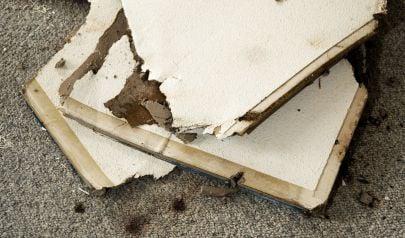
In Cartersville, the landscape does as much to direct water as it does to collect it. Our sloped yards and the natural runoff from higher elevations mean that during heavy Georgia rains, water is rarely stagnant—it’s on the move. It pushes laterally against garages, seeps through door thresholds, and hunts for low points along your foundation. By the time that water crosses your doorstep, it isn't just "water" anymore; it’s a cocktail of soil, organic debris, and microscopic contaminants.
The Deceptive "Dry" After the Flood
Once the visible water recedes, many homeowners assume the worst is over. However, the structure doesn't simply bounce back. What remains is a "layer of impact" that hides just out of sight.
Flooring may look intact on the surface, but beneath the planks, silty residue and moisture settle into the seams of your subfloor. Baseboards act as a shelf, holding contaminants against the wall, while drywall begins to "wick" up the organic matter, the water left behind. At AdvantaClean of Kennesaw, our technicians often step into a home that looks dry but feels "heavy." That shift in air quality is the first sign that the home is still holding onto the flood's ghost.
The "Dirty" Truth About Receded Water
Floodwater in the Cartersville area is never clean. As it travels across yards and streets, it picks up pollutants that don't evaporate when the liquid does. These materials settle into the "bones" of your home:
-
Uneven Contamination: Silt and bacteria collect more heavily in room corners, floor transitions, and low-hanging wall cavities.
-
Structural Absorption: Porous materials like wood framing and insulation absorb the water's "load," keeping interior humidity dangerously high long after the puddles are gone.
-
The Adjustment Phase: Even if the floor feels dry to the touch, the structure is still reacting. It is off-gassing moisture and odors, struggling to reach a stable state on its own.
Resetting the Interior: More Than Just a Mop
Proper flood damage cleanup in Cartersville is about addressing what the structure has absorbed, not just what stayed on the surface. We don't just dry the house; we reset its environment.
Surgical Exposure and Evaluation
We begin by identifying which materials are "stables" and which are "losses." Materials that have absorbed contaminated water—such as carpet padding or certain types of insulation—must be carefully removed to expose the underlying framing. This isn't about gutting the house; it's about isolating the contamination so it doesn't spread.
Environmental Rebalancing
Once the hidden areas are exposed, we shift the home’s physics:
-
Forced Evaporation: We introduce high-velocity airflow into previously sealed-off areas, such as spaces behind vanities or within wall voids.
-
Deep Dehumidification: Our industrial units pull moisture directly from the wood grains and concrete slabs, not just the air. This stops the "heavy" feeling and prevents secondary mold growth.
Stability: The True Goal of Restoration
A flood changes the way a home holds moisture and how air moves through its rooms. At AdvantaClean of Kennesaw, we’ve seen that a Cartersville home is only truly restored when it stops "reacting" to the storm.
Cleanup is complete when the temperature and humidity are consistent from the front door to the back, and the materials no longer carry a hidden "load" of moisture. When that balance is achieved, your home isn't just dry—it's healthy again.
AdvantaClean of Kennesaw, GA
(470) 887-9171
https://maps.app.goo.gl/QMashHc9CVBr77UF8