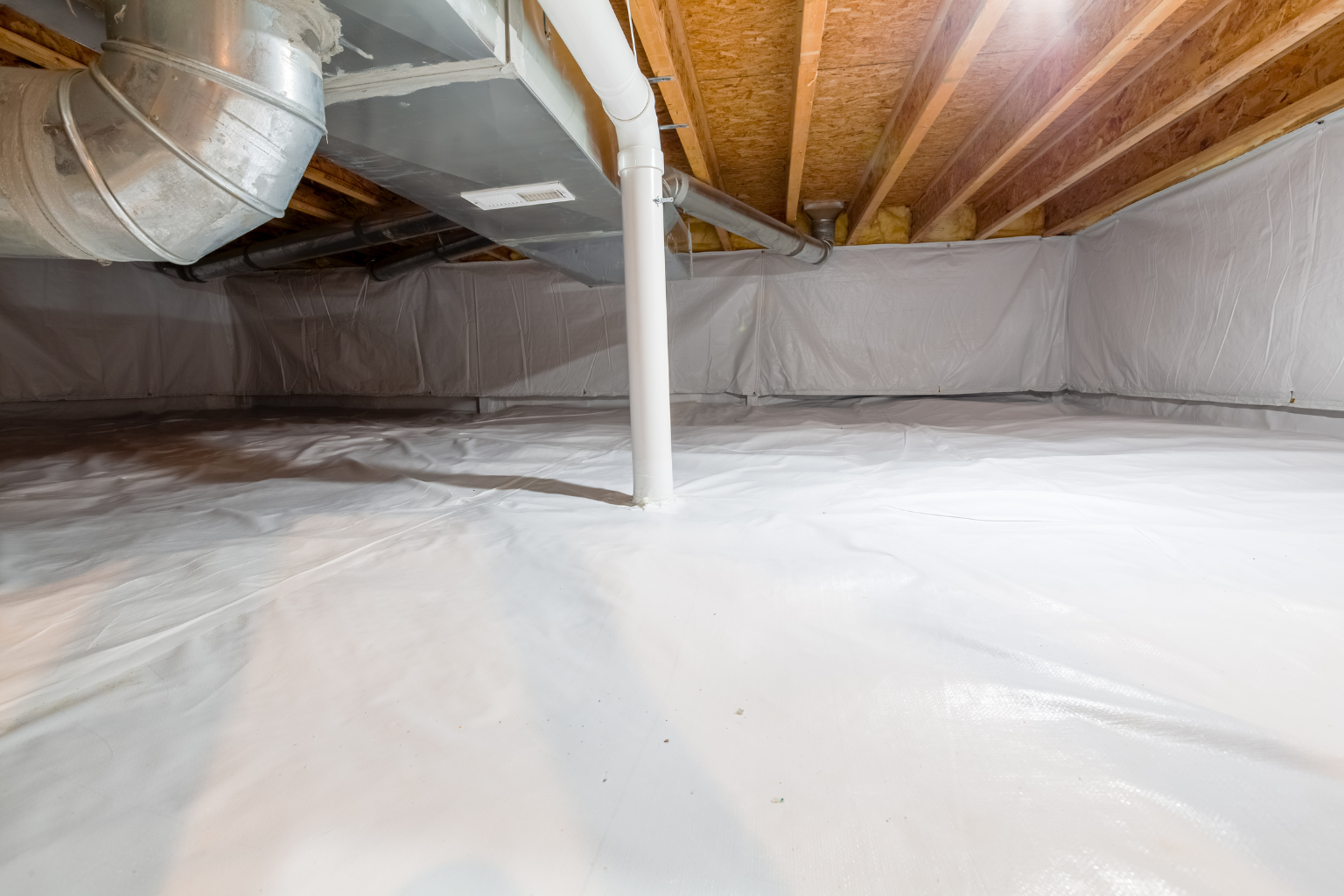
We frequently inspect crawl spaces in Buford and Hall County, and most homeowners are surprised by what we find. These homes are often well-maintained and in good neighborhoods, but homeowners rarely visit or monitor their crawl spaces until a problem becomes noticeable.
Moisture is the most common issue we find in Buford crawl spaces. This may be standing water from slow-developing drainage problems or, more often, elevated humidity that leads to mold growth on floor joists and subfloor panels. In most cases, the issue has been present longer than homeowners realize.
Why Hall County Crawl Spaces Stay Wet
The red clay soil common throughout Hall and Gwinnett counties plays a major role. Clay does not absorb and release moisture the way sandy or loamy soil does. After a stretch of rain, the ground around a Buford foundation stays saturated for days. That moisture presses against the foundation walls and rises as vapor from the exposed soil inside the crawl space. A vapor barrier helps contain it, but barriers installed during original construction thin, tear, and shift over time. Once a gap forms, ground moisture has a clear path up into the framing.
Vented crawl spaces worsen the issue during Gwinnett summers. Foundation vents were meant to remove moisture, but in Georgia’s humid climate, they can introduce more. Warm, humid air condenses on cooler floor framing, depositing moisture. We have seen compromised vapor barriers lead to significant mold growth in just one summer.
What Mold in the Crawl Space Means for the Rest of the Home
A musty odor from floors or certain rooms is often the first sign of a problem. This smell is usually stronger in the morning after the house has been closed overnight. It is not simply due to age or stuffiness, but rather microbial activity with a specific source.
Crawl space mold also impacts air quality throughout the home. As air moves upward, it carries mold spores through gaps around plumbing, cracks in the subfloor, and floor register edges. For households with allergies, asthma, or unexplained respiratory symptoms, inspecting the crawl space should be a priority before considering other causes.
Long-term, structural integrity becomes a concern. Prolonged moisture weakens floor joists, sometimes to the point where wood can be pushed in by hand. At that stage, replacement is required, which is much more costly than addressing moisture issues early.
What a Real Fix Looks Like
Resolving crawl space moisture involves two steps. First, remove existing mold from the framing using mechanical methods, HEPA vacuuming, and antimicrobial treatments. Second, address the underlying moisture conditions to prevent it from recurring.
This usually involves installing or replacing the vapor barrier with a heavy-duty, continuous barrier sealed at seams and foundation walls. If vented crawl space design is the main issue, sealing vents and conditioning the crawl space as part of the building envelope addresses the root cause. A conditioned crawl space with a dehumidifier remains dry year-round, regardless of outdoor humidity.
Frequently Asked Questions About Crawl Space Moisture
Can I just spray bleach on the mold myself?
Bleach kills only surface mold on non-porous materials and doesn't reach mold roots in wood, so the mold returns. Entering a compromised crawl space without proper protective equipment also exposes you to high spore concentrations, which can cause respiratory irritation. Professionals with appropriate gear and containment methods should handle this work.
How do I tell whether the moisture comes from the ground or a plumbing leak?
Both sources are possible and require different solutions. Plumbing leaks usually cause standing water near a specific pipe or localized wet soil under a supply or drain line. Ground moisture is more diffuse and aligns with wet weather or seasonal humidity. A moisture assessment using a meter and thermal imaging will identify the source before work begins.
Will my homeowners insurance cover crawl space mold?
Mold caused by a covered water event, such as a burst pipe, may be included in your policy up to the mold coverage limit. Mold from ongoing ground moisture or humidity is usually excluded as a maintenance issue. Proper documentation of the cause is important for claim evaluation.
How long does crawl space remediation take?
Standard mold remediation with vapor barrier replacement in a typical residential crawl space usually takes one to two days. Larger spaces, structural repairs, or extensive contamination require more time. We assess the scope before providing a timeline to ensure transparency.
If your crawl space hasn't been inspected in the past few years and you're in Buford, Johns Creek, Flowery Branch, or the surrounding area, consider scheduling an assessment. Contact AdvantaClean of Norcross and Buford to arrange an inspection. You can also view customer experiences on our Google Business Profile or call us at (470) 819-2070.
AdvantaClean of Norcross and Buford, GA
3050 Business Park Drive # D, Norcross, GA 30071
(470) 819-2070
https://share.google/NvvK058haG9uVmZfK