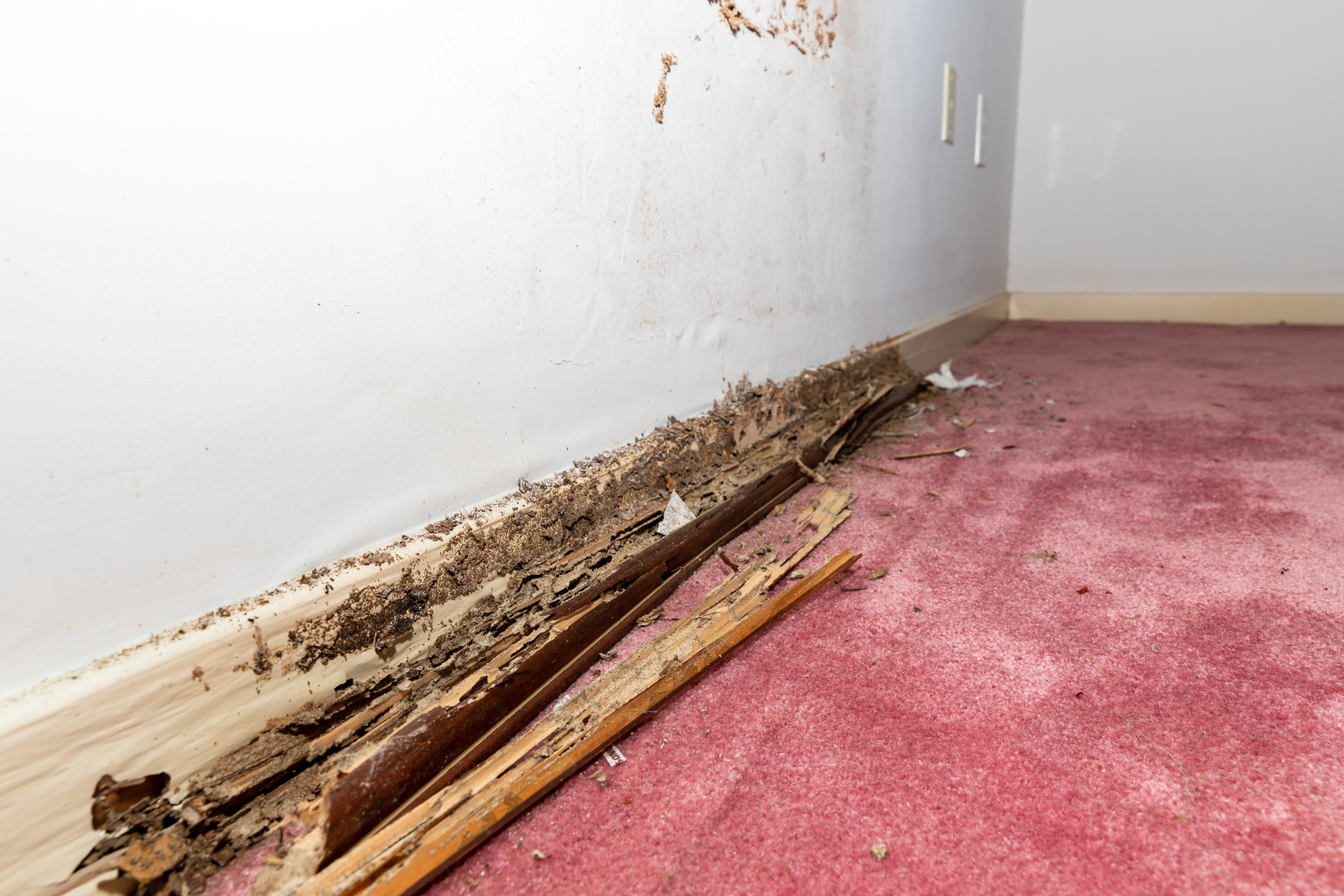
Mopping up standing water on a kitchen or bathroom floor provides immediate relief, but the mop only handles what sits directly on the surface. In a modern finished home, building materials are layered to hide structural elements, fasteners, and plumbing runs. Those same design features provide ready pathways for water to escape and migrate out of sight.
When a refrigerator supply line splits, an upstairs toilet overflows, or an angle stop fails behind a vanity, liquid immediately seeks the lowest point. It slips beneath baseboards, enters gaps in the flooring’s perimeter expansion, and wicks straight into the untreated lower edges of the drywall. By the time surface puddles are gone, internal wall cavities, sill plates, and subflooring may be thoroughly saturated.
The Hidden Layering of Modern Wall Assemblies
Drywall, paint, and decorative trim create a seamless interior appearance, yet this clean exterior often conceals moisture movement. Standard latex paint forms a flexible film on the front of the sheetrock, often masking water that has already soaked through the gypsum core from behind.
Once water contacts the raw bottom edge of a wall panel, capillary action draws that moisture upward through the cellulose backing. In multi-layer assemblies, fiberglass insulation holds moisture against wood framing studs like a saturated sponge, preventing natural airflow from reaching damp structural members.
Relying purely on visual inspections creates two distinct risks for property owners:
-
Leaving damp structural framing untouched until microbial growth or rot sets in.
-
Tearing out unaffected walls and cabinetry unnecessarily based on guesswork alone.
Accurate diagnostic tools remove that uncertainty. Using non-invasive moisture meters and thermal imaging cameras allows our crew to map the exact perimeter of moisture travel through wall assemblies without invasive cuts, ensuring that selective openings occur only where wet insulation or damp framing truly warrants them.
How Different Flooring Systems Respond to Water
Flooring rarely consists of a single material. Hardwoods, engineered planks, luxury vinyl tiles, and carpeting all rest on separate layers of underlayment, foam barriers, adhesives, and plywood subflooring.
Solid hardwoods cup as the bottom of the plank absorbs moisture faster than the top face, while laminate cores swell permanently once water penetrates unsealed joints. In carpeted rooms, water quickly passes through the face fibers into the open-cell pad beneath, trapping moisture against the subfloor even when the carpet surface feels dry within hours.
Restoration strategies depend entirely on the specific material profile and the duration of exposure:
-
Targeted In-Place Drying: When water is caught early and subfloor moisture levels remain within recoverable limits, specialized floor mat drying systems draw moisture directly out of hardwoods and subfloors without pulling up planks.
-
Controlled Material Removal: When saturated foam underlayment or deteriorated subflooring blocks drying equipment, selective removal allows air to circulate around wet structural joists.
-
Cabinet and Toe-Kick Ventilation: Injecting warm, dehumidified air beneath kitchen and bathroom base cabinets dries dark cavities without requiring the complete removal of expensive countertops and millwork.
Tracking daily drying progress with calibrated meters ensures that equipment is adjusted as the structural timber returns to its dry baseline.
Pacific Northwest Climate and Background Humidity
The Puget Sound region experiences extended stretches of cool, damp weather throughout the fall and winter months. In communities like Bellevue, Kirkland, and Mercer Island, this chronic ambient dampness means residential building assemblies cannot dry out passively through open windows or normal furnace operation.
When outdoor air is saturated, interior evaporation rates slow down dramatically. Trapped moisture in unconditioned crawl spaces or exterior wall cavities can remain stagnant for weeks without active mechanical drying.
Furthermore, prolonged rainy seasons make source identification critical. If water stains appear near floorlines or lower exterior walls during sustained downpours, the origin could stem from wind-driven rain, overwhelmed footing drains, or crawl space humidity rather than an isolated indoor plumbing break. Pinpointing the actual moisture source ensures that repairs address the root cause rather than merely masking symptoms.
Why Structural Drying Must Precede Reconstruction
Putting up new drywall, applying fresh paint, or installing replacement flooring feels like quick progress after an emergency. However, scheduling cosmetic repairs before framing members reach baseline moisture levels seals dampness inside structural cavities. Trapped water eventually causes new paint to bubble, warps newly laid floorboards, and provides an ideal environment for hidden fungal growth.
A methodical restoration plan first establishes clear moisture targets. Once verified, meter readings confirm that framing, subfloors, and wall plates are dry, allowing reconstruction to proceed with total confidence that the structure beneath is stable and sound.
Comprehensive Property Restoration Across the Eastside
Addressing indoor water damage requires balancing careful moisture detection with structural drying methods tailored to your home’s unique materials. Our local crew provides comprehensive water damage restoration and structural drying, along with professional mold remediation, moisture inspections, and fire damage recovery for homeowners and commercial properties across Bellevue, Kirkland, Mercer Island, Bothell, and Shoreline.
As a BBB Accredited Business with an A+ rating, our team is dedicated to precise diagnostic assessments and quality craftsmanship. If an unexpected leak, appliance overflow, or plumbing break has introduced moisture behind your walls, connect with AdvantaClean of the Eastside or call (425) 649-0600 to evaluate your property and protect your home’s structural framing.
AdvantaClean of the Eastside, WA
(425) 649-0600
https://share.google/CC4i4hXrse1a2Vxqj