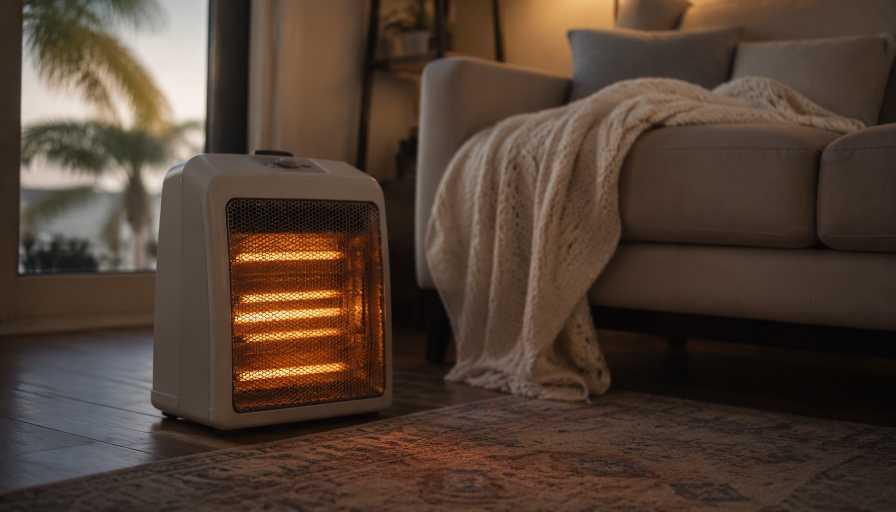
South Florida gets maybe a dozen nights a year cold enough to want extra heat. Most houses here have no real heating system, so the portable heater comes out of the garage, gets plugged in wherever there is an outlet, and runs overnight in a bedroom.
That combination, infrequent use and improvised setup, is why this appliance produces the fire statistics it does.
Why do space heaters cause so many house fires?
Space heaters account for a minority of home heating fires but roughly 73 percent of the deaths from them, according to NFPA data for 2020 through 2024. The reason is not that they malfunction often. It is that they are routinely placed too close to something that burns, and they run unattended while people sleep.
The underlying numbers are worth understanding. Heating equipment overall causes around 37,000 home fires a year in the United States and is the second leading cause of home fires after cooking. Within that, portable heaters and heating stoves do disproportionate damage: the US Fire Administration has found portable heaters involved in only a small share of home heating fires but a very large share of the fatal ones.
Three factors explain the gap between how often these fires start and how often they kill.
The first is proximity to combustibles, which is the leading contributing factor in home heating fires generally. A heater produces sustained radiant heat at close range. Fabric does not need to touch the element to ignite; it needs to sit near it long enough to reach its ignition temperature. A curtain two feet away, a bedspread hanging off the edge of a mattress, a pile of laundry, a sofa arm. All of these will eventually catch.
The second is unattended operation. These fires start at night, in bedrooms, while the occupants are asleep. That is also why the death rate is what it is.
The third is electrical load. A typical 1,500-watt heater draws around 12.5 amps, close to the capacity of a standard 15-amp residential circuit on its own. Run it through an undersized extension cord, a power strip, or an old circuit already carrying other loads, and the failure point moves from the heater to the wiring.
There is a Florida-specific wrinkle on top of all this. Equipment used a handful of nights a year sits in a garage or closet for eleven months, collecting dust, getting knocked around, and developing cracked cords that nobody inspects because nobody thinks of it as a regularly used appliance.
How far should a space heater be from curtains, beds and sofas?
Three feet, in every direction, from anything that can burn. That is the figure fire services repeat every winter, and it covers curtains, bedding, upholstery, clothing, paper, rugs, and furniture.
Three feet is a minimum rather than a target, and the direction matters as much as the distance. Radiant heaters project heat forward, so the space in front of the unit is the critical zone, but convection and ceramic models also heat the air around them in all directions.
Practical placement rules that follow from this:
Put it on a hard, level, non-combustible floor. Not on carpet, not on a rug, not on furniture, not on a shelf or a table.
Keep it out of the walking path. A heater knocked over by someone getting up in the night is one of the common failure sequences, and it is why tip-over protection matters.
Never put it in a bathroom unless it is specifically rated for wet locations. Water and these appliances do not mix, and most are not rated for it.
Do not use it to dry anything. Clothes, shoes, and towels draped on or near a heater is the direct route to ignition.
Keep children and pets away from it, and do not leave a running heater in a room where a pet is shut in alone.
Turn it off when you leave the room and when you go to sleep. This is the single rule that would eliminate most of the fatalities in this category, and it is the one most often broken, because the whole reason people run them is to stay warm overnight.
Is it safe to plug a heater into an extension cord?
No. A space heater should plug directly into a wall outlet, with no extension cord, no power strip, no surge protector, and no multi-outlet adapter. This is explicit in essentially every manufacturer's instructions and every fire service advisory.
The reason is load. A 1,500-watt heater pulls a sustained current close to the limit of a standard household circuit, and it pulls it continuously rather than in bursts the way most appliances do. Extension cords and power strips are generally sized for intermittent, lighter loads. Running a heater through one causes the cord to heat along its length, and the connection points, where the plug meets the strip and where the strip meets the wall, are where the heat concentrates. Those connections degrade, arc, and ignite.
A few related checks before each season:
Inspect the cord along its full length for cracking, fraying, scorching, or stiffness, and look at the plug for discolouration or bent prongs. Damaged cords get the heater thrown out, not repaired with tape.
Plug it into an outlet that is not sharing the circuit with other significant loads.
Touch the plug after ten or fifteen minutes of running. If the plug or the outlet face is hot, unplug it and stop using that outlet until an electrician looks at it.
If the only outlet in range requires an extension cord, the answer is a different location for the heater, not a heavier cord.
Which models shut off on their own if they tip over?
Most modern electric heaters sold in the United States include a tip-over switch that cuts power when the unit is not upright, and many also include overheat protection that shuts the element down if internal temperature climbs too high. What matters more than the feature list is whether the unit carries a certification mark from a recognised testing laboratory.
Look for a UL, ETL, or CSA mark on the unit itself, not just on the packaging. That mark means the design was tested against a safety standard rather than simply claimed to meet one.
Beyond certification, the features worth having:
A tip-over switch that actually works, which you can test by gently tilting the unit while it runs and confirming it cuts out.
Overheat protection, which shuts the heater off if it is blocked or the internal temperature rises too far.
A thermostat, so the unit cycles rather than running continuously at full output.
A timer or auto-shutoff, which addresses the overnight problem directly.
A cool-touch housing, particularly in a home with children or pets.
Two older categories deserve specific caution. Unvented combustion heaters that burn kerosene or propane add carbon monoxide to the fire risk and should never be used indoors unless they are specifically rated and vented for it. And any heater old enough to predate tip-over switches should be replaced rather than used.
Test the tip-over function at the start of each season. A switch that has been sitting in a garage for a year can stick.
Oil-filled radiators and ceramic heaters with enclosed elements run cooler on their surfaces than open-element radiant heaters, which makes them a reasonable default for a bedroom if you are going to run one at all.
What does fire restoration involve after a heater fire?
Restoration after a heater fire deals with three separate problems: structural damage where the fire burned, smoke residue through the rest of the house, and odor that will outlast both if the residue is not fully removed. The smoke portion is almost always larger than the burned area and is what drives the cost.
A heater fire usually starts in soft materials, which shapes what the aftermath looks like. Burning upholstery, bedding, curtains, and carpet produces dense, oily smoke with a heavy synthetic component, because most of those materials are petroleum-based. That residue is harder to remove than smoke from burning wood, it bonds to surfaces, and it carries a persistent odor.
The sequence a restoration crew works through:
Assessment and documentation, including mapping where residue has travelled, which is often well beyond the room involved.
Securing the structure if there is damage to it, including board-up and temporary roofing where needed.
Dry soot removal first, using chemical sponges, before anything wet touches the surface. Wet-cleaning soot first drives it into the finish permanently.
Wet cleaning with the appropriate agent for the residue type, which for synthetic smoke usually means a degreasing product rather than a general cleaner.
HVAC assessment and cleaning. If the system was running when the fire started, it moved residue into every room on the duct network, and it will keep doing so until it is cleaned.
Contents handling, including textiles, which hold odor longest and often need specialist cleaning rather than laundering.
Odor treatment, typically with hydroxyl or ozone equipment, after the residue has been removed rather than instead of removing it.
Sealing and refinishing, using a stain-blocking primer on affected surfaces before any paint.
One note on insurance: fire is a standard covered peril on homeowners policies, and smoke damage resulting from a covered fire is generally covered alongside it. Document everything photographically before any cleaning begins, including rooms away from the fire, because residue you have already removed is damage you can no longer prove. Our grease fire guide covers the claim-versus-cleanup threshold in more detail.
Before the next cold front
The rules that matter are short enough to remember: three feet of clearance in every direction, plugged straight into the wall, on a hard floor, off when you sleep or leave the room, and a certification mark on the unit. Test the tip-over switch before the season and throw out anything with a damaged cord.
If a heater fire does happen, the decision that affects your final cost most is how quickly the smoke residue gets assessed, because acidic residue keeps damaging surfaces the longer it sits and odor becomes harder to remove once it has worked into textiles and ductwork.
AdvantaClean of Fort Lauderdale provides fire and smoke damage restoration across Broward County, including soot removal, contents cleaning, and HVAC assessment. If you have had a heater fire of any size, call (754) 218-8070 or reach the local team here before you start cleaning.