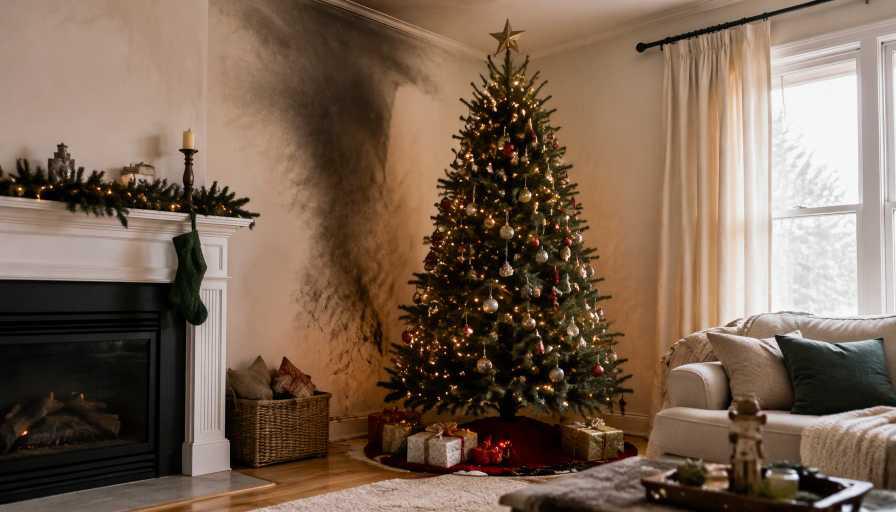
Christmas tree fires are rare. They are also, per fire, among the deadliest fires that happen in American homes, and the gap between those two facts is the reason the topic is worth five minutes of your attention in December.
How fast does a dry Christmas tree catch fire?
A dried-out tree can go from a single point of ignition to fully involved in roughly 30 to 60 seconds. Fire service demonstrations routinely show a dry tree taking a living room to flashover, the point at which everything in the room ignites, in under a minute. There is no realistic window in which you fight this fire yourself.
The physics are straightforward. A cut tree that has lost its moisture is essentially a rack of thin, resinous kindling with enormous surface area and air circulating through all of it. Every needle is fuel, and they are spaced for maximum oxygen contact. Once one branch catches, flame spreads across the whole structure in seconds rather than minutes.
NFPA data puts the practical consequence in numbers. Fires beginning with Christmas trees account for well under one percent of home fires, but roughly one in every 32 of them results in a death, compared with about one in 143 for home fires generally. The tree is not a common ignition source. It is a very efficient one.
The two leading causes are worth knowing because both are preventable. Electrical distribution and lighting equipment is involved in a large share of these fires, meaning damaged strings, overloaded outlets, and old sets left running unattended. And a heat source placed too close to the tree features in roughly a quarter of the fires but around 80 percent of the deaths. Space heaters, fireplaces, and candles near a tree are the single most lethal configuration in this category.
Do artificial trees burn slower than real ones?
Artificial trees are generally harder to ignite than a dry natural tree, since most sold in the United States are made with flame-retardant materials. But when they do burn, they produce dense black smoke, toxic combustion products, and burning plastic that drips, which makes the damage and the health exposure worse rather than better.
So the honest comparison is not safer versus less safe. It is a different risk profile.
A flame-retardant artificial tree resists a small ignition source that would take a dry natural tree instantly. That matters, and it is a real advantage. But the material is typically PVC or polyethylene, and once it is burning it behaves like burning plastic: heavy particulate smoke, a nastier mix of combustion byproducts than burning wood, and molten material that can spread fire downward to carpet and gifts.
Artificial trees also carry their own ignition pathway that natural trees do not. Pre-lit models put the wiring permanently inside the tree, where it gets compressed into a box for eleven months a year. Damaged insulation inside a pre-lit tree is not something you can inspect by looking at it.
A well-watered natural tree, for what it is worth, is genuinely difficult to ignite. The difference between a watered tree and a dry one is far larger than the difference between a natural tree and an artificial one.
How often should you water a real tree to keep it safe?
Check the water level daily and never let the base of the trunk sit dry. A fresh tree can take a surprising volume in its first days, sometimes a gallon or more in twenty-four hours, and once the cut end seals over with resin it stops drinking altogether.
The sequence that keeps a tree safe starts before it comes inside.
Buy fresh. Needles should be hard to pull off a branch, and a gentle bounce of the trunk on the ground should not shed a shower of them. A tree that is already dropping needles at the lot will be a hazard in two weeks.
Cut about an inch off the base before putting it in the stand, even if the lot made a cut. The fresh surface is what allows water uptake, and a trunk that has been out of water for a few hours has already begun to seal.
Use a stand that holds at least a gallon, and keep the water above the cut at all times. If the base dries out, the trunk seals again and refilling will not restore uptake.
Skip the additives. Commercial preservatives, aspirin, sugar, and bleach have no demonstrated advantage over plain water. Water, in sufficient quantity and without interruption, is the whole of it.
Keep the tree at least three feet from any heat source, including fireplaces, space heaters, radiators, candles, and heat vents. In Florida this one gets overlooked because the heat source is often a portable heater brought out for a cold snap and set down wherever there is floor space.
Turn the lights off whenever you leave the house or go to bed, inspect every string for frayed insulation and cracked sockets before using it, and do not run more strings on one circuit than the manufacturer allows.
Take the tree down when it dries out rather than when the holiday ends. A high number of these fires happen in January, with a meaningful share of them involving dried trees still standing after the season.
What should you do in the first hour after a holiday fire?
Get everyone out and call 911 before anything else, and do not go back in for possessions. Once the fire service has cleared the property, your first hour is about documentation and preventing the smoke damage from setting, not about cleaning.
After the fire department releases the house, work through roughly this order.
Do not enter until you are told it is safe. Structural damage, compromised wiring, and residual smoke are all real hazards, and a fire that looked small can leave an unsafe ceiling.
Photograph everything before you touch anything. Wide shots of every room, including rooms away from the fire, then close shots of specific damage. Smoke residue is the bulk of the loss in most small holiday fires, and residue you have already wiped away is damage you can no longer document for a claim.
Turn off the HVAC system and leave it off. If it was running during the fire, it distributed smoke through the ductwork into rooms the flames never reached, and running it afterward continues to move that residue around.
Ventilate once you have photographed. Open windows and create cross-flow.
Call your insurer and open the claim. Fire is a standard covered peril and smoke damage from a covered fire generally travels with it, which makes this more straightforward than most water and mold claims.
Resist the urge to start scrubbing. Smoke residue has to be removed in the right order with the right method, and the wrong first move makes several surfaces permanently worse. The next section explains why.
Our grease fire guide covers the same aftermath sequence for kitchen fires in more depth.
Can soot from a small fire stain walls and furniture for good?
Yes, and the most common way it becomes permanent is someone cleaning it with a wet cloth. Soot is a fine particulate that sits on the surface until water drives it into the paint, at which point the stain is in the finish rather than on it.
The correct first pass on soot is dry. Restoration crews use chemical sponges, which are blocks of vulcanized rubber that lift particulate without solvent or water. Dry removal takes off the bulk of the deposit. Only after that does any wet cleaning make sense, and the product depends on what burned.
The composition matters. Soot from burning wood or paper is dry and powdery and lifts cleanly if handled dry. Soot from burning plastic, which is what an artificial tree and most decorations produce, is oily and bonds to surfaces far more aggressively. Smoke from a tree fire in a furnished room is usually a mixture of both, which is why a single cleaning method rarely handles a whole room.
Several things routinely become permanent when treated wrong or left too long:
Painted walls and ceilings, where wet-wiped soot sets into the finish and no subsequent cleaning removes it.
Upholstery and carpet, where particulate works deep into fibers and sets with time.
Unfinished or porous wood, which absorbs both residue and odor.
Plastics and vinyl, which can yellow permanently from acidic residue, often within days.
Metal fixtures and appliance finishes, where acidic soot etches and corrodes if it sits.
Time is a factor independent of method. Smoke residue is chemically acidic, and the longer it stays on a surface the more likely the damage becomes structural rather than cosmetic. Discoloration that could have been cleaned in the first few days can be permanent after a few weeks.
Painting over smoke-stained walls without cleaning and sealing first does not work either. Residue bleeds through ordinary paint, sometimes weeks later, and the odor remains underneath regardless of how many coats go on. Affected surfaces need dry removal, appropriate cleaning, then a stain-blocking primer before any finish coat.
Odor is the last thing to resolve and the best indicator of whether the job was done. Smoke smell that persists after everything visible has been cleaned means residue is still present somewhere, commonly in ductwork, inside wall cavities, in insulation, or in textiles. Our guide on candle soot covers the same residue behaviour at a smaller scale, and our indoor air quality guide covers how HVAC systems redistribute airborne contaminants.
If a tree fire happens in your home
The prevention side comes down to three habits: keep the tree watered daily, keep every heat source three feet away, and turn the lights off when you are asleep or out. Those cover the large majority of what actually causes these fires.
If one does happen, the thing that determines your final cost is usually not the flames. It is how quickly the smoke residue is assessed and removed before it sets into finishes and migrates through the ductwork. Photograph everything, leave the HVAC off, and get an assessment before you start cleaning.
AdvantaClean of Fort Lauderdale provides fire and smoke damage restoration across Broward County, including soot removal, odor treatment, and HVAC assessment after holiday fires. If you have had a fire of any size this season, call (754) 218-8070 or reach the local team here for an assessment before the residue has time to set.