The instinct is water. Water is what puts out fire. In a pan of burning cooking oil, water is what turns a contained flame into a fireball that reaches the ceiling.
Understanding why takes thirty seconds and it is the most useful thing in this article.
Never water: why a grease fire explodes and what smothers it
Cooking oil burns at somewhere around 700 degrees Fahrenheit. Water boils at 212. Water is also denser than oil, so it does not sit on top where it might help. It sinks straight through the burning oil to the bottom of the pan.
At that point you have water sitting in a vessel several hundred degrees above its boiling point. It flashes to steam essentially instantly, and steam occupies roughly 1,700 times the volume of the liquid water it came from. That expansion happens underneath the oil, which means the oil is violently ejected upward and outward as a cloud of burning droplets.
A cup of water into a burning pan produces a fireball. This is the mechanism behind most of the dramatic kitchen fire footage people have seen, and it is why fire services lead with it.
What actually works is removing oxygen.
A metal lid is the best tool. Slide it across the pan from the side rather than dropping it on from above, which keeps your hand out of the flame path and avoids splashing. Leave it in place. Then turn off the heat.
Turn off the burner, but do not move the pan. Carrying a pan of burning oil to a sink or a door is how people end up with burns and with fire spread along the route. It stays where it is.
Baking soda works for small flames. Sodium bicarbonate releases carbon dioxide when heated and smothers. It takes a substantial quantity, so this is for a small pan fire, not a large one. Keep a box within reach of the stove rather than across the kitchen.
A Class K extinguisher is the correct rated device for cooking oils and fats. An ABC dry chemical extinguisher will work and is better than nothing, though it makes a corrosive mess that complicates cleanup considerably.
What not to use: water, obviously. Also flour, which looks like baking soda and behaves nothing like it; finely dispersed flour in air is combustible and can deflagrate. Also sugar. Also a wet towel, which introduces the same water problem. A dry, heavy towel or fire blanket can smother a small flame, but a lid is better and safer.
Leave and call 911 if the fire is not out in seconds, if it has reached anything beyond the pan, if flames are approaching cabinets or the range hood, or if you are hesitating. A kitchen fire doubles quickly. Close the door behind you to limit oxygen and spread.
Turkey fryers: the Thanksgiving setup that causes the most fires
Thanksgiving is the highest day of the year for home cooking fires in the United States, by a wide margin over an average day. Turkey fryers are a disproportionate part of why, and the failure modes are predictable.
Overfilling. Oil displaced by the turkey overflows the pot and hits the burner flame. This is the most common turkey fryer fire and it is entirely preventable. Before frying, place the thawed turkey in the empty pot, add water until it covers the bird by an inch or two, remove the turkey, and mark the water line. That line is your oil level. Dry the pot completely before adding oil.
A frozen or wet turkey. This is the spectacular one. Ice and water in the cavity hit 350-degree oil and flash to steam underneath it, producing the same violent boilover as water in a pan, at much larger scale. The turkey must be completely thawed and patted dry inside and out.
Lowering the bird too fast. Turn off the burner, lower the turkey slowly, then relight. Oil displaced gradually does not surge.
Location. Fryers belong outdoors, on level ground, well clear of the house, deck, garage, carport, and anything overhanging. Wooden decks are a common fire origin. Garages and covered patios are not outdoors for this purpose.
No thermostat. Most consumer propane fryers have no automatic temperature control, which means unattended oil will keep heating until it reaches its autoignition point. Use a thermometer, and never leave it unattended.
Instability. The stand plus a full pot of hot oil plus uneven ground plus someone walking past is a known sequence. Site it where nobody needs to walk.
Have a Class K or ABC extinguisher at the fryer, not in the kitchen. Keep children and pets well away. Oil-free infrared and electric indoor fryers eliminate most of these failure modes if you want the result without the risk.
After the flames: grease smoke residue on cabinets, ceilings and vents
Here is what people consistently underestimate. The fire was in the pan. The damage is all over the house.
Grease and protein smoke produce the most difficult residue in fire restoration. It is oily rather than powdery, it is semi-transparent so it does not look like much, it carries an exceptionally persistent odor, and it bonds to surfaces rather than sitting on them. Protein residue from burned food is close to invisible and has the strongest odor of any common residue type.
It travels much further than the fire did. Smoke follows air currents. It moves through doorways, up stairwells, and into every room on the same air path. If the HVAC system was running, it went into the ductwork and from there into rooms with no connection to the kitchen at all. It gets into wall cavities, on the tops of door casings, inside upper cabinets, into closets, and into every textile in range.
It is not a water-and-sponge job. Dry soot from a paper or wood fire is removed with dry chemical sponges, and using water on it smears it permanently. Grease residue is the opposite: it needs degreasing agents and sometimes solvents. Using the wrong method for the residue type is how a cleanable surface becomes a replacement.
Surfaces that routinely need attention after even a small grease fire:
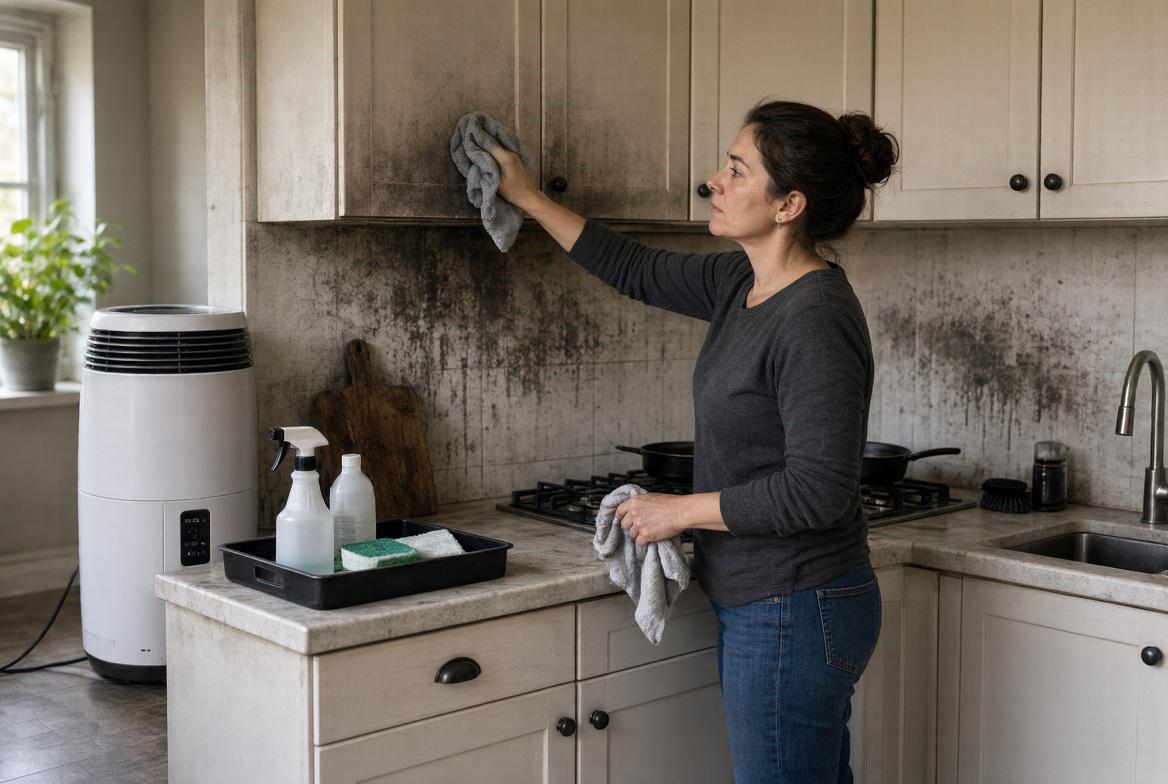
Cabinet exteriors and, critically, interiors, including the undersides of upper cabinets directly above the range. Ceilings, which collect the heaviest deposit because smoke rises and spreads laterally. Walls, with deposits heaviest near the ceiling. The range hood and its filters and duct. HVAC return and supply registers and, if the system ran, the ductwork. Countertops and backsplash. Window glass and frames. Light fixtures and ceiling fans.
Painting over it does not work. Grease residue bleeds through conventional paint, sometimes weeks later, and the odor remains underneath regardless. Affected surfaces must be cleaned and usually sealed with a stain-blocking primer before any finish coat.
Textiles hold the odor longest. Curtains, upholstery, rugs, bedding, and clothing in open closets absorb smoke odor readily. Laundering handles some of it. Professional cleaning handles more. Odor that persists after cleaning is usually addressed with hydroxyl generators or thermal fogging rather than masking agents.
The HVAC system is the decision point. If the air handler was running during the fire, the system distributed residue throughout the house and the ductwork itself is now a source. Running the system afterward continues to redistribute it. Have it assessed before putting it back into service.
When it's an insurance claim and when it's a weekend cleanup
The honest dividing line is narrower than people expect, because the thing that determines scope is odor and residue spread rather than flame damage.
Probably a weekend cleanup if the flames never left the pan, there is no odor outside the kitchen, no visible residue beyond the immediate stovetop area, the HVAC was off, and nothing textile was nearby. Degreaser, patience, and a thorough job on the hood and the cabinet undersides.
Probably a claim if any of the following apply. Odor is detectable in rooms beyond the kitchen. Visible residue appears on the ceiling or on walls away from the range. The HVAC system was running. Cabinets, countertops, or appliances show heat damage. Textiles, upholstery, or carpet were in the affected area. A fire extinguisher was discharged, since dry chemical residue is corrosive and has its own cleanup requirements. The fire department attended. Or the odor persists after you have cleaned everything you can reach.
That last one is the most common trigger. Homeowners clean the visible area, the kitchen looks fine, and three weeks later the house still smells like a fire every time the air conditioning runs.
Two practical notes on the claim side. Fire damage is a standard covered peril on homeowners policies, and smoke damage from a covered fire is covered along with it, which puts this on firmer ground than most of the water and mold scenarios discussed elsewhere on this blog. And document before you clean: photograph every affected surface, including rooms away from the kitchen, before touching anything, because residue you have already wiped away is damage you can no longer prove.
Air quality in the days after a small kitchen fire
Combustion produces fine particulates and a range of gaseous byproducts, and a kitchen fire concentrates them in an enclosed space. Burning synthetic materials, such as a plastic appliance housing or a vinyl surface, produces a more complicated mixture than burning oil alone.
In the first hours, ventilate aggressively. Open windows, run exhaust fans, and create cross-flow. This is the one scenario in Florida where pulling in humid outdoor air is clearly the right trade.
Do not run the HVAC if there is any possibility residue entered it. Replace the filter before the system goes back into service, and have the system assessed if it ran during the fire.
Portable HEPA air purifiers help with the particulate fraction. Size the unit to the room rather than the house. Units with activated carbon additionally help with odor compounds, which plain HEPA does not address.
Expect some irritation and watch for more. Throat and eye irritation, coughing, and headache are common in the day or two after and generally resolve with ventilation. People with asthma or other respiratory conditions, young children, and older adults are more affected and should stay out of the affected area until it has been cleaned and aired. Symptoms that persist, or any shortness of breath, warrant a physician.
Treat lingering odor as evidence. Smoke odor that persists after cleaning means residue is still present somewhere, commonly in ductwork, inside wall cavities, in insulation, or in textiles. Air fresheners and ozone treatments applied over uncleaned residue suppress the smell temporarily and it returns, usually when humidity rises. Our guide on whether your AC is worsening indoor air quality covers how HVAC systems circulate and concentrate airborne contaminants.
Frequently asked questions
Why can't I use water on a grease fire? Water is denser than oil and sinks beneath it, then flashes to steam at a temperature hundreds of degrees below the burning oil. The steam expands roughly 1,700 times instantly and ejects burning oil upward and outward. It converts a pan fire into a fireball.
What is the fastest way to put out a grease fire? Slide a metal lid over the pan from the side and turn off the heat. Leave the lid in place. Do not move the pan. If it is not out immediately, leave and call 911.
Can I use baking soda on a grease fire? Yes for a small flame, in quantity. Never flour, which looks similar and can deflagrate when dispersed in air.
Why does my house still smell weeks after a small kitchen fire? Grease and protein smoke residue bonds to surfaces and travels well beyond the fire, including into ductwork if the HVAC was running. Odor that persists after cleaning means residue remains somewhere you have not reached, commonly ducts, wall cavities, or textiles.
Is smoke damage covered by homeowners insurance? Fire is a standard covered peril, and smoke damage resulting from a covered fire is generally covered with it. Document everything photographically before cleaning, including rooms away from the kitchen.
Can I just paint over smoke-stained ceilings? No. Grease residue bleeds through ordinary paint and the odor stays underneath. Surfaces need cleaning with appropriate degreasing agents and then a stain-blocking primer before any finish coat.
Do I need to clean the air ducts after a kitchen fire? If the HVAC was running during the fire, yes, it should at minimum be assessed. The system distributed residue through the house and will continue to do so each time it runs.
Getting help
The decision point after a grease fire is usually not the kitchen, which you can see. It is everywhere else, which you cannot. If there is odor beyond the room, residue on a ceiling, or any chance the air conditioning was running, an assessment is worth more than a weekend of scrubbing that may need redoing.
AdvantaClean of Fort Lauderdale provides fire and smoke damage restoration across Broward County, including odor removal, residue cleaning, and HVAC assessment after kitchen fires. Call (754) 218-8070 or reach the local team here.