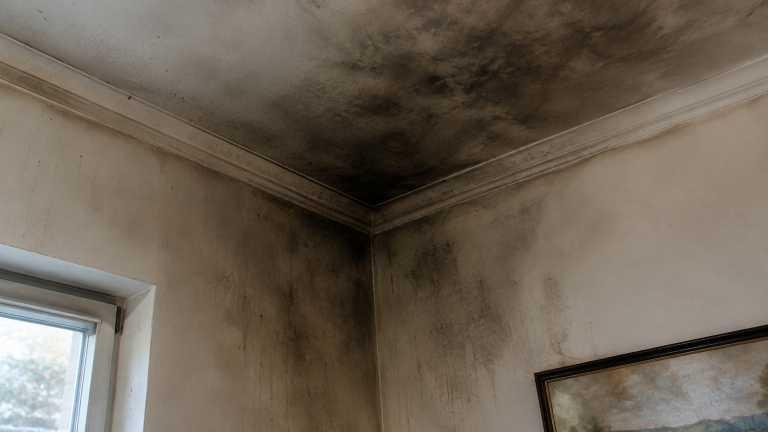
Candle soot produces two kinds of marks. There is the obvious one, a grey or black bloom on the wall above where a candle sits. And there is the stranger one, faint dark lines running up a wall or across a ceiling in a regular pattern, which people often assume is mold or a leak.
Both come from the same source, and both get permanently worse if you reach for a wet cloth first.
Why do some candles leave black marks above them?
Black marks come from incomplete combustion. When a candle's flame cannot burn all the fuel it is drawing up the wick, the unburned carbon leaves as fine soot particles, which rise with the heat plume and deposit on whatever surface is above.
A candle burning cleanly produces almost no visible soot. What pushes it into incomplete combustion is usually one of these.
A wick that is too long. This is the most common cause by a wide margin. A long wick draws more fuel than the flame can fully oxidise, and the flame goes tall, flickering, and smoky. Trimming to about a quarter inch before every lighting solves most soot problems on its own.
Draughts. A flame that is being disturbed by air movement cannot establish a stable combustion zone, so it flickers and sooties. Candles near an air conditioning vent, an open window, a ceiling fan, or a hallway with traffic will soot even with a properly trimmed wick. Flickering is the visible symptom.
Fragrance and dye load. Scented candles carry fragrance oils that do not combust as cleanly as the wax itself, and heavily scented or heavily dyed candles produce measurably more soot. This is why the worst staining in a house is often above the decorative candles rather than the plain ones.
Container geometry. Jar candles that have burned down into a deep well restrict airflow to the flame, which starves it of oxygen and increases soot output. The same candle that burned cleanly at the top of the jar can soot heavily once it is two thirds down.
Wax type. Paraffin generally produces more soot than soy or beeswax, though wick length and draughts matter more than the wax in practice.
The marks concentrate above the candle because that is where the heat plume carries the particles, and they spread outward across the ceiling as the plume hits it and turns. In an enclosed space, a single regularly burned candle can discolour a whole ceiling over a season.
Is candle soot harmful to breathe?
Candle soot is fine particulate matter in the respirable size range, which means it reaches deep into the lungs rather than being filtered out in the nose and throat. Occasional candle use in a ventilated room is a minor exposure for most people, but heavy use in a closed room is a genuine indoor air quality issue, particularly for anyone with asthma or respiratory sensitivity.
What is actually in it matters. The soot itself is largely elemental carbon, and candle combustion also releases unburned hydrocarbons and, with scented products, the combustion byproducts of the fragrance oils. Burning multiple heavily scented candles in a closed room measurably raises fine particulate levels.
Who should be more careful: people with asthma or COPD, young children, older adults, and anyone with existing respiratory conditions. Pets with small respiratory systems, particularly birds, are more sensitive again.
Practical reduction is straightforward. Trim wicks, burn candles away from draughts, ventilate the room, avoid burning several at once in a small closed space, and stop burning a jar candle once it has burned down into a deep well. Flameless alternatives remove the question entirely if someone in the household is sensitive.
The visible staining is a reasonable proxy. If the wall above your candles is discolouring, you are producing enough soot to be worth addressing on air quality grounds as well as decorative ones. Our indoor air quality guide covers how HVAC systems circulate particulate through a house.
Can you wash soot off painted walls without smearing it?
Not if you start wet. Soot sits on the surface as dry particulate, and introducing water or cleaner first turns it into a slurry that gets driven into the paint film, at which point the stain is in the finish rather than on it and no amount of further cleaning removes it.
The correct sequence is dry first, wet second, and only if needed.
-
Ventilate the room and protect the floor and furniture beneath the area with drop cloths. Soot falls as you work.
-
Vacuum loose particulate using a HEPA vacuum with a brush attachment held slightly off the surface rather than pressed against it. Do not use a regular shop vacuum, which will exhaust fine particles back into the room.
-
Dry-sponge the surface. A chemical sponge, sometimes called a soot sponge, is a block of vulcanized rubber that lifts particulate without any liquid. Wipe in one direction with light pressure, do not scrub, and rotate to a clean face of the sponge frequently. Do not wash the sponge, which ruins it; cut away the loaded surface with a knife to expose fresh rubber. This step removes the bulk of the deposit and is the one most people skip.
-
Assess what remains. On a washable paint finish, dry sponging alone often takes a light deposit back to clean.
-
If residue remains, move to wet cleaning. Because candle soot carries wax, a degreasing cleaner works better than a general-purpose one. Test in an inconspicuous spot first, work from the bottom of the wall upward to avoid streaking, use minimal moisture, and dry the surface as you go.
-
For stubborn staining, a dedicated smoke and soot cleaning product is worth more than a stronger household cleaner, which is more likely to damage the paint than remove the stain.
-
Rinse lightly with clean water and dry.
-
If the stain persists after all of that, the particulate is in the paint film and cleaning will not retrieve it. The surface needs a stain-blocking primer followed by repaint. Painting over soot without the primer does not work; it bleeds through, sometimes weeks later, and the odor remains underneath.
Two cautions. Flat and matte paints are porous and hold soot far more tenaciously than eggshell, satin, or semi-gloss, so expect a flat ceiling to need priming where a satin wall cleans up. And heat-set soot, where the mark came from a flame close to the surface rather than a plume, usually will not clean out at all.
What is ghosting, and why does it appear on cold spots of the wall?
Ghosting is soot deposited in a pattern that maps the framing behind your wall or ceiling, appearing as regular dark stripes over the studs or joists and sometimes as dots at each fastener. It happens because fine airborne particles migrate toward cooler surfaces, and the framing members conduct heat differently from the insulated cavities between them.
The mechanism is thermophoresis. Suspended particles in air move from warmer regions toward cooler ones, so over time soot preferentially accumulates on whichever interior surfaces run coldest. A wood stud or a steel fastener bridges from the exterior to the interior surface and makes the drywall directly over it a few degrees cooler than the drywall over the insulated cavity beside it. That small differential is enough to produce a visible stripe over months of particle deposition.
What this tells you is useful beyond the stain. Ghosting is a free thermal survey of your building envelope. A clear framing pattern means those members are thermally bridging, and gaps or irregularities in the pattern can indicate missing, settled, or wet insulation. Ghosting concentrated on one exterior wall points at that wall specifically.
It also tends to show up alongside moisture, since cool surfaces are where condensation forms too. Ghosting on an exterior wall in a humid house is worth checking for the other consequence of cool surfaces. Our winter mold guide covers that interaction.
Ghosting is not exclusively candles. Any persistent source of fine particulate contributes, including fireplaces, gas appliances, cooking, incense, and tobacco smoke. Candles are simply the most common contributor in homes that show it strongly, because people burn them in the same spot repeatedly.
Cleaning it follows the same dry-first sequence above. Preventing its return means reducing the particulate source and, where it is severe, addressing the thermal bridging with insulation improvements.
When does soot cleanup need a professional?
A localised mark above one candle on a washable paint finish is a reasonable afternoon with a dry sponge. Bring in a professional when the soot has spread beyond one area, when it has got into the HVAC system, when there is any odor, or when the deposit came from an actual fire rather than ordinary candle use.
The specific situations worth handing over:
Staining across multiple rooms, which usually means the HVAC system has distributed it and the ductwork is now a source.
Any persistent smoke odor. Odor means residue remains somewhere you have not reached, commonly in ducts, textiles, insulation, or wall cavities, and surface cleaning will not resolve it.
Soot on textiles, upholstery, or carpet, where particulate works into fibres and sets with time.
Flat or matte finishes over a large area, where cleaning frequently drives the stain in and the realistic path is priming and repainting rather than cleaning.
Anything following an actual fire, however small. Fire residue is chemically different from candle soot, more acidic, and will continue damaging surfaces the longer it sits. Our grease fire guide and Christmas tree fire guide cover that case.
Soot inside the air handler or on supply registers, which means every cycle redistributes it.
Any situation where you have already tried wet cleaning and made it worse, which is common and is the point at which professional methods still have options that household products do not.
Dealing with the marks you already have
For ordinary candle staining, the two things that matter most are trimming wicks to a quarter inch and keeping candles out of draughts, which between them eliminate the majority of soot production. For the marks already on the wall, go dry before you go wet, accept that flat paint may need priming rather than cleaning, and read any ghosting pattern as information about your insulation rather than just a stain.
If the staining has spread beyond one room, if there is odor, or if it came from a fire rather than a candle, the cleaning method and the order matter enough that a wrong first pass can cost you the finish.
AdvantaClean of Fort Lauderdale provides soot removal and smoke damage restoration across Broward County, including odor treatment and HVAC assessment. If you are looking at staining you are not sure how to approach, call (754) 218-8070 or reach the local team here before trying to wash it off.