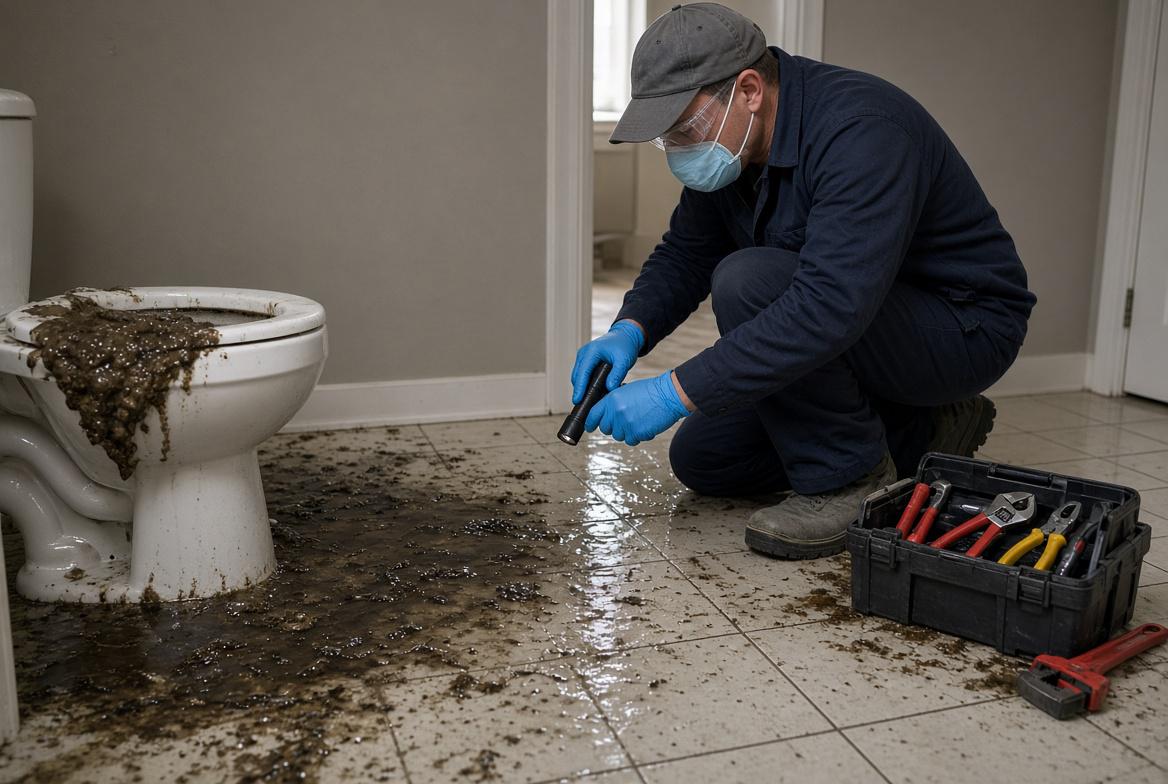
A sewage backup is the worst version of a water loss. It is a genuine health hazard, it destroys more material than clean water does, it is the most expensive category of water damage to remediate, and, for most Florida homeowners, it is the one their insurance policy does not cover.
That last point catches an enormous number of people off guard. Standard homeowners policies generally exclude water that backs up through sewers or drains unless a specific endorsement was purchased in advance.
This guide covers the immediate response, then spends most of its time on the three questions that determine what this actually costs you: whether your policy responds, whether the city might be liable, and what hardware stops it from happening again.
Why sewage is treated differently from other water losses
Under the IICRC S500 standard that professional restorers work from, sewage is Category 3 water, commonly called black water. It is classified as grossly contaminated and presumed to carry pathogenic agents.
Sewage can contain E. coli, Salmonella, Shigella, Campylobacter, Giardia, Cryptosporidium, hepatitis A, norovirus, and Leptospira, along with whatever chemicals and medications have been flushed into the system. Exposure routes include hand-to-mouth transfer, contact with broken skin, and inhalation of aerosolized droplets. Gastroenteritis is the common outcome; hepatitis A, leptospirosis, and wound infections are the less common ones. Young children, older adults, pregnant women, and immunocompromised people face elevated risk.
There is a second hazard people underestimate. Sewer gas containing hydrogen sulfide and methane can accumulate in enclosed spaces. Hydrogen sulfide deadens the sense of smell at higher concentrations, which means the warning sign disappears exactly when conditions become most dangerous.
The practical consequence of Category 3 classification is that porous materials contacted by the water do not get cleaned and dried. They get removed. Carpet, pad, drywall, insulation, particleboard cabinetry, upholstered furniture, and mattresses all come out. The blog's guide on sewage backup versus clean water flooding covers what survives and what does not, and the guide to restoring personal belongings after sewage damage covers contents specifically.
The first minutes: what to do and what not to do
The response order matters, and two of these steps are commonly missed.
Get everyone out of the affected area, including pets. Do not walk through standing sewage.
Stop all water use in the house immediately. This is the step people skip. Every toilet flush, every sink, every shower, and every appliance cycle adds volume to a backup that has nowhere to go. If the blockage is downstream, running water makes the flood bigger in real time. Tell everyone in the house, then verify.
Shut off electricity to the affected area if the panel is dry and safely accessible. If it is not, leave it and call an electrician or the utility.
Shut off the HVAC system. Running it circulates contaminated aerosols through the whole house and can contaminate ductwork, which converts a one-room problem into a whole-system one.
Ventilate if you can do it safely. Open windows in and near the affected area.
Document from a safe distance. Photos and video before anything is moved or cleaned. Timestamps matter for both insurance and any claim against a third party.
Call a licensed restoration company, then your insurer.
If the backup involves multiple fixtures at once, or you see sewage surfacing at a cleanout or in the yard, call the utility too. Simultaneous backups across several drains usually indicate a blockage in the main line rather than your fixture, and the location of that blockage determines who is responsible.
Two things not to do. Do not use a household wet/dry vacuum, which aerosolizes contaminated water, spreads it, and ruins the vacuum. And do not pour bleach into standing sewage: urine contains ammonia, and bleach mixed with ammonia produces chloramine gas. That reaction is a real hazard in exactly this scenario and it is rarely mentioned.
Why your homeowners policy probably does not cover it
This is the section most homeowners wish they had read a year earlier.
Standard homeowners policies generally exclude sewer and drain backup. The exclusion is separate from, and broader than, the flood exclusion. Water that backs up through sewers, drains, or sump systems is typically not a covered peril under the base policy, even though a burst supply line in the same house would be.
Coverage requires a specific endorsement, usually called water backup and sump overflow coverage, or sewer backup coverage. It has to be added before the loss. Typical annual cost is modest, often in the range of a few tens to a couple hundred dollars, with limits commonly running from around $5,000 to $25,000 depending on what you buy. Given that a single-bathroom sewage cleanup commonly runs $3,000 to $7,000 and larger events run well beyond that, the endorsement usually pays for itself the first time it is needed.
Check your declarations page now rather than later. Look for a line referencing water backup, sump overflow, or sewer backup. If it is not there, you do not have it. Your agent can add it, but it will not apply retroactively to a loss that already happened.
Flood-caused sewage is a separate matter entirely. When rising groundwater or storm surge overwhelms the sewer system, the resulting damage falls under flood, which requires NFIP or excess flood coverage. A hurricane can produce backup from a blocked line, wind-driven rain intrusion, and flood-driven sewer overflow in the same event, each handled under a different policy or excluded outright.
Mold that follows is capped separately. Even where the backup itself is covered by an endorsement, resulting mold remediation typically runs against a separate sublimit of $5,000 to $10,000. Our mold remediation cost guide covers how quickly that ceiling gets reached, and our water damage restoration cost guide covers Category 3 pricing.
If you are in a condo, responsibility splits between your HO-6 and the association's master policy depending on where the failure occurred and what your declaration says. Our condo water damage guide walks through that structure.
When the city may be liable, and the deadlines that decide it
If the failure was in the municipal main rather than your lateral, the city may bear responsibility. Pursuing that is possible, and it is also governed by rules strict enough that most people who wait forfeit the claim.
Fort Lauderdale has a documented history here. Between December 2019 and February 2020, a series of sewer main breaks discharged roughly 211 million gallons of sewage into neighborhoods and waterways including Rio Vista, Victoria Park, Coral Ridge Country Club Estates, and the Himmarshee Canal. It was the largest sewage spill on record in Florida, and the Florida Department of Environmental Protection fined the city roughly $2.1 million. The city had already been operating under a 2017 consent order requiring over $100 million in sewer repairs, and subsequently committed to a much larger capital program to replace aging mains. Substantial investment has gone into the system since, but the episode establishes that main-line failure in this city is a documented risk rather than a hypothetical one.
Claims against a Florida city run through Florida Statute 768.28, which waives sovereign immunity only partially and on strict terms:
-
Written pre-suit notice is mandatory. For a claim against a municipality or county, the claim must be presented in writing to the appropriate agency. This is a condition precedent, meaning a lawsuit filed without it can be dismissed regardless of merit.
-
The notice window is three years from when the claim accrues for most tort claims.
-
A 180-day investigation period applies after notice before suit can proceed, unless the agency denies the claim in writing sooner.
-
Recovery is capped at $200,000 per person and $300,000 per incident. Anything above that requires the Legislature to pass a claim bill, a process that historically succeeds in a minority of cases and can take years.
-
Punitive damages and pre-judgment interest are not available against a government entity.
One timely note: HB 145, passed by both chambers in March 2026, would have raised those caps to $350,000 and $500,000 for claims accruing on or after October 1, 2026. It was vetoed on June 30, 2026, so the existing caps continue to apply.
Several doctrines defeat otherwise reasonable claims, including discretionary-function immunity, the public-duty doctrine, and simple failure to meet the notice requirements. Whether a specific main failure was a negligent operational failure or a protected discretionary decision is exactly the sort of question that determines outcomes.
None of this is legal advice. If your backup traces to a municipal line, talk to an attorney early. The deadlines are unforgiving and the analysis is genuinely technical.
Practical steps that preserve the option: document everything immediately, report the event to the utility and get a reference number, request the city's records regarding the line and any prior failures at that location, keep every invoice, and do not discard damaged materials without photographing them and noting their condition.
What actually prevents a repeat
If a backup has happened once, the conditions that produced it usually still exist. Three interventions do most of the work.
A backwater valve is the primary defense. Also called a backflow preventer, it installs in the sewer lateral and allows flow out of the house while a flap closes against flow coming back in. When the municipal main surcharges, the valve keeps that volume out of your fixtures. Installation typically requires excavation and a permit, and cost varies with access and depth, but for a property that has backed up once or that sits low relative to the street, it is the single most effective thing available. Valves need periodic inspection and cleaning to function, so this is not entirely install-and-forget.
Know your lateral's condition. The pipe from your house to the main is generally the homeowner's responsibility, and in older Fort Lauderdale neighborhoods those laterals can be clay or cast iron with decades of root intrusion, scale, or partial collapse. A plumber can run a camera through it and tell you what is actually in there. That inspection is inexpensive relative to a backup and often reveals a problem years before it fails.
Address root intrusion and grease. Tree roots seeking moisture are the leading cause of lateral blockages in South Florida, and mature landscaping over a sewer line is a common setup. Hydro-jetting clears roots and buildup more thoroughly than snaking. Grease poured down kitchen drains solidifies downstream and accumulates; it belongs in the trash.
Also worth doing: keep the cleanout accessible and know where it is, avoid flushing wipes regardless of packaging claims, and if you have a sump system, test it before storm season. For multifamily buildings, shared plumbing creates cross-contamination paths that single-family homes do not have, which the blog's multi-story sewage removal guide covers.
What professional cleanup involves
Briefly, because the blog covers this in depth elsewhere. Category 3 remediation means full PPE, containment with negative air pressure, extraction with dedicated equipment, removal and regulated disposal of all contacted porous materials, cleaning of remaining surfaces with EPA-registered antimicrobials, HEPA vacuuming, structural drying with daily monitoring, and verification before anything closes up. Our professional sewage removal process guide walks through each phase, and the commercial sewage removal guide covers business properties.
Frequently asked questions
Does homeowners insurance cover sewage backup? Usually not under the base policy. Sewer and drain backup is typically excluded and requires a separate water backup and sump overflow endorsement purchased before the loss. Check your declarations page for a line referencing water backup or sewer backup.
How much does sewage backup coverage cost to add? Typically a modest annual premium, often somewhere between a few tens and a couple hundred dollars, with limits commonly ranging from about $5,000 to $25,000. Given typical cleanup costs, it generally pays for itself on first use. Your agent can quote your specific options.
Who is responsible if the backup came from the city sewer main? Potentially the municipality, but claims against Florida cities run through Statute 768.28, which requires written pre-suit notice, imposes a 180-day investigation period, and caps recovery at $200,000 per person and $300,000 per incident. The deadlines are strict. Consult an attorney promptly.
Is the sewer line from my house to the street my responsibility? Generally yes. The lateral connecting your home to the municipal main is typically the homeowner's, while the main itself is the utility's. Where the blockage sits usually determines who pays, which is why documenting the location matters.
Can I clean up a small sewage backup myself? Category 3 water is not a DIY scenario regardless of size. Porous materials it contacted have to be removed rather than cleaned, contaminated aerosols spread easily, and household equipment is not appropriate for the work. Even a contained bathroom backup warrants professional handling.
What stops it from happening again? A backwater valve on the lateral is the primary defense. Beyond that, a camera inspection of your lateral to identify root intrusion or deterioration, hydro-jetting to clear buildup, and keeping grease and wipes out of the system.
Why can't I use bleach on it? Beyond being ineffective on porous materials, bleach poured into sewage containing urine can generate chloramine gas, since urine contains ammonia. Disinfection in Category 3 work uses EPA-registered antimicrobials applied after material removal, not bleach applied to standing water.
How fast does mold become a problem after a sewage backup? The same 24 to 48 hour window applies as with any water event, and in South Florida humidity the fast end is common. Because Category 3 work already involves removing porous materials, prompt professional response usually prevents mold from becoming a separate project.
Getting help
The three things worth doing regardless of whether you are currently dealing with a backup: confirm whether your policy carries a water backup endorsement, find out what condition your sewer lateral is in, and know where your cleanout is.
AdvantaClean of Fort Lauderdale provides 24/7 sewage removal and Category 3 water damage restoration across Broward County, including Fort Lauderdale, Deerfield Beach, Plantation, and Pompano Beach. To request emergency response or an assessment, call (754) 218-8070 or visit our local team page.
This article is general information and not legal or insurance advice. Consult an attorney regarding claims against a municipality and your agent or carrier regarding your specific coverage.