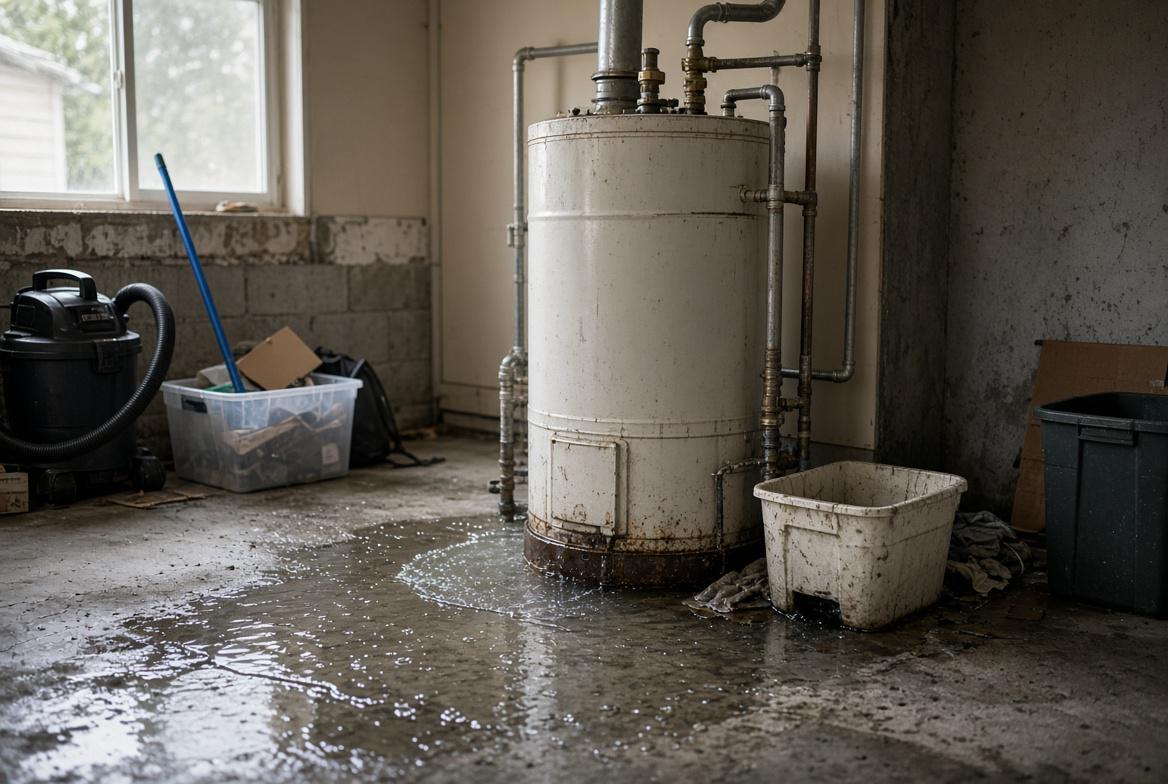
Every tank water heater in every house will eventually fail. This is not a risk to manage, it is a certainty to schedule. The tank is a steel cylinder holding forty to eighty gallons of hot water under municipal pressure, and the thing keeping it intact is a corrosion process that runs on a timer.
What varies is not whether it fails but what happens in the hours after it does. And that outcome is determined almost entirely by two things a homeowner can assess in about five minutes.
The two numbers that decide how bad it gets
How old is it, which sets the probability that failure is near.
Where does it sit, which sets how much damage occurs when the failure comes.
A twelve-year-old tank in a garage near an open door is an inconvenience waiting to happen. A twelve-year-old tank in an attic above finished bedrooms is a five-figure claim waiting to happen. Same tank, same failure, completely different week.
Work out both numbers, then decide what to do about them.
The age number
Tank water heaters last eight to twelve years. Ten is a reasonable planning figure. Past twelve you are running on borrowed time, and the failure probability curve gets steep rather than staying flat.
Finding the age. Most people have no idea how old theirs is, and the installation sticker is usually gone or illegible. The manufacture date is encoded in the serial number on the data plate. Rheem, A.O. Smith, Bradford White, and the rest each use their own format, but every major manufacturer publishes a decoder and there are free lookup tools online. Take a photo of the data plate and spend two minutes on it. If the heater came with the house and the house has not been remodeled, its age is roughly the age of the house or the last major renovation.
Why tanks die, and the part nobody services. The inside of a steel tank is glass-lined, but that lining always has imperfections. Protecting the steel underneath is a sacrificial anode rod, usually magnesium or aluminum, suspended inside the tank. It is designed to corrode preferentially so the tank does not. It works well, and then it runs out.
Once the anode is consumed, corrosion moves to the tank wall. From there it is a matter of time until a seam or the bottom lets go.
Anode rods can be inspected and replaced, typically every three to five years, for a modest cost. Doing so can roughly double the service life of the tank. Almost no homeowner does this, and most plumbers do not bring it up unless asked. If your heater is five or six years old and otherwise healthy, this is the highest-value maintenance available to you.
What shortens the clock in South Florida. Moderately hard water leaves mineral scale on the bottom of the tank, which insulates the burner or element from the water and drives up local metal temperature. Garage installations sit in high ambient heat and humidity, which works on the exterior shell and fittings. Coastal properties add salt to that. And supply pressure above roughly 80 psi stresses the tank and its connections continuously, which a simple pressure gauge on a hose bib will tell you in a minute.
The location number
Walk to your water heater and answer four questions.
What is directly beneath and around it? Garage slab near a door is the best case, because water runs out and the damage is limited to whatever was stored on the floor. A ground-floor interior closet is moderate: contained, but adjacent flooring and drywall are in the path. A second-floor closet or a unit sitting above finished living space is bad. An attic installation, which is common in some Florida construction, is the worst case, because the water travels down through ceilings into every room below.
Is there a drain pan? Look under the tank.
If there is a pan, is it plumbed to a drain? This is the question that matters, and the answer is frequently no. An unplumbed pan holds perhaps two or three gallons. Against a fifty-gallon tank emptying itself, followed by a supply line that keeps feeding the failure, a pan with nowhere to send the water is decorative. Trace the pan fitting and see whether a line actually runs from it to a floor drain or to the exterior.
Where is the cold water shutoff, and does it turn? There should be a valve on the cold inlet at the top of the tank. Find it now. Try it now. Old gate valves seize, and discovering that while standing in an inch of water is the wrong time.
Those four answers tell you your exposure. A homeowner with an aging tank in a bad location and no functioning pan drain has a different situation from one with the same tank in a garage, and should act differently.
What the tank tells you before it goes
Some failures give warning. Not all of them do, which is why the two numbers above matter more than symptom-watching, but these are worth knowing.
Rusty or discolored hot water, particularly if cold water runs clear, points to corrosion inside the tank.
Rumbling or popping during a heating cycle means a sediment layer has built up on the bottom and water is flashing to steam underneath it. Sediment accelerates tank wear and reduces efficiency.
Any moisture at the base. A faint ring, a damp spot, mineral staining on the pan or slab. Small seeps often precede larger failures, and a seep at the tank bottom is not a fitting you can tighten.
Visible rust at the seams, at the fittings, or around the base ring.
Less hot water than the tank used to deliver, or longer recovery between showers. Both suggest sediment accumulation or element and burner degradation.
The temperature and pressure relief valve discharging. The T&P valve is a safety device that opens if the tank exceeds safe temperature or pressure. If it is releasing water, either the tank is running too hot or too high pressure, or the valve itself is failing. Both warrant a plumber. This valve should be tested annually, and a stuck T&P on an overheating tank is one of the few genuinely dangerous failure modes in a house.
A metallic taste or smell in hot water only.
The failure nobody is home for
Here is why this particular appliance produces such disproportionate losses.
A slow seep announces itself. A bottom seam rupture does not. It opens, the tank empties in a few minutes, and then the cold water supply keeps feeding the opening at whatever rate the line and the breach allow. Residential supply lines commonly deliver several gallons per minute.
Run the arithmetic conservatively. At even a few gallons per minute, an eight-hour workday puts well over a thousand gallons into the house. A weekend away is several times that. A week-long trip, or a snowbird property sitting empty through the summer, is a different category of loss entirely.
Water at that volume does not stay in the room. It finds the path of least resistance, spreads under flooring, wicks into wall bases and up into drywall, and in a multi-story or attic installation, comes down through ceilings. By the time anyone opens the door, the mold clock has been running for a while. Our emergency mold guide covers what that 24 to 48 hour window means, and the restoration cost guide covers what the resulting scope runs.
On insurance, briefly: a sudden tank rupture is typically treated as sudden and accidental damage, though the failed appliance itself is generally not covered. Slow seepage over an extended period is a different matter and runs into the same exclusions that catch slab leaks, which our slab leak guide covers in detail.
The first ten minutes
Shut off the cold water supply to the heater. The valve at the cold inlet on top. If it will not turn or you cannot find it, go to the main shutoff for the house.
Cut the energy source. For an electric heater, the breaker. For gas, the gas control valve on the unit. Do not reach for a breaker panel while standing in water; if the panel is in the flooded area, leave it and call an electrician or the utility.
Do not open the drain valve or T&P valve to relieve the tank unless you know what you are doing. On a hot tank this is a scalding risk.
Move what you can out of the water path. Boxes, stored contents, anything absorbent.
Photograph everything before you start cleaning. Wide shots and close shots, with the water still present.
Call for mitigation, then your carrier. Extraction and drying started the same day is the difference between a contained loss and a mold remediation project. Our restoration timeline guide covers what follows.
What actually reduces the risk
Ranked by how much they change the outcome.
Automatic leak detection with an auto-shutoff valve. This is the intervention that matters most, and it is underused. A sensor at the base of the heater detects water and closes a motorized valve on the supply, usually within seconds. Point-of-appliance units are inexpensive. Whole-home smart shutoff valves that monitor flow on the main cost more installed but protect against every plumbing failure in the house, not just this one. Either converts the nobody-home scenario from a catastrophe into a puddle.
A drain pan plumbed to an actual drain. If you have a pan with no drain line, adding one is straightforward for a plumber and is the difference between the pan doing something and doing nothing.
Proactive replacement at year ten to twelve. Replacing a functioning heater feels wasteful right up until the alternative arrives. If the unit sits anywhere above or adjacent to finished space, replace on schedule rather than on failure.
Anode rod inspection every three to five years. The cheapest way to extend tank life significantly.
Annual flush to clear sediment, and an annual T&P valve test.
A pressure regulator if your supply pressure runs above 80 psi, and an expansion tank if you are on a closed system.
If you do one thing after reading this, find the data plate, decode the age, and look at what is underneath the tank. Those two facts tell you whether this is a problem for this year or a problem for later, and almost nobody knows either one about their own house.
AdvantaClean of Fort Lauderdale provides emergency extraction, structural drying, and water damage restoration across Broward County for exactly this kind of failure, including the ones discovered hours or days after they started. To reach the local team, call (754) 218-8070 or visit our page here.