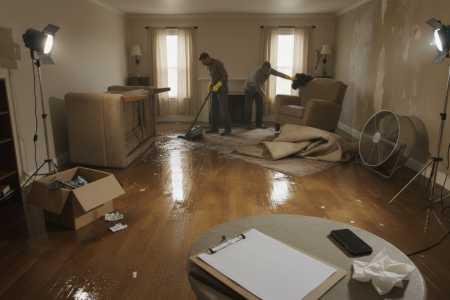
A water emergency in a single-family home is stressful. A water emergency in a condo is stressful and bureaucratic. The first hours matter just as much, but the people you have to coordinate with grow from one (your insurer) to four or five (your insurer, the association or property manager, the association's master policy carrier, possibly the unit owner above you and their insurer). Acting fast still matters more than anything else, but acting fast and documenting cleanly is what protects you from getting stuck holding a bill that should not have been yours.
This guide walks through the first 60 minutes, the first 24 hours, who is legally responsible for what under Florida law, and how to handle the most common water sources in Fort Lauderdale condo buildings.
Why condo water damage is different from a single-family home
Three structural differences change everything about how a condo water emergency plays out.
Responsibility is split by statute. Under Florida Statute 718.111(11), the association is generally responsible for insuring the building "as originally installed," and unit owners are responsible for everything inside the unit that counts as personal property, finishes, or owner improvements. The line between those two categories is where almost all condo water damage disputes start.
Insurance is layered. The association carries a master policy on the building. You should carry an HO-6 condo policy on your interior and personal property. The unit owner above you should carry their own HO-6. If a tenant is involved, renter's insurance enters the picture. A single water event can trigger claims against two or three separate policies.
There are approval and notification requirements. Most condo declarations require unit owners to notify the association of any damage that affects (or may affect) common elements or other units. Some buildings require pre-approved vendors for any work. Ignoring these requirements can complicate reimbursement later, even when the emergency response itself was justified.
The good news is that Florida law explicitly recognizes a homeowner's duty to mitigate. You do not need to wait for board approval before starting emergency water extraction. You do need to notify in parallel.
The first 60 minutes: what to do immediately
Order matters here. Do these in sequence.
-
Shut off the water source if you can do it safely. The unit's main shutoff is usually in a utility closet, near the water heater, or on the supply line for the failed fixture. If the source is in another unit or in a common wall, you may need building maintenance to shut off a riser.
-
Document before you move anything. Photos and video of the water source, standing water, affected walls and flooring, contents, and any visible damage. Wide shots and tight shots. Timestamps matter for both your insurance and any later dispute with the association or another unit owner.
-
Notify the property manager or association in writing. Email or the building's resident portal is fine. The point is creating a written record with a timestamp. State the time you discovered the water, what you have done so far, and that you are starting emergency mitigation.
-
Call your HO-6 insurance carrier. Open the claim. Get a claim number. Ask whether they have preferred vendor relationships.
-
Call a 24/7 mitigation company. Same standards apply as for any water emergency: Florida DBPR mold license, IICRC certifications, true 24/7 dispatch with an under-two-hour ETA in Broward.
-
If standing water is significant, move contents. Furniture legs sitting in water transfer moisture and stain. Books, documents, and electronics need to come up off the floor immediately.
For more on the broader water damage response checklist, see our emergency mold removal guide, which covers the 48-hour mold growth window in detail.
The first 24 hours: notifications, claims, and documentation
Once the immediate response is underway, the next priorities are paperwork and identifying the source.
Notify everyone with skin in the game, in writing. Beyond the association, this includes:
-
Your HO-6 carrier (formal claim open)
-
The upstairs unit owner if the water is coming from above
-
Your mortgage holder if your loan documents require it
-
Your landlord and renter's insurance if you are a tenant
Identify the water source as specifically as you can. This is the single most important determinant of who pays. Was it your dishwasher supply line? A pinhole leak in a common riser inside the wall? The upstairs neighbor's bathtub overflow? A roof failure during a storm? Each answer routes the claim to a different party. If the source is unclear, request that the association investigate immediately and put that request in writing.
Build a documentation file. What goes in it:
-
Time-stamped photos and video from before any mitigation began
-
Your written notification to the association and the timestamped acknowledgment
-
The claim number from your HO-6 carrier
-
Receipts for any out-of-pocket emergency expenses (fans, hotel if displaced, contractor invoices)
-
The mitigation company's initial assessment and moisture readings
-
Any communication with the upstairs owner or their representative
-
The association's response (or lack thereof) to your investigation request
Do not throw anything out yet. Damaged materials sometimes need to be inspected by an adjuster before disposal. Take photos of everything before it goes into a contractor's debris pile.
Who is responsible for what under Florida Statute 718.111(11)
The general framework, with the caveat that your specific declaration of condominium may modify this:
The association is generally responsible for:
-
The building structure and common elements
-
Exterior walls, roof, foundation
-
Plumbing, electrical, and HVAC inside common element walls (not the parts that serve only your unit)
-
The drywall in interior walls, in many readings of the statute, as part of "originally installed" condition
-
The master policy deductible (often, unless the association has formally voted to opt out under 718.111(11)(k))
The unit owner is generally responsible for:
-
All personal property inside the unit
-
Floor coverings (carpet, tile, hardwood)
-
Wall coverings (paint, wallpaper)
-
Ceiling coverings
-
Electrical fixtures, light fixtures
-
Appliances, including water heaters
-
The HVAC unit that serves only your unit
-
Window treatments
-
Cabinetry installed by the owner
-
Any improvements or upgrades made after original construction
The "original installation" line is where most disputes happen. A bathroom that was renovated by a prior owner with upgraded tile and a new vanity will be treated differently than an unrenovated original bathroom from the same building. Keep records of any renovations you do; if a water event damages them, you may need to prove what was original versus what you upgraded.
Liability between unit owners is negligence-based. This is important and often misunderstood. If the upstairs unit's water heater fails and floods you, the upstairs owner is not automatically liable just because the water came from their unit. Florida's Fourth District Court of Appeal confirmed in Universal Property & Casualty Insurance Co. v. Loftus (2019) that Section 718.111(11)(j) does not create an automatic right of action against another unit owner. You (or your insurer through subrogation) generally have to prove negligence: that the upstairs owner knew or should have known about the problem and failed to act.
This is one reason your HO-6 policy matters so much. Your insurer pays you for your covered damage and then handles the subrogation fight on your behalf.
Common Fort Lauderdale condo water sources and who is typically on the hook
These are the recurring scenarios across Broward County buildings:
Burst supply line under your sink or behind your toilet: Generally your responsibility. Your HO-6 covers the interior damage up to its limits; the line itself is yours.
Failed water heater in your unit: Generally your responsibility, including damage to units below. Maintain your water heater and replace it before end of life.
Air conditioning condensate overflow: Generally your responsibility if it is your AC unit. If it is a chiller system serving multiple units, look at the declaration.
Roof leak after a storm: Generally the association's responsibility for the roof itself and the resulting common element damage. Your interior finishes are still your HO-6 claim, which the association's policy or the upstairs owner's policy may have to reimburse depending on the source.
Common plumbing in a shared wall: Generally the association's responsibility, including damage caused to your unit, but the interior repairs may run through your HO-6 first with subrogation against the master policy.
Upstairs unit's plumbing or appliance failure: Liability depends on negligence. File on your own HO-6 first; your insurer pursues subrogation against the upstairs owner's policy.
Hurricane wind-driven rain through windows or sliders: Depends on whether windows are designated common elements in your declaration. In many newer Fort Lauderdale buildings, exterior windows and sliders are association responsibility; in older buildings, often the unit owner's responsibility.
Sprinkler discharge: Almost always the association's responsibility if the system itself failed; an owner's responsibility if their negligence triggered it.
In every case, the practical answer for the homeowner is the same in the first 24 hours: open your HO-6 claim, document everything, notify the association, and let the insurance carriers fight about subrogation later.
Insurance coordination: master policy, HO-6, and subrogation
A few realities to plan around.
Deductibles are often high. HO-6 deductibles of $2,500 to $10,000 are common in Florida. Hurricane deductibles can run higher, calculated as a percentage of the dwelling limit. Master policy deductibles can be $25,000 or more for large buildings. Whoever ends up paying the deductible will be hunting for reimbursement somewhere.
Mold sublimits apply the same way as in single-family homes. Most Florida HO-6 policies cap mold remediation at $5,000 to $10,000 unless you bought a mold endorsement. After a water event, mold growth in 48 to 72 hours is the realistic expectation, especially in coastal humidity, which makes prompt drying critical to staying within the sublimit.
Loss assessment coverage matters. Most HO-6 policies include some loss assessment coverage that pays your share of a special assessment levied by the association after a covered loss. Check your declarations page. Common defaults are $1,000 to $2,000, which can be raised.
The subrogation timeline is long. Even when liability is eventually assigned correctly, the subrogation fight between insurance carriers can take months or years to resolve. This does not affect your repairs (those run on your HO-6 timeline), but it does affect when and whether deductibles get reimbursed.
For more on how the restoration phases sequence in time, see our Fort Lauderdale water damage timeline guide.
When to escalate
Most condo water damage events resolve through the standard insurance and mitigation process. Some do not. Consider escalating when:
-
The association is unresponsive after multiple written requests to investigate a suspected common-element source
-
Your HO-6 carrier denies a claim you believe is covered
-
The water source is being disputed between you, the upstairs owner, and the association, and no one is moving the investigation forward
-
Mold remediation costs exceed your sublimit and the source points to a party with insurance that should respond
-
The association levies a special assessment you believe is improper or beyond its authority
A licensed public adjuster can help with insurance disputes; a real estate or community association attorney can help with disputes between you and the association or another unit owner. Florida's Department of Business and Professional Regulation also handles consumer complaints about associations through the Division of Florida Condominiums, Timeshares, and Mobile Homes.
Standard caveat: nothing here is legal advice, and your building's declaration and bylaws may modify the general framework above in important ways. Always read the declaration when you buy, and call an attorney for disputes that involve real money.
Getting help
AdvantaClean of Fort Lauderdale provides 24/7 water damage restoration for condominiums across Broward County, including downtown Fort Lauderdale, beachfront and intracoastal buildings, Pompano Beach, Plantation, and Deerfield Beach. We work directly with HO-6 carriers, can coordinate with property management and the association, and can document the loss in the way that insurance adjusters and association boards expect to see it.
For immediate response, call (754) 218-8070 or visit our local team page.