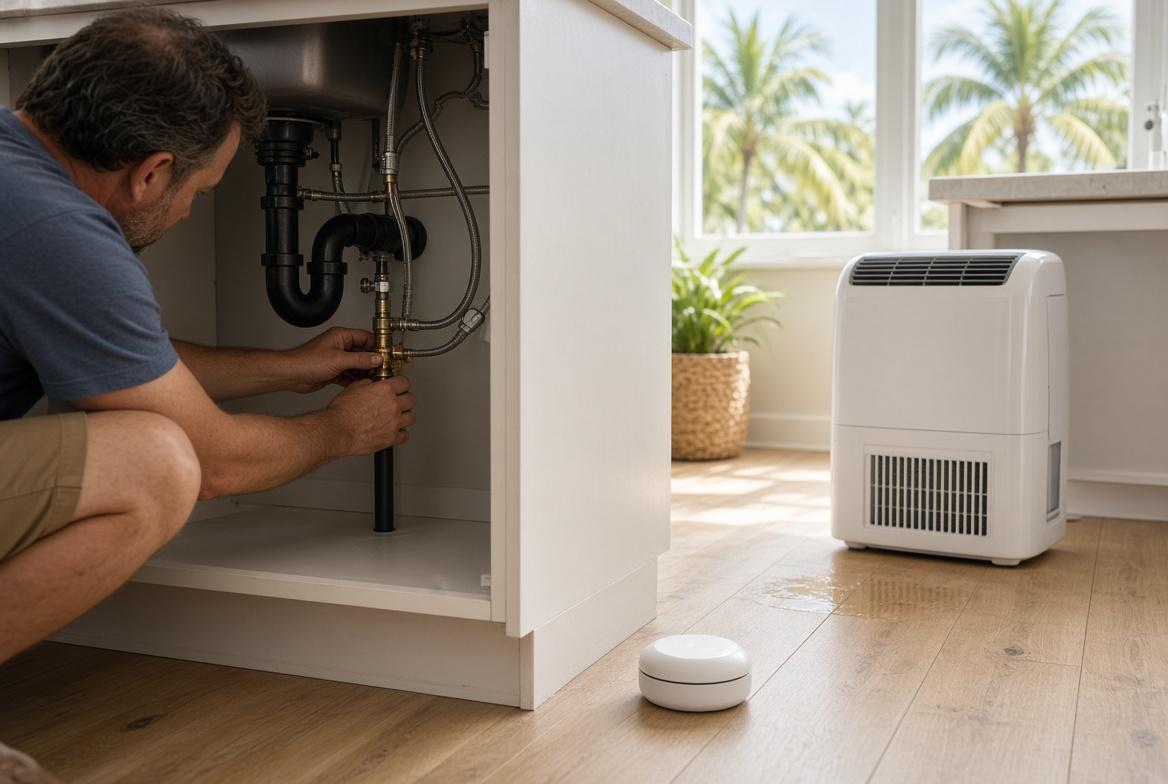
A supply line that fails while you are home is a bad afternoon. The same line failing the day after you leave for two weeks is a different category of event entirely, because nothing stops it. Residential plumbing delivers several gallons a minute, and nobody is there to notice for fourteen days.
This is among the most preventable losses in a house, and most of the prevention takes under an hour before you leave.
First, calibrate to how long you are gone
The right answer differs by trip length, and treating a long weekend like a three-month absence leads people to skip the whole thing.
Under a week. Shut off the washing machine and ice maker supplies, set the thermostat properly, and have someone look in once. The main shutoff is optional.
One to three weeks. Shut the main if your setup allows it, set the water heater to vacation mode, and arrange a weekly check.
A month or more, including seasonal absence. All of the above, plus active humidity management, remote monitoring, and a scheduled check with someone who knows what to look at. At this length, also confirm your insurance position, since some policies contain vacancy or unoccupancy provisions that can restrict coverage after an extended period with nobody living in the home. Thirty and sixty days are common thresholds. Worth a call to your agent rather than an assumption. Our guide to returning after a closed-up season covers the other half of that scenario.
Main water valve: shut it off or not, and what that means for irrigation and ice makers
For any trip longer than a few days, shutting the main is the single most effective thing you can do. No water in the lines means no supply-side failure can flood the house, regardless of what fails.
Three things to understand before you do it.
Irrigation is usually on a separate line. In most Florida homes the irrigation system taps in upstream of the house shutoff, often directly off the meter or from a dedicated well. That means closing the house main typically leaves your sprinklers running normally. Verify this rather than assuming it in either direction: if irrigation is downstream of your main, closing it kills the system and your landscaping, and if it is upstream, an irrigation failure can still flood the exterior while you are away.
The ice maker needs separate attention. With the main closed, the refrigerator will try to run a fill cycle, find no water, and keep trying. Shut the ice maker off at its own valve or turn the feature off at the appliance. This also prevents the classic failure where a brittle quarter-inch plastic supply line lets go after the water comes back on.
Fire sprinklers must stay pressurized. If you are in a condominium or a home with a residential sprinkler system, that line is not optional and is usually separate. Do not interfere with it.
Also handle the water heater. With the main off, set the heater to vacation or pilot mode, or switch off its breaker. An electric element that energizes in a tank that has partially drained will burn out.
If you cannot shut the main, close individual appliance valves instead: washing machine, dishwasher, ice maker, and the angle stops under each toilet and sink. Less complete, considerably better than nothing.
Whatever you do, find the main shutoff before you need it and confirm it actually turns. Old gate valves seize, and discovering that an hour before a flight is not useful.
The three appliances most likely to fail in an empty house
Insurance claims data consistently points at the same short list.
Washing machine supply hoses. The standard rubber hoses supplied with most machines degrade from the inside, and they fail at full line pressure. They are the most common single cause of appliance-related water loss in homes. Braided stainless steel hoses cost very little and largely solve it. Replace them on a schedule regardless of appearance, and close the valves behind the machine whenever you leave.
The water heater. A tank is forty to eighty gallons under constant pressure, with a service life of eight to twelve years and a failure mode that can be a slow seep or a bottom seam letting go all at once. In an empty house the second one runs unchecked for the length of your trip. Our water heater failure guide covers how to assess yours and what a drain pan does and does not accomplish.
The refrigerator ice maker line. Usually a quarter-inch plastic tube running behind and under the unit, frequently kinked during installation or when the fridge was last moved. It is small, out of sight, and positioned to soak the floor and subfloor for as long as it takes someone to notice.
Two more worth closing off: the dishwasher, whose supply connection and door seal both fail quietly, and toilet supply lines and fill valves, where a failed fill valve can run continuously.
Leak sensors and smart shutoff valves: what they catch and what they miss
This technology is the best value available for the problem, provided you understand what each type actually does.
Point sensors are inexpensive pucks placed where water would appear: behind the washing machine, under the water heater, beneath each sink, near the dishwasher. They alert your phone when they get wet. They catch what they are sitting next to and nothing else, and they alert rather than act, so an alert while you are abroad still needs someone local to respond.
Whole-home smart shutoff valves install on the main and monitor flow. They detect anomalous patterns, such as continuous flow where there should be none, and close the valve automatically. This is the one that converts a two-week flood into a two-gallon puddle, and it protects against failures anywhere in the system rather than only where you placed a sensor. Cost is higher and installation usually needs a plumber.
What both miss: roof leaks, window intrusion, and anything that is not supply plumbing. Slow seepage below the detection threshold. Drain-side failures and sewer backup, which do not register as supply flow. And anything at all if the power or internet is out, which in Florida means storm season, so battery backup and cellular fallback are worth paying for.
What makes them work: alerts routed to more than one person, including someone local who can act, and testing before you leave rather than trusting that the app still has your current phone number.
Thermostat and humidity settings for a closed Florida home
Turning the air conditioning off is the single most expensive money-saving decision available to a Florida homeowner.
A closed house with no cooling in this climate reaches 85 percent relative humidity and higher. The EPA recommends staying below 60 percent to limit mold growth, and above that threshold the house grows mold on anything organic: drywall paper, wood, leather, fabric, dust.
The target is humidity, not temperature. Aim to hold indoor relative humidity below 60 percent, ideally in the 50 to 55 range.
Best option: a thermostat that can call for cooling based on a humidity setpoint rather than temperature alone. Several smart thermostats do this. Set an RH ceiling and the system runs to meet it.
Also good: a dehumidifier, either whole-home and ducted or a standalone unit with a hose run to a permanent drain so it does not depend on anyone emptying a reservoir.
Workable: a conventional thermostat set somewhere between 77 and 80. That produces enough runtime in most Florida houses to dehumidify. Setting it to 85 to save money means the system barely cycles, which leaves the house warm and wet instead of cool and wet.
Regardless of method, monitor remotely. A smart thermostat or a standalone temperature and humidity sensor reporting to your phone, with alerts configured, is what turns a setting into a safeguard. An air conditioning failure in week one of a three-week trip is recoverable if you know about it and a remediation project if you do not.
Service the system and change the filter before a long absence, with particular attention to the condensate drain line. A clogged condensate line overflowing into a ceiling is one of the most common ways an empty Florida house floods itself without any plumbing failure at all. Our summer humidity guide covers why the margins are so much tighter here than elsewhere.
Who should check on the house, and what they should look for
A checker who does not know what to look at provides reassurance rather than protection.
Who. A neighbor, a friend, a family member, a property manager, or a paid home-watch service. For absences over a month, a paid service with documented visits is worth the cost, and some insurers look favorably on it. Whoever it is, they need a key or code, your contact details, the location of the main shutoff, and permission to call a plumber without reaching you first.
How often. Weekly for most absences. Twice weekly for a month or more, and immediately after any significant storm.
What they should actually check, which is worth sending them in writing:
Walk every room and look at ceilings for new staining, particularly below bathrooms and below the air handler.
Stand inside the front door and note the smell on entry, before adapting to it.
Look under every sink and behind every toilet.
Check the floor around the water heater and look at its pan.
Check behind and under the washing machine and the refrigerator.
Confirm the air conditioning is running and the air is cold, and read the thermostat for temperature and humidity.
Look at the condensate drain pan and the area below the air handler.
Check the breaker panel for anything tripped.
Walk the exterior for irrigation leaks, pooling water near the foundation, and anything visibly wrong with the roof.
Confirm the refrigerator is cold and no water is pooling beneath it.
Give them one instruction above all the others: if they find water, shut off the main first and call you second.
The departure checklist
Condensed, in the order worth doing it.
Close the washing machine and ice maker supply valves. Shut the main if your setup allows, after confirming what irrigation and any sprinkler system are connected to. Set the water heater to vacation mode or kill its breaker. Set the thermostat to hold humidity under 60 percent, or run a dehumidifier draining to a permanent line. Service the air conditioning and change the filter. Test your leak sensors and confirm alerts reach a phone someone will be looking at. Photograph the house interior for insurance purposes. Brief your checker in writing and show them the main shutoff. For absences over a month, call your agent about any vacancy provisions in your policy.
If something does fail while you are away, speed is what determines cost. Our water damage cost guide covers how a loss reprices itself the longer it sits, and our emergency mold guide covers the window before a water problem becomes a mold problem.
AdvantaClean of Fort Lauderdale provides 24/7 water damage restoration across Broward County, including losses discovered days or weeks after they began. Call (754) 218-8070 or reach the local team here.