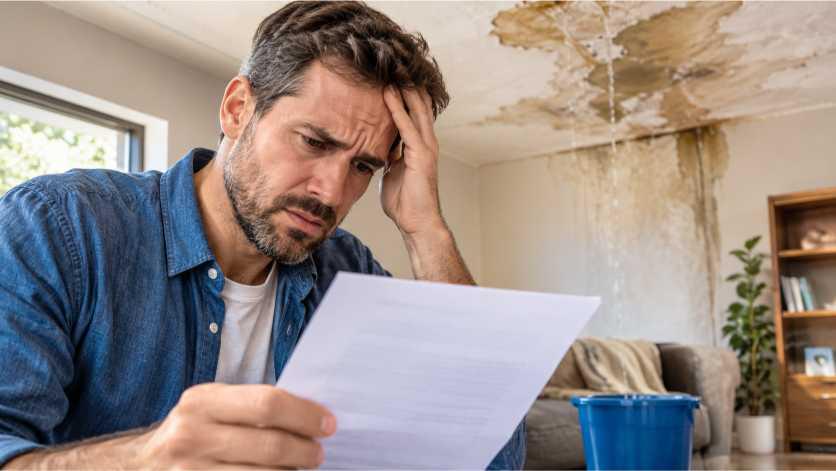
A denial letter is not the end of a claim. In Florida it is the start of a defined process with several routes short of litigation, and a meaningful share of denials get reversed or substantially increased when the policyholder produces evidence the insurer did not have.
What decides the outcome is usually documentation rather than argument.
Why do insurers deny water damage claims in Florida?
Most Florida water damage denials come down to one of a handful of reasons, and the dominant one by far is the insurer concluding the damage happened gradually rather than suddenly. Standard policies cover sudden and accidental water damage and exclude deterioration, seepage, and maintenance failures, so the entire dispute often turns on how long the water was present.
The common grounds, roughly in order of how often they appear:
|
Denial reason |
What the insurer is asserting |
|
Wear and tear, deterioration |
The component failed from age rather than an accident |
|
Long-term leak or continuous seepage |
Water was present over an extended period, commonly 14 days or more |
|
Lack of maintenance |
A reasonable owner would have caught and fixed this |
|
Late notice |
Reported too long after the loss, under the policy or the statute |
|
Flood exclusion |
The water was rising ground water or surge, which needs NFIP coverage |
|
Mold sublimit reached |
The water may be covered, but mold remediation is capped separately |
|
Pre-existing damage |
The condition predated the policy or the claimed event |
|
Insufficient documentation |
The insurer says there is not enough evidence to establish cause or scope |
|
Failure to mitigate |
The owner did not act to prevent further damage after discovering it |
|
Policy exclusion or sublimit |
Plumbing water damage sublimits, often around $10,000, are common in post-2022 Florida forms |
Two observations about that list.
The first is that several of these are conclusions rather than facts, and conclusions can be rebutted with evidence. "Long-term leak" is an opinion about timing, and timing can be documented.
The second is that a denial can be partially wrong. Insurers sometimes deny the whole claim when the correct outcome was reduced payment, or apply a sublimit that does not fit the loss. Reading the letter closely against your own policy language is the first step, and you are entitled to that letter in writing. Florida Statute 627.7142, the Homeowner Claims Bill of Rights, gives policyholders the right to a written explanation of a claim decision.
What does "long-term leak" or "wear and tear" mean in a denial letter?
Both phrases mean the insurer has concluded the damage developed over time rather than from a sudden event, which moves it from a covered peril into an excluded one. Many Florida policies make this explicit with language excluding constant or repeated seepage continuing over a period of 14 days or more.
This is the crux of most water damage disputes, and it is worth understanding why it is so common.
A great deal of residential water damage genuinely is gradual. A slab leak runs for months before anyone notices. A roof detail lets go in a storm and the ceiling stain appears the following spring. A supply line weeps behind a cabinet. In each case the homeowner discovered it suddenly, but the water was not sudden, and the policy distinguishes between those two things even though the experience does not.
Insurers also apply the label where it does not fit, because the evidence that distinguishes a two-day leak from a two-month leak is technical and the homeowner usually does not have it.
Three things typically determine which way this goes.
The condition of the failed component. A supply line that burst cleanly looks different from one that corroded through over years, and photographs of the actual failure are persuasive.
Moisture distribution in the surrounding materials. How far water has travelled, how saturated the substrate is, and whether there is staining with multiple wetting and drying cycles all speak to duration.
Whether there is biological growth, and how established it is. Mold tells you water has been there longer than 48 hours. The extent of it tells you considerably more.
Note that a related exclusion can apply even to a sudden event. Some policies exclude damage from a sudden failure if the resulting water was allowed to sit, which is why mitigating promptly matters for coverage and not only for the repair bill. Our slab leak guide covers the scenario where this exclusion most often bites.
How long do you have to dispute a denied claim?
Less time than most people assume, and the clocks generally run from the date of loss rather than from the date of the denial. That distinction catches people, because a denial issued ten months after a loss leaves far less time than it appears to.
Three separate deadlines matter and they are frequently confused.
Notice deadlines come first. Under Florida Statute 627.70132, a claim arising from a hurricane or windstorm must be reported within one year of the date of loss, with 18 months for a supplemental claim on a timely-filed claim. Our hurricane claim deadline guide covers that framework and the trap in the difference between supplemental and reopened claims.
The deadline to file suit is separate, and it is short. Florida has shortened the window for suing on a property insurance contract in recent legislative sessions, and current published sources do not agree on the figure, with both two and five years appearing in material written this year. It runs from the date of loss rather than the denial. Because the answer depends on your policy period and the type of claim, and because getting it wrong ends the matter permanently, this is one to confirm with an attorney rather than with an article. Do it early.
Pre-suit notice is a third requirement. Under Florida Statute 627.70152, before filing suit on most property insurance claims you must serve written notice through the Department of Financial Services portal at least 10 business days beforehand, identifying the disputed amount and making a settlement demand. Skipping this step gets a lawsuit dismissed regardless of its merits.
The practical implication is to start the appeal process immediately rather than treating the denial as something to deal with eventually.
Can a restoration company's moisture report help your appeal?
Yes, and against a gradual-damage denial it is often the single most useful document you can produce. Moisture meter readings, thermal imaging, and dated photographs from a qualified restoration contractor provide the technical evidence that distinguishes a sudden failure from months of seepage, which is exactly the question the denial turns on.
What makes this evidence effective is that it addresses the insurer's reasoning directly rather than disputing the conclusion.
A thorough report typically contains moisture content readings across affected and unaffected reference materials, which establishes the extent of migration. Thermal imaging showing the pattern of moisture behind surfaces. Time-stamped photographs of the failed component itself, which is often the most persuasive single item. Documentation of what was done to mitigate and when. And a professional assessment of the mechanism of failure.
A few practical points on using it.
Earlier is better. A moisture assessment performed in the first days after discovery carries far more weight than one performed after the denial, because it captures conditions before anything was dried or repaired. If you are reading this before filing rather than after being denied, get the assessment now.
Independence helps. A report from a licensed assessor who is not performing the remediation carries weight precisely because the author has nothing to sell on the repair side. For mold specifically, Florida law generally requires that separation anyway.
Keep the failed component. Do not let anyone discard the section of pipe, the failed hose, or the water heater. It is physical evidence of the failure mode.
Independent reports are also what support an appeal that asks the insurer to reconsider rather than simply disagreeing with them. An appeal consisting of new technical evidence is a different proposition from an appeal consisting of a letter saying you think they are wrong.
Our water damage cost guide covers what documentation an estimate should contain, and for condominium losses our condo responsibility guide covers the additional question of which policy should be responding in the first place.
When is it worth hiring a public adjuster or attorney?
It depends on the size of the claim and on which part of it is disputed, and the calculus changed in Florida in March 2023. HB 837 repealed the one-way attorney fee statute that previously let a policyholder recover legal fees from the insurer after winning. Advice written before that date assumed litigation was close to free for the policyholder, and that is no longer generally true.
Here is how the options compare now.
Free routes worth exhausting first. The Department of Financial Services offers free mediation for most residential property claim disputes under Florida Statute 627.7015, which is non-binding, relatively quick, and resolves a substantial number of disputes. A DFS complaint is also free and prompts regulatory attention, though it does not pause any deadline.
Appraisal, if your policy includes it. This is a binding process for resolving disputes over the amount of loss. The important limitation is that appraisal resolves how much, not whether. If your claim was denied on coverage grounds rather than valuation, appraisal generally cannot fix it.
A public adjuster. These are licensed professionals who represent policyholders rather than insurers, and they re-scope the loss and negotiate. Florida caps their fees under Statute 626.854, generally at 20 percent for ordinary claims and 10 percent for claims arising from a declared emergency within the first year. A public adjuster makes most sense on a sizeable claim that was underpaid or where the scope is disputed, rather than on a flat coverage denial.
A civil remedy notice under Florida Statute 624.155. This filing gives the insurer a 60-day window to cure and opens the door to bad faith exposure if they do not. It carries real weight with a carrier and is normally filed with counsel.
An attorney. Still the right answer for a coverage denial on a substantial claim, for suspected bad faith, or where pre-suit notice and litigation are in prospect. But get the fee arrangement in writing and understand it, because post-HB 837 the economics are different and contingency terms vary. On a small claim, legal costs can now consume a meaningful portion of any recovery, which was less true before 2023.
A rough rule: free routes first, public adjuster for disputed scope or underpayment, attorney for coverage denials and bad faith, and confirm your filing deadline before you spend time on any of it.
What to do with a denial letter
Read it against your policy and identify exactly which exclusion is being invoked, then build evidence that addresses that specific point rather than the denial in general. If the grounds are wear and tear or a long-term leak, the evidence you need is technical: moisture readings, thermal imaging, dated photographs, and the failed component itself. Get your filing deadline confirmed by an attorney early, because it probably runs from the date of loss and it is shorter than you expect.
If you have been denied on gradual-damage grounds, or you are in the middle of a loss and want the documentation done properly before anyone argues about timing, an assessment now is worth more than an argument later.
AdvantaClean of Fort Lauderdale provides moisture assessment, documented thermal imaging, and water damage restoration across Broward County, in the form adjusters expect to see. Call (754) 218-8070 or reach the local team here to have your loss documented properly.
This article is general information about Florida insurance claims, not legal advice. Deadlines and remedies depend on your policy and the type of claim, and Florida's property insurance statutes have been amended repeatedly in recent years. Consult a Florida attorney or licensed public adjuster about your specific situation.