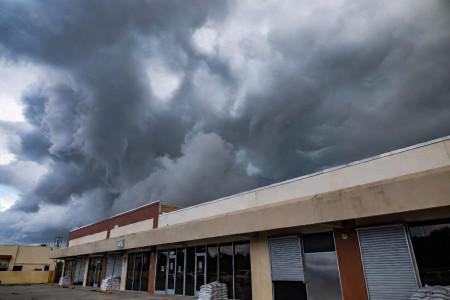
For South Florida businesses, the difference between a tropical storm that costs a week of revenue and one that closes the doors for months usually comes down to what happened before the storm made landfall. The preparation work is not glamorous, and most of it belongs in April and May, before the National Hurricane Center starts naming storms. But it is the single highest-return investment a business owner in Broward, Miami-Dade, or Palm Beach County makes each year.
This guide covers the storm damage claims South Florida businesses actually file most often, the pre-storm checklist that meaningfully reduces those risks, how to protect inventory and business-critical records, what to do in the first 24 hours after a storm, the Florida claim deadlines that changed in 2023 and that most owners still do not know about, and why a commercial restoration partner on call is a business continuity decision rather than a marketing preference.
The most common storm damage claims South Florida businesses face
Commercial carriers see the same claim patterns after almost every named storm. Knowing what they are tells you where to spend the preparation budget.
Roof damage. By a wide margin the most common commercial claim category. Tile displacement, membrane tears and seam separations on flat roofs, uplift damage on shingle roofs, and flashing failures around HVAC penetrations and roof drains. Even Category 1 winds (74–95 mph) will lift compromised roofing material — and on a flat commercial roof, the failure almost always starts at a detail, not in the field of the membrane.
Wind-driven rain intrusion. Water forced through window seals, door thresholds, and small envelope gaps even when the structure itself holds. This is the source of most interior water damage claims that are not caused by outright roof failure. Rain driven at 60 mph goes places that rain falling straight down never does.
Window and door breaches. Impact from wind-borne debris, uplift pressure failure, or catastrophic failure of non-impact-rated glazing. Once the envelope is breached, internal pressurization can lift the roof from below — which is why a failed overhead door so often precedes a total roof loss.
Storm surge and flood damage. Coastal properties and low-lying areas in Fort Lauderdale, Hollywood, Dania Beach, Deerfield Beach, and along the Intracoastal are exposed. Standard commercial property policies do not cover flood. A separate NFIP commercial policy or excess flood policy is required.
Signage, awning, and exterior fixture damage. Retractable awnings, freestanding signs, canopy structures, exterior lighting, and site amenities are frequently torn loose or destroyed — and then become the debris that damages the building behind them.
Business interruption losses. Often larger than the physical damage itself. A building that comes through with minor damage can still trigger a week or more of forced closure while power, water, and permits are sorted out. Business interruption coverage is a separate line item that a great many businesses under-insure.
Post-storm mold. In a South Florida summer, moisture that gets inside and stays there for 24 to 48 hours starts producing mold. Carriers treat post-storm mold as a resulting loss of the water event, typically with a sublimit — and sublimits are where a manageable claim turns into an out-of-pocket problem.
Utility and equipment damage. Rooftop HVAC units, generators, refrigeration systems, IT infrastructure, and anything else roof-mounted or exterior-connected. On restaurants and grocery, refrigeration loss frequently exceeds the building damage.
A pre-storm checklist for your roof, drainage, and entry points
Most preventable damage traces back to three systems: the roof (keeps water out from above), drainage (moves water away from the building), and entry points (openings that can be breached). Work through each one annually, in April or May.
Roof
Schedule a professional roof inspection before the season starts. Focus on:
-
Loose, cracked, or missing shingles or tiles
-
Membrane condition on flat roofs — blisters, seam separations, punctures, ponding
-
Flashing integrity at HVAC penetrations, roof drains, curbs, and skylights
-
Sealant condition at every roof penetration
-
Loose gutter and downspout attachments
-
Rooftop equipment secured against uplift — units, exhaust hoods, satellite dishes
-
Uplift restraints and curb attachments inspected for corrosion (in a salt-air environment this is a real failure mode, not a formality)
Deferred roof maintenance becomes an insurance question after a storm. Carriers routinely deny or reduce claims when pre-existing roof condition contributed to the loss — and a dated pre-season inspection report is the cheapest rebuttal you will ever buy.
Drainage
Water that cannot leave the property fast enough backs up into the building. Check:
-
Gutters and downspouts clear and functional
-
Parking lot storm drains clear of debris
-
Ditches, swales, and site drainage channels flowing
-
French drains and area drains functional
-
Sump pumps tested — both primary and backup
-
Backflow preventers on sewer lines inspected
-
Roof drains and overflow scuppers clear (on a flat roof, a blocked primary drain plus a blocked overflow is a structural load problem, not just a leak)
For businesses in flood-prone areas, a portable pump or two and a pallet of sandbags kept on site are cheap insurance.
Entry points and building envelope
-
Windows: hurricane shutters deployed, or plywood pre-cut and labeled for each opening
-
Impact-rated glazing certified and maintained — check for cracks and seal failures
-
Exterior doors: weather stripping, threshold seals, deadbolt engagement
-
Garage doors and roll-up doors braced or reinforced for pressure — a failed overhead door is one of the most common causes of catastrophic building failure
-
Skylights and roof hatches secured and sealed
-
Temporary or portable structures (tents, tarps, sheds) removed or fully secured
Site and grounds
-
Trees pruned of dead limbs, especially within 20 feet of the building
-
Loose site items secured or brought inside — dumpsters, patio furniture, planters, pallets
-
Company vehicles moved to sheltered locations or higher ground
-
Fences inspected (chain link survives better than solid privacy fencing, which acts as a sail)
-
Exterior signage taken down where possible; permanent signs reinforced
Most commercial property policies require some level of pre-storm preparation for coverage to apply. Read that section of your policy before it matters.
Protecting inventory, documents, and equipment from water intrusion
Even when the building holds, water often gets in. What is sitting on the floor when it does can be the difference between a manageable loss and a catastrophic one.
Elevate physical inventory. Anything on the floor of a retail space, warehouse, or storage room should come up at least 6 inches on pallets or shelving. In flood-prone locations, 12 inches or more. If the business is in an evacuation zone, move critical inventory to upper floors or interior spaces away from glazing.
Cover with plastic. Six-mil poly draped over inventory, equipment, and open shelving costs almost nothing and prevents dust, debris, and secondary water damage after a roof or window failure. Tape it down where it can move.
Protect documents. Any paper record that cannot easily be recreated — contracts, HR files, tax records, permits, insurance policies, warranties — should be:
-
Digitally scanned and backed up to cloud storage
-
Stored, in original form, in fireproof and water-resistant cabinets
-
Moved off the ground floor for storm events if the property is exposed
-
Kept, in the case of insurance policies and emergency contact lists, both on-site and off-site — so they are reachable when the property is not
Protect IT and electronics. Servers, network equipment, and business-critical electronics are usually the highest value per square foot in the building:
-
Unplug non-essential equipment — surge on restoration kills a lot of electronics that survived the storm itself
-
Cover with plastic
-
Elevate off the floor in server rooms and IT closets
-
Confirm UPS batteries are current
-
Test generator startup and top off fuel
-
Verify cloud backups are current before landfall, not after
Refrigerated inventory. For restaurants, grocery, medical practices, and any business with cold chain requirements:
-
Generator plans for extended outages — tested monthly, not annually
-
Temperature loggers on all refrigeration for insurance documentation (a logger printout is worth more to an adjuster than any amount of testimony)
-
Pre-storm inventory reduction where practical
-
Contingency arrangements with cold storage providers
Employee documentation. Current contact information, payroll records, and benefits information accessible off-site. If the property is inaccessible for weeks, this is what allows payroll to continue.
What to do in the first 24 hours after storm damage
The first day after the storm passes is a compressed sequence of safety checks, documentation, insurance calls, and initial mitigation. The order matters.
-
Wait for the all-clear before entering. Downed power lines, unstable structures, standing water hiding hazards, and gas leaks are the real dangers in the first hours. Local authorities announce when it is safe to move around.
-
Conduct a safety inspection before anyone enters the building. Structural damage, roof integrity, gas odor, standing water near electrical panels. If in doubt, wait for a licensed professional.
-
Photograph and video everything before moving anything. Wide shots of every affected area first, then tight shots of specific damage. Timestamps in the file metadata matter. Do not clean, move, or discard anything until documentation is complete.
-
Turn off utilities if unsafe conditions exist. Water, electricity, and gas shut off in affected areas at any indication of compromise.
-
Notify your carrier immediately. See the deadlines section below — Florida law changed in 2023, and the window is shorter than most owners think. Get a claim number and an assigned adjuster.
-
Call your commercial restoration partner. If you have a Priority Response Agreement in place, this call triggers a pre-negotiated deployment. Without one, you are competing with every other business in three counties for crews.
-
Begin emergency mitigation to prevent further damage. Board up broken glazing, tarp compromised roof sections, extract standing water, stop further ingress. Commercial policies impose a duty to mitigate and will reduce coverage where it was not performed promptly.
-
Communicate with employees. Confirm safety, communicate closure status, set expectations for reopening. Payroll continuity depends on communication continuity.
-
Communicate with customers. Social posts, signage, direct outreach on scheduled appointments and orders.
-
Preserve damaged inventory for inspection. Do not throw damaged goods away without documenting them, even if disposal is imminent. Adjusters need to see the inventory to settle at full value.
The Florida claim deadlines that changed — and that most owners still do not know
This is the section most South Florida business owners have never read, and it is the one most likely to cost them money.
In December 2022, Florida enacted SB 2-A, which rewrote the property claim timelines in both directions — tightening what the carrier must do, and sharply shortening what the policyholder has to do it in.
Your deadline to give notice (this got much shorter)
Under Florida Statute 627.70132:
-
A new or reopened property claim is barred unless notice is given to the insurer within 1 year of the date of loss. It used to be two years.
-
A supplemental claim is barred unless notice is given within 18 months of the date of loss. It used to be three years.
That matters more than it sounds. Storm damage is frequently discovered late — a slow membrane leak that only shows up as a ceiling stain eight months later, or mold behind a wall that no one opened. Under the old two-year rule there was room for that. Under the one-year rule there is not. If you had any storm event in the past twelve months and have not filed, check the date of loss today.
What the carrier owes you, and how fast
Under Florida Statute 627.70131, for a property insurance claim the insurer must:
-
Acknowledge a claim communication within 7 calendar days (formerly 14)
-
Begin a reasonably necessary investigation within 7 days of receiving proof-of-loss statements (formerly 14)
-
Complete any physical inspection of the property within 30 days of receiving proof-of-loss statements
-
Provide the adjuster’s name and state license number, in writing, on the assigned claim
-
Pay or deny the claim, or a portion of it, within 60 days of receiving notice of the claim (formerly 90), with a written explanation of the basis
None of that helps if you filed late. The practical takeaway for a business owner is simple: document before the storm, file immediately after it, and keep every timestamp.
This article describes general statutory timeframes and is not legal advice. Coverage turns on the language of your specific policy. Confirm your position with your broker or counsel.
Why a commercial restoration partner on call reduces downtime
The single biggest determinant of business downtime after a South Florida storm is how fast qualified crews arrive on site. In a normal week, that decision can wait until the damage happens. In storm season, it cannot.
A named storm triggers thousands of simultaneous claims across three counties. Reputable restoration companies book out within hours. Every hour past your own damage event is another hour water spreads, mold starts, and inventory deteriorates. Businesses without a pre-arranged relationship end up on a waiting list behind the ones that have one — and in a 90°F, 75°F-dew-point aftermath, the 24-to-48-hour mold clock does not pause while you wait your turn.
A commercial restoration partnership — sometimes called an Emergency Response Agreement or Priority Response Agreement — typically includes:
-
A guaranteed response window from a specific dispatch priority (often 2 to 4 hours for members)
-
Pre-negotiated rates locked in before demand spikes
-
A pre-visit property assessment, so crews already know the layout, utility shut-offs, priority protection areas, and access limitations before they arrive
-
Integration with the business’s continuity plan
-
Insurance billing familiarity, so the documentation is in a form the adjuster will accept the first time
-
Post-storm mold monitoring built into the response
The cost is typically low; many agreements are structured as no-fee retainers where the business pays only for actual services performed. The value shows up in a single event, when the difference between a 2-hour response and a 3-day response is the difference between reopening in a week and reopening in three months.
For businesses that lease, a partnership does not remove the landlord’s or property manager’s responsibility for the building envelope — but it does mean the interior mitigation, which is the tenant’s obligation under most commercial leases, starts immediately instead of after a two-week argument about who calls whom. For owner-occupied property, the partnership covers both sides.
For a broader look at 24/7 response across Broward and Palm Beach, see our emergency restoration services guide. If you are already dealing with an active loss, our commercial water damage restoration guide walks through the sequence step by step, and our water damage restoration timeline sets realistic expectations for how long each phase takes.
Frequently asked questions
How long do I have to file a hurricane claim in Florida?
One year from the date of loss for a new or reopened claim, and 18 months for a supplemental claim, under Florida Statute 627.70132. Those windows were shortened from two and three years respectively by SB 2-A in December 2022. If you had a storm event in the past year and have not filed, check your date of loss now.
Does business interruption insurance cover a hurricane closure?
Usually only if the closure results from covered physical damage to your property. Standard BI coverage does not pay for lost revenue if the business closed voluntarily, or if only the surrounding area — not your property — sustained damage. Some policies add Civil Authority coverage that pays when authorities restrict access to an undamaged property. Read the policy or ask your broker; the distinction decides a lot of money.
What is the difference between wind damage and flood damage on a Florida commercial policy?
Wind damage — including wind-driven rain that enters through a wind-created opening — is covered by standard commercial property insurance. Flood damage — rising ground water, storm surge, drainage overflow — is not, and requires a separate NFIP commercial policy or excess flood policy. When both occur, allocating which loss is which becomes one of the most common sources of dispute in South Florida claims.
How fast does a Florida insurer have to respond to my claim?
Under Florida Statute 627.70131: acknowledge a communication within 7 calendar days, begin investigation within 7 days of proof-of-loss, complete any physical inspection within 30 days of proof-of-loss, and pay or deny within 60 days of notice of the claim.
How much lead time do we need for pre-storm preparation?
For a business that has done its annual preparation, 48 to 72 hours before landfall is enough to execute the closure and protection sequence. For a business that has not, 48 to 72 hours is not enough. That is the entire argument for the April–May window.
Should we close the business ahead of the storm?
Employee safety first. Beyond that, most commercial policies do not penalize a proactive closure taken to protect the property. If you are in an evacuation zone, closure is mandatory. If you are not, weigh inventory protection and employee travel safety against the cost of the closure.
What if the landlord is responsible for the building?
Commercial leases split it. Typically the landlord carries the envelope — roof, exterior walls, structure, common areas, often the HVAC — while the tenant carries the interior fit-out, inventory, equipment, and operations. Both parties need their own preparation plan and their own insurance. Confirm the specifics in your lease before hurricane season, not during it.
When can we reopen after storm damage?
It depends on scope. Minor water intrusion with no structural damage: often 3 to 7 days after mitigation. Roof damage needing temporary repair: often 1 to 3 weeks. Major damage requiring reconstruction: 4 to 12 weeks or longer, depending on materials, permits, and insurance processing. Post-storm contractor backlogs extend every one of those numbers.
Do we need a written emergency response plan?
Yes, for two reasons. It forces the decisions to be made in advance — who calls insurance, who secures the building, who talks to employees, who can authorize emergency spending. And some carriers offer premium credits for documented business continuity plans. FEMA’s Ready Business program provides free templates most South Florida businesses can adapt in an afternoon.
Getting help
AdvantaClean of Fort Lauderdale provides 24/7 commercial and storm damage restoration and water damage restoration across Broward County, with Priority Response Agreements available to businesses that want a guaranteed response window in the middle of a named storm. Because our owner also holds a Florida Certified Building Contractor license (CBC1269223), we can carry a commercial loss from emergency mitigation through reconstruction without handing you off to a second contractor mid-claim. See our commercial and government capabilities. The best time to set up storm response is when no storm is coming.
AdvantaClean of Fort Lauderdale — 236 NE 33rd St, Oakland Park, FL 33334. Serving Fort Lauderdale, Oakland Park, Wilton Manors, Lauderdale-by-the-Sea, Pompano Beach, Deerfield Beach, Plantation, Davie, and Broward County. Call (754) 218-8070 or request service online. Emergency response available 24/7.
ABOUT THE AUTHOR
Mariano Llorian is the owner and qualifying agent of AdvantaClean of Fort Lauderdale (Innoveco LLC), 236 NE 33rd St, Oakland Park, FL 33334. He holds Florida license CBC1269223 (Certified Building Contractor), CAC1823910 (Class A Air Conditioning Contractor), and MRSR2683 (Mold Remediator), and is licensed for radon mitigation (R3039 / RB3040). Licenses are verifiable through the Florida DBPR license portal. He has spent more than a decade diagnosing moisture, mold, and HVAC failures in Broward and Miami-Dade buildings, from single-family homes to commercial restaurant build-outs.
Technically reviewed July 2026 against Florida Statutes 627.70131 and 627.70132 as amended by SB 2-A (2022), and current FEMA Ready Business guidance.