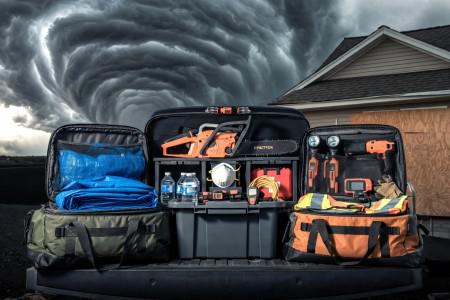
The standard hurricane preparedness list from FEMA and the Red Cross is a good starting point. It covers water, food, medications, a first aid kit, batteries, and a weather radio — all essential. What those lists mostly leave out is what people in the restoration industry know from cleaning up afterward: the items that decide whether a recovery is manageable or badly slowed are often not on the standard list at all.
This guide covers the basics quickly, then walks through the moisture control tools restoration crews always keep in their trucks, the pre-storm documentation that determines how claims actually settle, the Florida claim deadline that changed in 2023 and that most homeowners still have not heard about, generator and power habits that keep people alive, and the post-storm return sequence that avoids the most common preventable damage.
The basics everyone knows, and the items most families forget
The standard checklist you have probably seen:
-
Water — one gallon per person per day
-
Non-perishable food — shelf-stable options for the household
-
Prescription medications
-
First aid kit
-
Flashlights and batteries
-
Battery-powered or hand-crank NOAA weather radio
-
Cash in small bills
-
Copies of important documents
For South Florida households specifically, a few adjustments are worth building in.
Stock 7 days of water and food, not 3. The three-day guidance is a national baseline. In Broward, Miami-Dade, and Palm Beach counties, a major storm can leave large populations without normal grocery access for a week or longer. Wilma in 2005 and Irma in 2017 both produced week-plus disruption in parts of this service area.
Extra prescription medication for 7 to 10 days minimum. Pharmacies lose power, and even after they reopen the prescription systems can be down. Ask your doctor for an emergency supply refill before hurricane season, not during a warning.
A manual can opener. Electric openers do not work without power. This is the single most commonly forgotten item, and the one that most reliably converts "shelf-stable food" into "food we cannot open."
Portable phone battery packs, fully charged. Cell service usually outlasts home power. If you can keep phones charged, you can reach family, insurance, and emergency services. Several small packs beat one large one, because they can be in several places.
Sturdy closed-toe shoes for every household member, kept together. Post-storm environments are full of broken glass, exposed nails, and displaced wildlife. Sandals and bare feet account for a meaningful share of post-storm injuries.
Work gloves and N95 masks. Cleanup means handling wet materials, potential mold, and debris. Multiple pairs of each, per person.
Pet supplies, including proof of vaccination. Hotels and shelters that accept pets during an evacuation typically require current vaccination records. Keep printed copies with your emergency documents.
A printed copy of your policy declarations page and your agent’s contact information. Digital-only copies are inaccessible when your phone is dead and cell service is out. This one printed page is what makes the first insurance call possible.
Moisture control tools the pros always pack: tarps, fans, and meters
This is the section that separates the standard preparedness list from the professional one. Restoration companies know exactly what moisture does in the 48 to 72 hours after a storm, because we clean up the results. Homeowners who have these items on hand before the storm cut their eventual damage substantially — and this is not theory, it is the difference we see between two houses on the same street.
Heavy-duty tarps. Blue poly tarps in the 20 x 30 ft size cover most roof damage and window breaches. Keep at least two, plus rope, bungee cords, roofing nails, furring strips, and a hammer to secure them. A tarp you cannot deploy is not a tarp. Practice putting one up once, in daylight, before you ever need to.
6-mil plastic sheeting on a roll. For covering furniture, sealing broken windows from the interior, and building temporary containment around a wet area. One roll is inexpensive and covers a lot of situations.
Gorilla tape or heavy-duty duct tape. Standard duct tape loses adhesion in humid conditions and on damp surfaces. Gorilla tape holds. Two rolls minimum.
Utility knife with spare blades. For cutting tarps, sheeting, and any damaged material that has to come out.
Sandbags or absorbent water socks. For sealing door thresholds and directing water flow. Ten to twenty sandbags handle most residential intrusion points; absorbent socks work for smaller gaps and store more easily.
A basic pinless moisture meter. Inexpensive models run under $40. This is the single tool most homeowners do not have and most professionals wish they did, because it converts "it looks dry" into a measurable answer. Use it by comparison: take a reading in the affected area and a reading in an unaffected area of the same material in the same room. When those two readings match, the material is dry. Until they match, keep drying. On wood framing, moisture content above roughly 16% means it is still wet enough to grow mold.
Two or more box fans, plus extension cords. After the storm, if the AC is out but power is available (or a generator is running), fans moving air across wet surfaces are the fastest way to prevent mold from taking hold. Air movement matters more than fan capacity.
A small portable dehumidifier, if space and budget allow. A 30 to 50 pint per day unit runs on ordinary household power and will dry a room in a way passive drying simply cannot. Especially valuable when grid power returns before AC service does.
A wet/dry shop vacuum. For extracting standing water from carpet, tile, and other flooring. Even a 5 or 6 gallon unit handles most residential storm intrusion.
Nitrile gloves and heavy-duty contractor bags. For handling wet, contaminated, or potentially moldy material during cleanup.
Weatherproof extension cords rated for outdoor use. For running fans and dehumidifiers from a generator located outside the house — which, as covered below, is the only place a generator ever belongs.
Having these on hand means the first 48 hours after a storm — the window that decides whether you have a water problem or a mold problem — can be spent working instead of driving to a hardware store that is closed or sold out. For why that window matters so much, see our emergency mold removal guide, and for the drying method itself, our article on why summer thunderstorms create ideal conditions for mold growth walks through the full sequence.
Documenting your home before the storm for insurance claims
Claims settle at very different values depending on the quality of pre-storm documentation a homeowner can produce. Adjusters cannot compensate for damage they cannot verify. Ten minutes of preparation before the season saves days of argument after it.
A full video walk-through of the interior. Walk every room slowly with your phone in video mode. Open closets and cabinets and show the contents. Show every wall, ceiling, and floor. Narrate as you go — "this is the primary bedroom, that is a 65-inch Samsung bought in 2023, this rug came from..." A single 15-minute video captures more than an hour of trying to reconstruct a room from memory a month later.
Photos of every high-value item. Appliances, electronics, furniture, art, jewelry, collections. Serial numbers where visible. Purchase receipts if you have them.
Photos of the exterior. Roof condition (from ground level on all four sides, or a drone shot if you can get one safely), landscaping, fences, driveway, exterior walls. Pre-storm exterior photos are the strongest defense you have against an insurer arguing that damage was pre-existing.
Photos of any pre-existing damage or wear. Old ceiling stains, cracked stucco, worn shingles, previously repaired areas. Documenting these in advance is what stops them from being used to deny a post-storm claim. This feels counterintuitive — photographing your own defects — and it is one of the highest-leverage things on this list.
Cloud backup and an offsite copy. Save all photos and video to at least two locations: your phone’s cloud service plus an emailed compressed copy to yourself. If the phone is lost or destroyed, the documentation survives.
A printed home inventory list, stored with your evacuation documents. Room by room, item by item, with approximate purchase dates and values. A simple spreadsheet is enough. Inventory apps help, but the printed backup is what actually gets you through the first week with no internet.
Your policy declarations page, printed. With your agent’s name, direct phone number, and the claim reporting number. This one page is what lets you open the claim inside the notice window even if the carrier’s website is down and cell data is spotty.
The Florida deadline that changed — and that most homeowners have not heard about
This is the part of the article most worth acting on today.
Under Florida Statute 627.70132, as amended in December 2022:
-
A new or reopened property insurance claim is barred unless notice is given to the insurer within 1 year of the date of loss. It used to be two years.
-
A supplemental claim is barred unless notice is given within 18 months of the date of loss. It used to be three years.
Hurricane damage is very often discovered late. A slow roof leak that only shows as a ceiling stain eight months later. Mold behind a wall nobody opened until the following spring. Under the old two-year rule there was room for that. There is not anymore. If you had a storm loss in the past twelve months and have not filed, check your date of loss today, not in September.
On the carrier’s side, Florida Statute 627.70131 requires the insurer to acknowledge a claim communication within 7 calendar days, begin investigation within 7 days of proof-of-loss, complete any physical inspection within 30 days of proof-of-loss, and pay or deny the claim within 60 days of notice. Those windows were all shortened by the same 2022 reform. Knowing them tells you when a carrier has actually gone quiet on you versus when it is simply still inside its clock.
This describes general statutory timeframes and is not legal advice. Coverage depends on your specific policy language. Confirm your position with your agent or an attorney.
Safe generator and power practices during outages
Portable generators kill Floridians in every major storm event, almost always through carbon monoxide poisoning caused by indoor or attached-garage operation. These rules are not negotiable.
Never run a generator indoors, in a garage — even with the door open — on a porch, or within 20 feet of any window, door, or vent. Carbon monoxide is odorless and colorless and accumulates to lethal levels within minutes in enclosed or partly enclosed space. The U.S. Consumer Product Safety Commission is unambiguous on this. It is the most common cause of preventable post-hurricane death in this state.
Install working CO detectors on every floor. Battery-powered, so they work when the grid does not. Test them before the season, when testing is easy.
Never backfeed a generator into the panel. Feeding generator power through an outlet into household wiring can electrocute the utility workers restoring your power, and will damage the generator when the grid comes back. Use a transfer switch installed by a licensed electrician, or run individual appliances on outdoor-rated cords.
Store fuel safely. Roughly 20 gallons is a two to three day supply for a mid-size portable running essentials. Approved containers, stored outside, away from ignition sources. Rotate the supply in the off-season so what you have is fresh when you need it.
Test the generator every May. Start it, put a real load on it with a fan or a lamp, confirm it holds voltage. A generator that has not run in a year usually needs service before it will work when it counts.
Choose your loads deliberately. Portable generators are limited. Prioritize: refrigerator (cycled, not run continuously), one or two lights, phone charging, and one fan or a small window AC unit.
Do not run a central AC condenser off a portable generator. Residential central systems typically need 3,500 watts or more just for locked-rotor starting current, more than most portable units can deliver as surge. If cooling is genuinely essential — a heat-sensitive family member, medical equipment — the answer is a properly sized standby generator with a transfer switch, sized and installed before the season, not a portable unit and hope.
Guard against theft. Generators are a common target during outages. Chain or lock yours to something fixed. This sounds paranoid right up until the first time you watch a neighbor go through it.
Plan for surge damage when the grid comes back. Restored service often carries voltage spikes that destroy electronics which survived the storm itself. Unplug refrigerators, computers, and TVs before you evacuate, or when you hear utility crews are working nearby. A whole-house surge protector at the panel is the thorough version.
What to do first when you return home after a hurricane
The re-entry sequence matters more than most homeowners realize. Doing the first steps in the wrong order can turn a manageable damage situation into a much larger one, or expose you to hazards that are not obvious.
Do not enter if there is visible structural damage. Compromised roofs, leaning walls, or shifted foundations mean the building is not stable. Wait for a professional inspection.
Treat every downed line as live, especially near standing water. Any wire on the ground, or any leaning or fallen pole, is energized until the utility says otherwise. Water conducts across distance; standing water near a downed line is lethal from well beyond arm’s reach.
If you smell gas, do not touch a switch or a flame. Leave immediately, call the gas utility from outside the area, and do not return until they clear the property.
If water reached the interior, turn off the main breaker before entering. Then use a flashlight, not a flame.
Photograph and video everything before moving or cleaning anything. Wide shots of every affected area, then tight shots of specific damage. Include the exterior, roof, fences, trees, landscaping, and vehicles. Timestamps in the file metadata matter.
Contact your carrier as soon as cell service allows. Get a claim number and an assigned adjuster. Reference the printed declarations page you set aside. Remember the one-year notice window.
Do not turn on the AC if water reached the air handler, ductwork, or return. Running the system in that condition distributes moisture and biological contamination through the entire house within hours — turning a localized water problem into a whole-house mold problem. This is one of the most damaging and most common post-storm mistakes we see. Wait for an assessment. Our emergency mold removal guide covers this scenario specifically.
Discard perishables that were without power for more than 4 hours. The USDA cutoff: refrigerated food held above 40°F for that long should not be eaten. Photograph what you throw out, for the claim.
Begin drying wet areas immediately. Fans and dehumidifiers. Do not open windows if the outdoor dew point is high — in a Florida summer aftermath you would be importing moisture, not removing it. Do not strip drywall or pull insulation before the adjuster has documented the damage, but do start drying. Carriers generally require homeowners to take reasonable steps to prevent further damage.
Watch for wildlife. Snakes, rodents, and insects displaced by flooding relocate into structures. Check garages, sheds, and interior spaces carefully before starting extended cleanup.
Document as you go. Every cleanup step, every receipt, every discarded item. Our water damage restoration timeline guide covers the phases that follow the immediate return.
Frequently asked questions
How many days of water and food should we stock?
Seven days is realistic for Broward County. The FEMA three-day baseline assumes normal supply chain restoration timelines, which historically have not applied to major South Florida storm events.
How long do I have to file a hurricane claim in Florida?
One year from the date of loss for a new or reopened claim, and 18 months for a supplemental claim, under Florida Statute 627.70132. These windows were shortened from two and three years in December 2022. If you had a storm loss in the past year and have not filed, check your date of loss now.
Where should important documents be stored?
Physical copies in a waterproof container that leaves with you if you evacuate, plus digital copies in cloud storage, plus emailed copies to yourself. Three formats in three locations is the standard for anyone in an evacuation zone.
Can I run my generator in the garage if the door is open?
No. Carbon monoxide accumulates in enclosed and partially enclosed spaces regardless of door position. Generators go outdoors, at least 20 feet from any door, window, or vent, pointed away from the house. This is the single most common cause of preventable death after Florida hurricanes.
When is it safe to turn my AC back on after the storm?
Only after confirming no water reached the air handler, ductwork, or condenser, and that no visible damage exists. If any of those were compromised, wait for a professional assessment. Running a water-contaminated system can spread moisture and biological contamination through the entire house within hours.
Should I remove damaged drywall before the adjuster comes?
No. Policies generally allow and require emergency mitigation to prevent further damage, but structural removal should wait until the adjuster has documented the loss. Photograph everything, begin drying, and leave demolition until after the visit unless there is an active safety hazard.
What supplies do restoration pros recommend beyond the basic list?
The moisture control kit is the biggest gap in most homeowner preparation: tarps, 6-mil plastic sheeting, a pinless moisture meter, box fans, a wet/dry vacuum, and a small dehumidifier. These are what let a homeowner start effective drying within hours of the storm — which is the whole difference between preventing mold and paying to remediate it.
When do I need professional help versus handling it myself?
Call a licensed water mitigation professional if there is standing water anywhere in the house, if water affected more than about 25 square feet, if water reached the HVAC system, if you cannot identify or stop the source of intrusion, or if any structural damage is visible.
Getting help
AdvantaClean of Fort Lauderdale provides 24/7 emergency water damage restoration and hurricane and storm damage response across Fort Lauderdale, Deerfield Beach, Plantation, and Pompano Beach — for the events that exceed what a homeowner can handle alone. For the events that do not, having the kit already assembled is the whole difference between a fast recovery and a slow one. The full list above can be bought at any hardware and big-box store in a single afternoon and stored in a garage or utility closet; total cost typically runs $200 to $400 depending on what you already own. Build it in May.
AdvantaClean of Fort Lauderdale — 236 NE 33rd St, Oakland Park, FL 33334. Serving Fort Lauderdale, Oakland Park, Wilton Manors, Lauderdale-by-the-Sea, Pompano Beach, Deerfield Beach, Plantation, Davie, and Broward County. Call (754) 218-8070 or request service online. Emergency response available 24/7.
ABOUT THE AUTHOR
Mariano Llorian is the owner and qualifying agent of AdvantaClean of Fort Lauderdale (Innoveco LLC), 236 NE 33rd St, Oakland Park, FL 33334. He holds Florida license CBC1269223 (Certified Building Contractor), CAC1823910 (Class A Air Conditioning Contractor), and MRSR2683 (Mold Remediator), and is licensed for radon mitigation (R3039 / RB3040). Licenses are verifiable through the Florida DBPR license portal. He has spent more than a decade diagnosing moisture, mold, and HVAC failures in Broward and Miami-Dade buildings, from single-family homes to commercial restaurant build-outs.
Technically reviewed July 2026 against CPSC portable generator safety guidance, USDA food safety guidance, FEMA preparedness recommendations, and Florida Statutes 627.70131 and 627.70132.