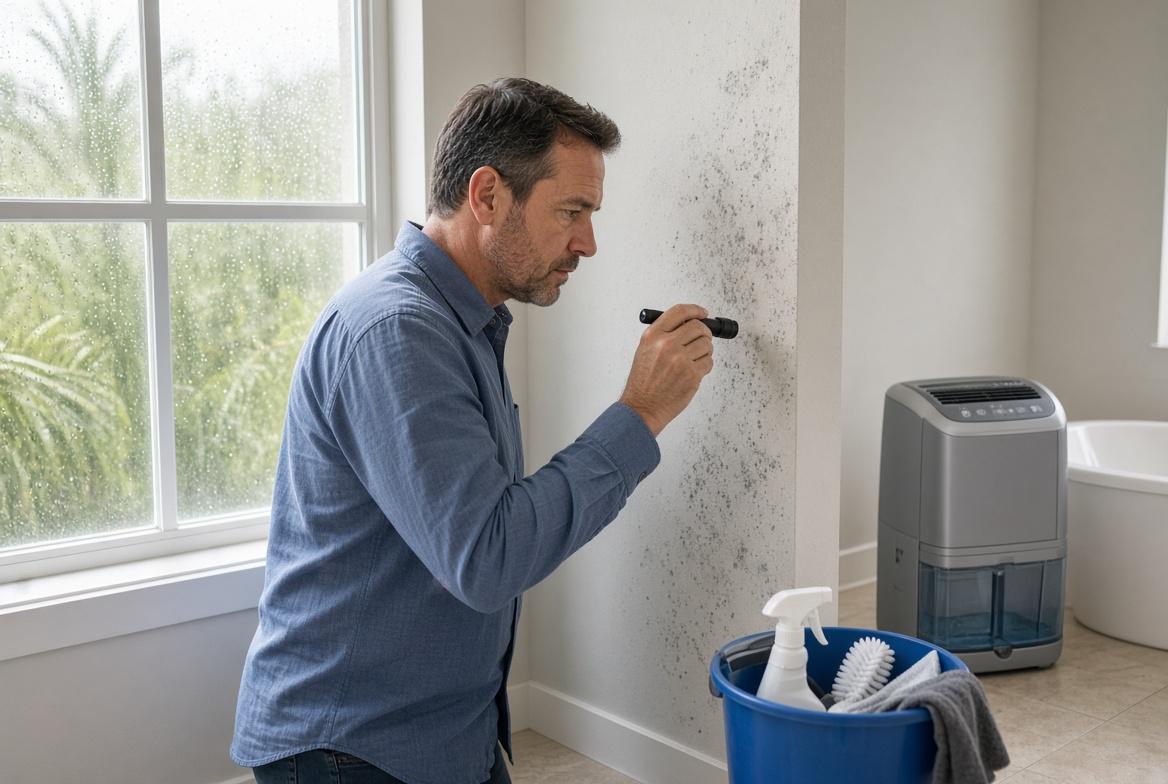
The first thing to understand about mold in a Florida rental is that there is no Florida mold law.
No statute defines an acceptable spore count. None sets a square-footage threshold at which a landlord must act. None requires mold disclosure in a residential lease, even though Florida does mandate a radon disclosure in every one.
That absence leads landlords in two opposite wrong directions. Some conclude there is no real obligation and treat complaints as tenant nuisance. Others assume a body of strict mold-specific requirements exists and concede far more than the law asks. Both are expensive.
What actually governs is the implied warranty of habitability, and it is more demanding than the first group expects and narrower than the second group fears.
What the law actually requires
Florida Statute 83.51 sets the landlord's obligation to maintain the premises. It requires compliance with applicable building, housing, and health codes, and where no such code applies, it requires maintaining roofs, windows, doors, floors, steps, porches, exterior walls, foundations, and other structural components in good repair and capable of resisting normal forces, along with keeping plumbing in reasonable working condition.
Mold is never named. Courts read it in. Visible mold growth traceable to a moisture source the landlord is responsible for, such as a roof leak, a plumbing failure, an HVAC problem, or a building envelope defect, is a condition that can materially affect health and violate the habitability duty.
This obligation cannot be waived by lease. A clause purporting to shift the implied warranty of habitability onto a tenant is not enforceable. Lease language can allocate certain maintenance responsibilities, particularly for single-family homes and duplexes under 83.51(2)(b), but it cannot contract away habitability itself.
Florida Statute 83.56(1) creates the mechanism tenants use. A tenant delivers written notice specifying the noncompliance. The landlord then has seven days to cure. If the condition is not remedied and the noncompliance is material, the tenant may terminate the rental agreement.
Three elements matter in that provision. The noncompliance must be material, meaning a minor cosmetic issue does not trigger it. The notice must be written, so a text message complaint or a verbal mention to a maintenance tech does not start the statutory clock. And the cure period is seven days from delivery, not seven business days and not seven days from when it was convenient to read.
Florida Statute 83.60 governs rent withholding, and the procedure is sequential. The tenant must have delivered proper written notice, must wait the full seven days, must be otherwise current on rent, and may then withhold in proportion to the reduced rental value. Tenants who withhold improperly expose themselves to eviction; landlords who assume any withholding is improper are frequently wrong.
Florida Statute 83.64 prohibits retaliatory conduct. Raising rent, decreasing services, or initiating eviction primarily because a tenant complained about conditions or exercised statutory rights is a separate violation with its own consequences. This catches landlords who respond to a mold complaint by declining to renew.
Licensing rules apply to the work itself. Under 468.8411, mold remediation on an area larger than ten square feet requires a DBPR-licensed remediator, and under 468.8419 the party performing assessment generally cannot also perform remediation on the same property within twelve months. A landlord hiring an unlicensed handyman for a substantial mold job has a compliance problem independent of the tenancy dispute. Licenses verify in under a minute at MyFloridaLicense.com.
What the law does not require
This section is where most landlord-facing mold content goes wrong.
No mold disclosure obligation. Florida requires a radon notice in every residential lease. It requires no equivalent for mold. There is no statutory duty to disclose prior mold history or remediation to a prospective tenant, though misrepresenting it in response to a direct question is a different matter.
No numeric threshold. No statute or regulation defines a spore count, a species, or a square footage at which mold becomes a legal violation. The test is the habitability standard, which is qualitative and assessed case by case.
No prescribed remediation standard. Florida licensing law governs who may perform the work, not how. Industry standards such as the IICRC S520 exist and are what competent contractors follow, but they are not incorporated into landlord-tenant law.
No obligation to fund tenant relocation. This one surprises landlords and tenants equally. Florida's statutory remedies for a tenant facing an uninhabitable unit are termination of the rental agreement and rent abatement, not a right to demand that the landlord pay for a hotel. A tenant's own renters insurance loss-of-use coverage is the usual mechanism for their temporary living costs. A lease can voluntarily create a relocation obligation, and some do, so read yours before assuming either way.
No requirement to test. Testing is often useful and sometimes decisive, but no statute compels a landlord to conduct air sampling in response to a complaint.
Knowing where the legal floor sits matters because it lets a landlord decide deliberately what to do above it, rather than negotiating from a misunderstanding.
The first 48 hours after a tenant reports mold
The seven-day clock in 83.56 runs from delivery of written notice, which means the response window is short and the early moves determine everything that follows.
Acknowledge in writing, same day. A dated written acknowledgment costs nothing and establishes responsiveness. This becomes the first entry in the record if a dispute develops later.
Inspect promptly and personally, or send someone competent. Do not rely on the tenant's photos alone. Note the location, extent, apparent moisture source, and any building conditions contributing to it.
Find the moisture source before discussing the mold. This is the single most important step, both practically and legally, because the source determines who pays. Mold is a symptom. A roof leak, a failed supply line, a clogged condensate drain, and a bathroom with no working exhaust fan are landlord issues. Persistent failure to run the AC in a Florida summer, blocked return vents, or an unreported leak that ran for weeks may not be.
Bring in an independent licensed assessor when the situation is unclear or the area is substantial. Under 468.8419, the company that assesses generally cannot be the company that remediates. That separation exists to remove the conflict of interest, and it works in a landlord's favor: an independent assessment documents the moisture source, defines the scope, and produces a report that is credible precisely because the assessor has nothing to sell on the remediation side. Landlords who obtain one before a formal notice arrives are consistently better positioned than those who wait.
Communicate the plan and the timeline in writing. Seven days is a cure period, not necessarily a completion deadline for complex work. A documented plan with dates demonstrates good-faith action, which is the standard courts actually apply.
Do not paint over it. Sealing visible growth without addressing the moisture source is the most common landlord mistake, and it converts a manageable maintenance issue into evidence of bad faith.
Who pays for what
|
Situation |
Typically the landlord |
Typically the tenant |
|
Roof leak, plumbing failure, envelope defect, HVAC failure |
Inspection, remediation, repairs |
None |
|
No functioning bathroom exhaust, inadequate ventilation as built |
Inspection, remediation, correcting the deficiency |
None |
|
Tenant failed to report a known leak promptly |
Shared or disputed |
Portion attributable to the delay |
|
Tenant conduct: AC left off, vents blocked, chronic excess humidity |
None |
Remediation attributable to that conduct |
|
Tenant's personal property damaged |
None |
Renters insurance |
|
Tenant's temporary living costs |
Only if the lease requires it |
Renters insurance loss-of-use |
|
Independent assessment where cause is disputed |
Usually worth funding regardless |
None |
Two practical notes on that table. Allocation disputes are decided on evidence, and the party with documentation of the moisture source generally prevails, which is why the assessment matters more than the argument. And landlord dwelling policies typically carry the same low mold sublimits as homeowners policies, commonly $5,000 to $10,000, with loss-of-rents coverage handled separately. Our mold remediation cost guide covers what the work runs and how Florida's two-party assessment structure affects the total.
The documentation that decides disputes
Mold disputes are won and lost on records, not on who is more upset. A file that protects both parties contains:
Move-in condition reports with dated photographs of every room, ideally including a baseline humidity reading.
The tenant's written notice, with proof and date of delivery.
The landlord's dated written acknowledgment.
Inspection findings, including moisture meter readings and thermal imaging where used.
The independent assessor's report and remediation protocol.
Photographs before, during, and after the work.
Documentation that the moisture source was actually repaired, which is separate from documentation that the mold was removed.
Post-remediation verification testing, performed by the assessor rather than the remediator.
A complete communication log, with every exchange in writing even when the conversation happened by phone.
The last point is worth emphasizing. A landlord who handled a complaint well by phone and documented none of it is in nearly the same position as one who ignored it.
Preventive practices for multi-unit portfolios
Across a portfolio, the economics favor prevention heavily, because a single contested remediation costs more than a year of maintenance across several units.
Service condensate drains on a schedule. Clogged AC condensate lines are among the most common sources of unit mold in South Florida, and they fail quietly, staining ceilings below air handlers before anyone reports anything.
Verify exhaust fans actually vent outside. Bathroom fans terminating into an attic or a soffit rather than through the roof or wall are a widespread builder shortcut and a persistent moisture source.
Never leave a vacant unit unconditioned. This one gets missed constantly. A closed-up Florida apartment with the AC off in August will reach conditions that grow mold within weeks. Set vacant units to hold a reasonable temperature and humidity, or run a dehumidifier, and check them. Turnover periods and seasonal vacancies are when portfolio mold problems originate. Our summer humidity guide covers the conditions involved.
Give tenants written guidance at move-in on ventilation, running the AC, and reporting leaks immediately. This serves two purposes: it genuinely reduces incidents, and it establishes what the tenant was told if conduct becomes an issue later.
Respond to every water report the same day, regardless of how minor it sounds. The 24 to 48 hour window before mold establishes is the entire ballgame, and a small plumbing call now is cheaper than a remediation and a habitability dispute later.
Maintain roofs and envelopes proactively, and keep the records.
Inspect periodically where the lease permits, with proper notice under Florida's entry provisions.
For the tenant's side of this relationship, the blog's guide to mold testing for renters covers rights and responsibilities from that perspective, and our guide to the signs of hidden mold covers what to look for during inspections.
Working with contractors
When remediation is needed, the licensing framework shapes who you hire. Any job over ten square feet needs a DBPR-licensed remediator. The assessor who defines the scope and the contractor who performs the work generally need to be different parties. Verify both licenses, get the scope in writing, and require post-remediation verification by the assessor rather than accepting the remediator's own sign-off. Our guide to vetting a mold remediation company covers the questions worth asking.
AdvantaClean of Fort Lauderdale performs mold remediation for rental and multifamily properties across Broward County. Because of the assessor and remediator separation in Florida law, we generally cannot serve as your independent assessor on a property we remediate, and we would point you to a licensed MRSA assessor for that report. To discuss a specific property, call (754) 218-8070 or reach the local team here.
This article is general information about Florida landlord-tenant and mold licensing law, not legal advice. Statutes and their application change, lease terms vary, and specific disputes turn on their facts. Consult a Florida attorney regarding any actual or threatened claim.