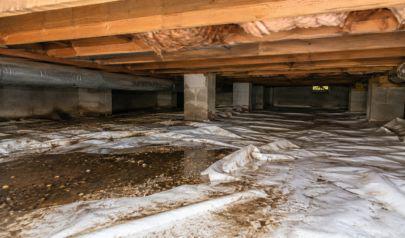
Most people in Peachtree Corners rarely think about the space under their house. It’s dark and cramped, so unless there’s an obvious problem, it’s easy to forget about. But with spring storms that can bring two inches of rain in an hour and summer humidity often reaching the high eighties, your crawl space is actually one of the busiest parts of your home.
What goes on in your crawl space can have a direct impact on your home’s air quality and structure.
Georgia Weather and What It Does to a Crawl Space
Peachtree Corners and the rest of Gwinnett County experience all kinds of Georgia weather. In spring, heavy rain can last for days, and the ground often stays soaked from earlier showers. Summer brings quick, intense thunderstorms that drop a lot of rain before drains can keep up. In fall, leaves and debris can clog gutters and push water toward your home’s foundation.
Red clay soil makes these problems worse. When it gets wet, Georgia’s clay-heavy soil expands and pushes water around instead of soaking it up. If your house sits on a slight slope, you might notice water pooling near the foundation or even getting into the crawl space through vents or unsealed openings.
When water gets into a crawl space, it often doesn’t drain away on its own. Depending on your vapor barrier, insulation, and ventilation, water can sit on the ground and slowly rise into the wood above. Over time, this creates moisture problems that your home’s structure isn’t built to handle.
The Warning Signs Worth Taking Seriously
Homeowners often brush off early crawl space warnings as small issues. Here are a few signs you shouldn’t ignore:
A musty smell that appears and disappears, especially in rooms on the first floor. This usually means moisture is moving up from below, bringing odors with it.
Soft spots in your hardwood or tile floors. Moisture damage to the subfloor happens slowly, but if you notice it underfoot, it’s likely been going on for some time.
Higher-than-expected energy bills combined with HVAC running frequently. Wet insulation in a crawl space loses its R-value significantly, and the system has to work harder to compensate.
Condensation on windows or pipes inside the home during warm months can signal that humidity levels throughout the structure are elevated above normal levels.
What a Professional Assessment Looks At
Our technicians check crawl spaces using moisture meters, humidity tracking, and by looking at the vapor barrier, insulation, wood framing, and drainage. We measure the real moisture in the wood, not just whether the floor looks wet.
After the inspection, our recommendations depend on what we find. Sometimes, the vapor barrier needs to be replaced if it’s damaged. Other times, fixing drainage outside the house solves the problem. If moisture has already reached the wood structure, we may need to dry and treat the area before making repairs.
We regularly work with homeowners in Peachtree Corners, Norcross, Johns Creek, and Buford on crawl space moisture issues. The scope and cost vary widely depending on how long the conditions have been present and what the moisture has affected.
Getting Ahead of It
The most cost-effective time to address a crawl space moisture issue is before it becomes a floor system problem. A professional assessment — especially after a wet spring or following any period of unusually heavy rainfall — gives you a clear picture of where things stand. If everything is fine, you know that. If there's a developing issue, you find out before it advances.
Spring and early summer are usually the riskiest times for crawl space moisture in Gwinnett County. If it’s been a few years since your last inspection, now is a good time to schedule one.
AdvantaClean of Norcross and Buford helps homeowners in Peachtree Corners, Norcross, Buford, and Johns Creek with water damage, crawl space moisture, and mold problems. Our local team knows how Georgia’s weather affects homes because we deal with it every day.
Give us a call at (470) 819-2070, check us out at advantaclean.com/norcross-ga, or find our team on Google. We're straightforward about what we find and what it takes to fix it.