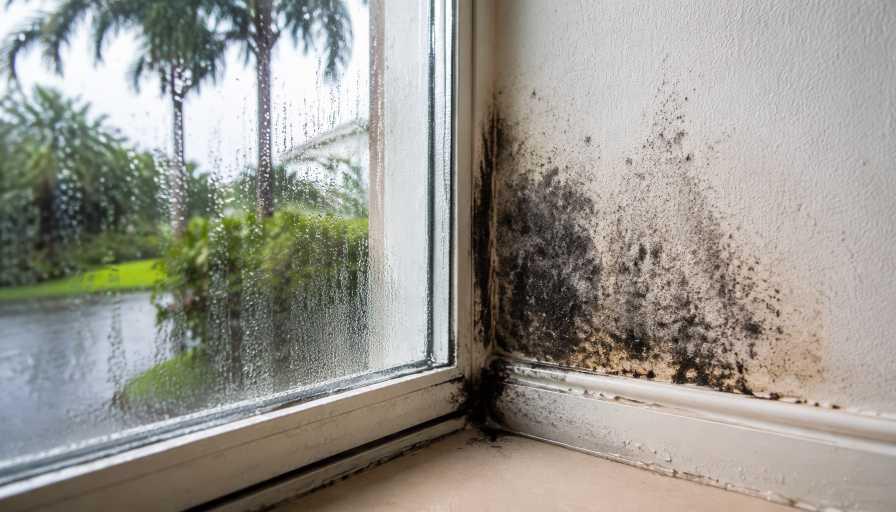
Most people treat mold as a summer problem, and in Florida that assumption produces a predictable result: a steady stream of growth discovered in February that has been developing since the first cool week in November.
The winter version of this problem has a different cause than the summer version, which is why the summer fixes do not catch it.
Does mold die when the temperature drops?
No. Cold slows mold down and can push it into dormancy, but it does not kill it. Spores survive freezing temperatures comfortably, and the moment conditions turn favourable again the colony resumes growing from where it stopped.
This matters more in Florida than almost anywhere, because the temperatures here never get low enough to even slow it meaningfully. Most mold species grow across a broad range, roughly 40 to 100 degrees Fahrenheit, with the fastest growth between about 70 and 90. A South Florida winter sits squarely inside the comfortable band. Indoor temperatures in a Broward home in January are, from a mold's perspective, indistinguishable from ideal.
So the question of whether mold grows in winter here has a short answer: it never stopped. Temperature was never the limiting factor in this climate. Moisture is, and that is where the seasonal change actually happens.
There is a second misconception bundled into this one. People sometimes assume that mold found in winter must have started in summer and simply gone unnoticed. Sometimes that is true. Often it is not, and the growth genuinely began in November or December for reasons covered below.
Why does running the heat with windows closed raise indoor moisture?
Because the house is sealed and the air conditioning has stopped running, which means the only system that was removing moisture from your indoor air is now idle. Meanwhile the occupants keep generating moisture through showering, cooking, laundry, and breathing, and it has nowhere to go.
This is the heart of the Florida winter mold problem and it is worth being precise about.
Your air conditioner is a dehumidifier that happens to also cool. It pulls moisture out of the air as a byproduct of running, condensing it on the coil and draining it outside. In July it runs almost continuously, which is why indoor humidity stays manageable even though outdoor air is saturated.
In January it barely runs at all. Outdoor temperatures in the seventies mean the thermostat is rarely calling for cooling. The system cycles briefly or not at all, and the dehumidification stops with it. Humidity that was being continuously removed now accumulates.
Add the sealed house. In cooler months people close up and stop opening windows, which removes the limited natural ventilation that was diluting indoor moisture.
Add the occupant load, which does not change seasonally. A household generates a substantial amount of water vapour every day through normal activity. A single shower, a load of laundry, a pot of pasta, and a sleeping adult all contribute, and in a sealed house with no dehumidification running, it accumulates rather than clearing.
Then add the heat, on the nights it is used. Portable heaters and heat pumps warm the air without removing moisture, and warm air holds more water vapour. That moisture-laden warm air then meets cold exterior surfaces, which brings us to the next question.
The EPA recommends keeping indoor relative humidity below 60 percent, with 30 to 50 percent considered ideal. Plenty of Florida houses sit above 60 all winter without anyone checking, because the house feels fine. Cool and damp registers as comfortable in a way that hot and damp does not. Our summer humidity guide covers the dew point mechanics underlying all of this.
Where does winter mold show up first in a Florida home?
It appears first on cool surfaces in poorly ventilated spaces, which in winter means exterior-facing walls, closets on those walls, and the areas around windows. The pattern is different from summer mold, which tends to start near moisture sources and in the HVAC system.
The places worth checking between December and February:
Window frames, sills, and the wall directly beneath a window, where condensation runs down and soaks into paint and drywall.
Closets on exterior walls, particularly ones kept closed. Dense hanging clothes, no air circulation, and a wall surface running several degrees cooler than the room is a reliable combination. Leather shoes and belts at the back of a closet usually show it first.
Corners where two exterior walls meet, which run cooler than the surrounding wall because of the framing geometry.
Behind furniture pushed flat against an exterior wall, where air cannot circulate and the surface stays cool.
Inside cabinets on exterior walls, particularly in kitchens and bathrooms.
Bathrooms, where winter shower moisture has nowhere to go if the exhaust fan is weak or vents into the attic rather than outside. This is a year-round issue that worsens when the house is sealed.
Garages and the walls they share with conditioned space, where the temperature differential across the wall is largest.
The attic, where warm moist indoor air rising into an unconditioned space meets a cool roof deck at night.
Around supply registers, if the system runs intermittently and the register surface cools between cycles.
Our guide to the signs of hidden mold covers the subtler indicators that appear before anything is visible.
Is condensation on windows a warning sign?
Condensation on the inside of your windows is a direct reading of your indoor humidity, and in winter it is the clearest free diagnostic you have. If moisture is beading on the glass, the indoor air contains enough water vapour to condense on the coldest surfaces in the house, and glass is simply the first place you can see it.
The important part is what it implies about surfaces you cannot see. Window glass is usually the coolest interior surface in a room, so it condenses first. But the back side of exterior drywall, the inside of closet walls, and the wall behind a sofa are all cooler than the room average too. If the glass is wet, those surfaces are close to the same threshold.
A few distinctions worth making:
Condensation on the inside of the glass means high indoor humidity. That is the one to act on.
Condensation on the outside of the glass, which happens in Florida during warm humid mornings when the interior is cooled, is normal and not a concern.
Condensation between panes of a double-glazed unit means the seal has failed. That is a window repair issue rather than a humidity issue, though the failed unit will also perform worse thermally.
Persistent water pooling on the sill is the stage where damage starts. Paint blisters, the sill swells, and the drywall below begins absorbing.
A hygrometer removes the guesswork. They cost around fifteen dollars, and putting one in a bedroom and one in a main living area tells you what is actually happening rather than what the house feels like. Readings consistently above 60 percent mean you have a problem to solve regardless of the season.
Should you keep the dehumidifier on from December to February?
In most Florida homes, yes. The cooler months are precisely when your air conditioning stops dehumidifying, so a dehumidifier is covering the gap rather than duplicating what the AC already does. Target indoor relative humidity below 60 percent, ideally between 45 and 55.
How to approach it depends on the house.
If you have a thermostat capable of humidity control, use it. Several smart thermostats can call for cooling based on a relative humidity setpoint rather than temperature alone, which means the system runs when the house is damp even if it is already cool enough. This is the cleanest solution because it uses equipment you already own.
If you do not, a standalone dehumidifier handles it. Size it to the area and, if possible, run the drain hose to a permanent drain rather than relying on someone emptying a reservoir. Units in the 30 to 50 pint per day range cover most single rooms or small zones.
A whole-home dehumidifier tied into the ductwork is the most complete option for a house that has this problem every year, and it operates independently of whether the cooling system is running.
Some practical additions that cost nothing. Run bathroom exhaust fans during and for twenty minutes after every shower, and confirm they actually vent outside rather than into the attic. Use the kitchen range hood. Leave closet doors ajar on exterior walls so air can circulate. Pull furniture a few inches off exterior walls. And on the genuinely dry days that Florida does get in winter, open the windows for an hour, which is the one time of year that helps rather than hurts.
If growth has already started, lowering humidity slows it but does not remove it. Our mold remediation cost guide covers what assessment and remediation involve, including why Florida law requires the assessor and the remediator to be separate parties.
What to do this month
Put a hygrometer in two rooms and look at the readings for a week. If they sit above 60 percent, you have found your winter mold mechanism before it produces anything visible, and a dehumidifier or a humidity-capable thermostat setting solves it. Check the windows, the exterior-wall closets, and the corners while you are at it, since those are where it starts.
If you find something already growing, or a musty smell you cannot trace, the useful next step is an assessment rather than a cleaning, because what is visible on a wall is usually a fraction of what is behind it.
AdvantaClean of Fort Lauderdale provides mold inspection, mold testing, and remediation across Broward County. To have a winter humidity or mold problem looked at before it spreads, call (754) 218-8070 or reach the local team here.