A Florida house left closed from May to October has spent roughly five months in conditions that would be hard to improve on if you were deliberately trying to grow mold.
Most returning owners open the door, notice the place smells stale, prop a few windows, turn the air conditioning down to 72, and get on with unpacking. That sequence is understandable and it is close to the worst available option, because two of those steps can take a contained problem and distribute it through the whole house.
What follows is what to check, in what order, and what the smell is actually telling you.
Why a closed-up house in August is a mold incubator
Mold needs moisture, a food source, and time. A closed Florida house in summer supplies all three without interruption.
Indoor humidity climbs and stays there. The EPA recommends keeping indoor relative humidity below 60 percent, with 30 to 50 percent considered ideal. A sealed house with the air conditioning off, or set high enough that it rarely runs, will routinely sit between 70 and 85 percent through a South Florida summer. Mold begins growing on organic materials sustained above roughly 60 percent, and drywall paper, wood, dust, leather, and fabric are all organic.
There is no air movement. Stagnant air lets moisture concentrate in enclosed spaces. Closets, cabinets under sinks, the backs of wardrobes against exterior walls, and the inside of drawers all become pockets where humidity runs higher than the open rooms.
The thermostat setting that saves money prevents dehumidification. Setting the system to 82 or 85 while away is standard advice for utility bills, and it is a problem for moisture. Air conditioning dehumidifies as a side effect of running. At a high setpoint, the system either rarely cycles or short-cycles, which means it never runs long enough to pull meaningful water out of the air. The house stays warm and wet rather than cool and wet, which is worse.
Nobody is there when something fails. A condensate drain clogs in June and the overflow runs for four months. A supply line under a bathroom sink starts weeping. A roof detail lets go during a July storm. Each of these is a minor repair when someone is home and a major remediation when nobody is.
Our summer humidity guide covers the dew point physics behind all of this in more detail.
The first-hour walkthrough: smells, surfaces and spots to open
Do this before you unpack, and before you adjust anything.
Stand in the doorway and smell, for thirty seconds, before you walk in. This is the most sensitive instrument you have and it has a very short service life. Olfactory adaptation means your nose stops registering a persistent odor within a few minutes of exposure. Whatever you detect in the first half minute is the most honest reading you will get all day. Note it before you do anything else.
Do not open windows yet. Pulling 85 percent outdoor air into a house that has been closed adds moisture to surfaces that are currently at ambient temperature. It also disperses the odor you are trying to locate. Diagnose first.
Do not turn the air conditioning on yet either. If there is growth on the coil, in the drain pan, or in the ductwork, starting the system distributes spores through every room in the house within minutes. Check the system first.
Then work through the house in this order.
The air handler and its closet. Look at the drain pan for standing water, rust staining, or a visible film. Check the floor and the wall below it for staining. Look at the coil if accessible. Check the secondary drain line outlet outside, which is usually a small pipe above a window; staining below it means the primary line clogged at some point.
Supply registers. Run a clean fingertip along the inside edge of a few vents. Dark grey dust is normal after months. A damp, greasy, or fuzzy deposit is not.
Under every sink. Kitchen, every bathroom, laundry, wet bar. Look at the back wall of the cabinet, not just the floor of it, and feel the shutoff valves and supply lines for moisture.
Behind and under appliances. Refrigerator, especially if it has an ice maker line. Dishwasher. Washing machine, including the hoses at the wall.
Water heater. Base, pan, and the floor around it.
Closets, particularly on exterior walls. Open them and smell before looking. Check the back wall, the floor corners, items stored on the closet floor, and the shoulders of hanging clothes. Leather and suede show it first.
Bathrooms. Behind toilets, around tub and shower bases where caulk has failed, inside vanity drawers, and on the underside of the counter overhang.
Mattresses and upholstered furniture. Lift the mattress and look at the underside and the box spring. Check the underside of sofa cushions.
Windows and sliders. Bottom tracks, the wall directly beneath, and any wood trim at the sill.
The attic access, if you have one. A flashlight scan of the roof deck for dark streaking, and a look at the insulation for staining or matting.
Anywhere water lives or travels. Pool equipment, irrigation controllers, the garage shared wall, laundry room floor.
Our guide to the signs of hidden mold covers what the subtler indicators look like.
AC and humidity settings that should have been running while you were away
If the walkthrough comes back clean, the reason is almost always that the system was set correctly. If it does not, this is usually why.
The setting that works is humidity-based, not temperature-based. The goal while away is holding indoor relative humidity below 60 percent, ideally 50 to 55. Temperature is only the lever used to get there.
Three approaches, in order of reliability:
A thermostat with genuine humidity control. Several smart thermostats can call for cooling based on a relative humidity target rather than temperature alone. Set an RH ceiling and the system runs to meet it even when the house is already at setpoint. This is the correct tool for the job.
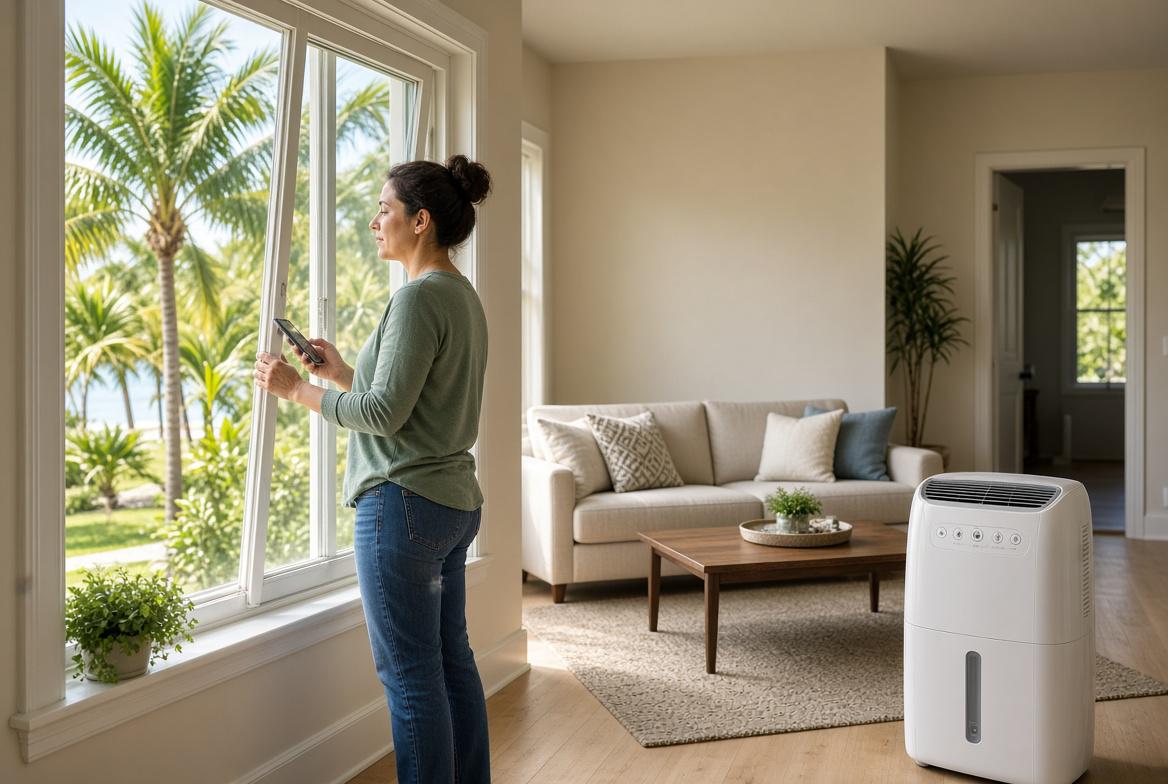
A dedicated dehumidifier. Either a whole-home unit tied into the ductwork or a standalone unit with a hose run to a drain so it does not depend on someone emptying a bucket. This works independently of the cooling system and is the most robust option for long absences.
A conventional thermostat set low enough to actually run. If the above are unavailable, something in the range of 77 to 80 degrees will produce enough runtime to dehumidify in most Florida houses. Higher than that and the system stops doing the job you left it to do.
Whatever the method, remote monitoring is what turns a setting into a safeguard. A smart thermostat or a standalone sensor that reports humidity and temperature to your phone, with alerts configured, means a failure in June reaches you in June rather than in October.
Two related items worth handling at the same time: set the water heater to vacation mode or turn it off, and shut off the supply to the ice maker and the washing machine.
Furniture, mattresses and closets: what can be cleaned and what cannot
The general rule is that porous items with visible growth are usually a loss, and non-porous items are usually recoverable. Odor without visible growth is a separate question and often resolvable.
|
Item |
Usually recoverable |
Usually a loss |
|
Mattresses with visible growth |
Replace |
|
|
Mattresses with odor only, no growth |
Airing and professional cleaning may work |
|
|
Upholstered furniture, visible growth |
Replace, unless the piece justifies professional restoration |
|
|
Solid wood furniture |
Clean, dry slowly, monitor |
|
|
Particleboard and MDF furniture |
Replace if it absorbed moisture |
|
|
Clothing and linens |
Launder, hot wash where the fabric allows |
|
|
Leather goods, shoes, handbags |
Often cleanable if caught early |
Replace if growth penetrated the material |
|
Books and paper |
Freeze-drying occasionally works |
Usually a loss |
|
Rugs and carpet |
Professional cleaning if backing is dry |
Replace if backing or pad is affected |
|
Window treatments |
Launder or dry clean |
Replace if backing is affected |
|
Hard non-porous goods |
Clean and dry |
|
|
Drywall and insulation with growth |
Remove |
Two cautions. Surface cleaning a porous item removes the visible growth and leaves the roots, which is why mattresses and upholstery come back. And cleaning anything without first fixing the moisture condition is temporary by definition.
If household members are experiencing symptoms, our guide on mold exposure covers what is and is not associated with exposure, and when to see a physician.
When a musty smell calls for testing instead of airing out
Not every closed-house smell is mold. Stale air, dust, dry plumbing traps, and stagnant water in appliances all produce odors that resolve on their own.
Here is how to tell the difference.
Likely just stale air. The smell is general rather than localized, it fades noticeably within a day of ventilation and running the air conditioning, it does not return once the house is back in normal use, and nothing visible or damp turns up in the walkthrough. Dry plumbing traps are worth ruling out first by running every fixture for a minute, including guest bathrooms and floor drains, since an evaporated trap lets sewer gas in and that smell is frequently mistaken for mold.
Worth an assessment. The smell is stronger in one room, one closet, or one cabinet. It intensifies when the air conditioning starts. It persists after several days of ventilation and conditioning. It fades during the day and returns when the house is closed overnight. Anything visible turned up in the walkthrough, including staining, warping, or softness. Indoor humidity is still reading above 60 percent after the system has been running. Anyone in the household is reacting.
Assess rather than guess if any of these apply. There was a known water event while you were away. The air handler or ducts showed any sign of growth. The house has been closed for more than one season. Someone in the household is immunocompromised or asthmatic.
The reason to assess rather than clean is that odor in a closed-up house is usually coming from somewhere specific, and the visible portion is rarely the whole of it. A licensed assessor uses moisture meters and thermal imaging to find growth behind surfaces, and under Florida law the party doing the assessment is generally separate from the party doing any remediation, which is what makes the scope credible. Our mold remediation cost guide covers how that structure works and what it costs. Our musty smell diagnostic guide covers tracing an odor to its source.
Before you close it up next time
Five settings decide whether next October is a walkthrough or a remediation.
Hold humidity below 60 percent by whatever means the house allows, with a humidity-capable thermostat or a dehumidifier draining to a permanent line.
Put a monitoring sensor in the house that reports temperature and humidity to your phone, with alerts set.
Shut off the supply to the washing machine and the ice maker, and set the water heater to vacation mode.
Have the air conditioning serviced before you leave, with particular attention to the condensate line, and change the filter.
Arrange for someone to walk the house monthly and tell them specifically to check the air handler closet, under every sink, and the ceiling below the air handler.
AdvantaClean of Fort Lauderdale provides mold inspection, mold testing, and remediation across Broward County, including seasonal properties. To schedule an assessment after a return, call (754) 218-8070 or reach the local team here.