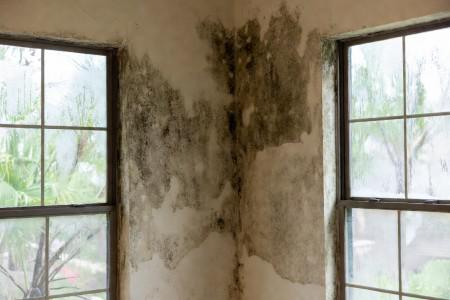
Fort Lauderdale summers do not just feel humid. They deliver a specific combination of temperature, dew point, and duration that pushes indoor spaces into mold-friendly territory even when the AC is running and the house looks fine. Understanding the physics of what is actually happening, and calibrating your AC and dehumidifier accordingly, is what separates a house that develops mold problems every few summers from one that does not.
This guide covers why dew point matters more than relative humidity for mold risk, which rooms in a typical Broward County home fail first, how to read your home’s warning signs before growth starts, and how to actually set your AC and dehumidifier to prevent it.
How Florida’s summer dew point creates indoor condensation you can’t see
Relative humidity gets most of the attention in home comfort advice. For mold risk in a Florida summer, dew point is the number that matters.
The distinction is worth understanding. Relative humidity (RH) is the percentage of moisture the air is holding compared to what it could hold at that temperature. Warm air holds far more moisture than cool air, so the same absolute amount of water in a room can read as 40% RH at 80°F and 70% RH at 65°F. This is why relying on RH alone can be misleading. Your thermostat might read 45% RH in the living room, while the closet wall against the exterior sits at 68°F with 90% RH on its surface.
Dew point is the temperature at which air becomes saturated. Unlike RH, it does not change when air moves to a cooler surface. When air with a given dew point touches any surface at or below that temperature, water condenses on that surface. Every time. That is why the National Weather Service treats dew point, not RH, as the honest measure of how much moisture is actually in the air.
Fort Lauderdale summer dew points routinely sit between 72°F and 78°F from June through September, and touch 80°F on peak days. Anything above 70°F is what meteorologists call oppressive; above 75°F is what most people describe as tropical. It also means any interior surface that drops below the outdoor dew point becomes a condensation site the moment humid air reaches it. That includes:
-
The back side of exterior walls behind furniture pushed against them
-
Interior surfaces of closet walls that share an exterior wall
-
Cold water pipes running through interior wall cavities
-
HVAC ducts and duct boots routed through unconditioned attics
-
The surfaces of AC supply vents in rooms that have been cooling for hours
The condensation itself is usually invisible. It happens in wall cavities, behind cabinets, and on ductwork above ceilings, feeding mold growth for weeks before any surface stain appears. In our own field work, the most common source of a mystery ceiling stain in a Broward home is not a roof leak at all — it is a duct boot sweating in a 95°F attic because the insulation and vapor barrier were never sealed on the attic side.
The rooms where humidity hits hardest: bathrooms, closets, and garages
Certain rooms in a typical Fort Lauderdale home fail before others, and the reason is physics, not luck.
Bathrooms
A single 10-minute shower can push local relative humidity above 90% and add multiple pints of water to the air. If the exhaust fan is undersized, or vents into the attic instead of outside (a surprisingly common builder shortcut), that moisture stays inside the building envelope. Over months of daily use, drywall paper behind tile, framing above the ceiling, and the back side of vanity cabinets cycle through repeated wetting and partial drying. That is prime mold territory.
Closets
Especially closets on an exterior wall. The physics stack up badly here: no ventilation, dense clothing that traps moisture, dead air with no circulation, and a wall surface cooler than the room because it faces the outside. In an air-conditioned Florida home, closet walls against the exterior can run 4 to 6°F cooler than the room. That is enough to bring the surface below the dew point of any humid air that infiltrates. Leather goods, luggage stored on the floor, and clothes at the back of the closet often show mold before anything is visible on the walls.
Garages
Most garages are not conditioned. In summer they run 85 to 90°F with 70 to 85% RH and a dew point matching outdoor air. The shared wall between the garage and the house has cool conditioned space on one side and hot humid air on the other. Condensation forms on the garage side of that wall. Over time, water damage and mold show up on the interior wall of whichever room shares it, most often the primary bedroom or a home office. Attached garages also push humid air into the house every time the connecting door opens.
Other rooms worth watching:
-
Laundry rooms where dryer vents leak or terminate short of the exterior
-
Utility rooms with water heaters and softeners that produce ambient condensation
-
Kitchens where range hoods recirculate rather than vent outside
-
The primary bedroom closet, which combines the closet risk with occupant-generated overnight moisture (a sleeping adult exhales close to a pint of water in eight hours)
Warning signs your home is holding too much moisture
Before mold shows up on a wall, the house tells you it is retaining too much moisture. These are the signals to watch.
Persistent condensation on the inside of windows
In a Florida summer, interior-side window condensation means indoor humidity is high enough that even the modest cooling of the interior glass reaches the dew point. Exterior-side condensation on windows is normal in summer and is not a warning sign.
Sweating metal surfaces
Door hinges, cold-water lines under sinks, toilet tanks, and metal furniture legs developing a wet sheen means the indoor dew point is at or above the surface temperature of those metal parts.
A musty smell when the AC first starts up
This is often the first indicator of biological growth on the evaporator coil, in the drain pan, or on ductwork surfaces. Our signs of hidden mold guide covers what that smell means and how to separate it from other sources. For the specific case of AC-related odors, see our mold growth in HVAC systems guide.
Doors that stick in summer and free up in winter
Wood absorbs moisture when indoor RH is high. If interior doors bind and rub from June to October but move freely from December to March, indoor humidity is running higher than it should for most of the year.
Warped wood flooring or lifting laminate seams
Once these appear, the problem has been building for months.
Peeling paint on ceilings or walls, especially near AC vents
Cool surfaces plus humid air plus paint losing its bond equals condensation happening faster than the wall assembly can handle it.
Hygrometer readings consistently above 55% RH indoors
A $15 hygrometer from any hardware store will tell you what is actually happening in each room — and rooms differ, which is the whole point. In a Florida summer, target 45 to 55% RH. Sustained readings above 60% are the range the EPA and ASHRAE both identify as mold-favorable.
If several of these show up in the same room, that room already has hidden condensation happening regularly. Our musty smell diagnostic guide can help distinguish moisture-driven odors from other sources. If the signs spike specifically after rain rather than running all summer, read our companion piece on why summer thunderstorms create ideal conditions for mold — that is a different mechanism with a different fix.
AC settings and dehumidifier habits that keep mold at bay
Most Florida homeowners run their AC in ways that maximize cooling and minimize dehumidification. A few calibration changes flip that.
Set the fan to AUTO, not ON
With the fan running continuously, air keeps blowing across the evaporator coil after the cooling cycle ends. That coil is wet with condensate the compressor just pulled out of the air, and air moving across a wet coil re-evaporates the water back into the house. Switching to AUTO (fan runs only during the cooling cycle) lets the coil drain properly. In humid climates this single change can drop indoor RH by 5 to 10 points, at zero cost.
Aim for longer runtimes at a higher setpoint, not colder blasts at a lower one
A common mistake is setting the thermostat to 72°F expecting drier air. What actually happens is the AC hits 72°F quickly on a mild day, shuts off, and never runs long enough to remove moisture. A slightly higher setpoint — 76 to 78°F — with longer, steadier runtimes usually produces lower indoor RH than a lower setpoint that short-cycles. It also costs less to run.
Right-sized AC dehumidifies better than oversized AC
This is the single most misunderstood point in Florida residential HVAC. An oversized system short-cycles: it hits the temperature setpoint fast, shuts off, and leaves moisture in the air. A properly sized system runs longer and pulls more water out. Oversizing is not a small problem here — in our load calculations on South Florida homes we routinely find existing systems 25% or more above the calculated load, which is enough to leave a house at 60% RH all summer while the thermostat reads a comfortable 75°F.
If you are replacing your AC, ask the installer for a Manual J load calculation, not a rule-of-thumb tonnage by square footage. Variable-speed and two-stage systems handle humidity better than single-stage units in Florida because they can run at reduced capacity for longer periods.
Use a thermostat that senses humidity, not just temperature
Modern smart thermostats (Ecobee, several Honeywell models, some Nest configurations) can call for cooling based on an RH target rather than temperature alone. Set a 50% RH ceiling and the system will run to hit that number even when room temperature is already at setpoint. Note the tradeoff: this "overcool to dehumidify" strategy uses more energy, which is exactly why a dedicated dehumidifier is often the better answer.
Consider a whole-home dehumidifier for the shoulder seasons
From November through April, the AC does not run enough to dehumidify, because outdoor temperatures do not demand much cooling. This is often when hidden mold gets started, and it is the gap almost no Florida homeowner plans for. A standalone unit rated for 50 pints per day handles a single room. A ducted whole-home dehumidifier (Aprilaire, Santa Fe, and similar) handles the whole house and can run independently of the cooling call. On tight, well-insulated homes we frequently specify 100 to 130 pints per day — the sizing follows the latent load, not the square footage.
Change filters monthly in summer
A loaded return-air filter reduces airflow across the coil, which reduces dehumidification. Filter cost is trivial next to the mold problem a starved coil can seed. Our companion article on whether your AC is making your allergies worse covers MERV selection and the airflow tradeoff in detail.
Schedule annual coil cleaning
Biofilm on the evaporator coil both reduces heat exchange and becomes a mold source when the coil is wet — which, in a Florida summer, is most of the time.
For the broader prevention framework across all seasons, see our high humidity mold prevention guide, which covers strategies beyond the AC calibration angle here. If you want the equipment side handled, our moisture control services page covers dehumidification and attic ventilation assessments.
When high humidity has already turned into a mold problem
The transition from "high humidity" to "active mold problem" is gradual and easy to miss. These are the thresholds where the response shifts from calibration to investigation:
-
A musty smell in a specific room that does not clear after airing out, running the AC on a fresh filter, and cleaning surfaces
-
Visible growth of any size on drywall, ceilings, wood, or fabric
-
Water stains that appeared with no identifiable leak (often hidden condensation)
-
Allergy or respiratory symptoms in the household that improve when away from the house
-
Multiple warning signs from the section above clustered in the same area
At any of these thresholds, the moisture has already found something to grow on. Reducing humidity from that point forward slows the problem; it does not resolve growth that has already happened. That requires assessment and, above a defined threshold, licensed remediation.
What Florida law actually requires
This is worth stating precisely, because a lot of marketing gets it wrong. Under Florida Statute 468.8411, "mold remediation" is defined as the removal, cleaning, sanitizing, demolition, or other treatment of mold or mold-contaminated matter greater than 10 square feet. Above that threshold, the work falls under Chapter 468, Part XVI and is a licensed activity.
There is a second requirement most homeowners never hear about. Under Florida Statute 468.8419, a mold assessor generally may not remediate a structure they assessed within the previous 12 months, and a remediator generally may not assess a structure they remediated within the previous 12 months. The point is to stop one company from writing its own scope and then billing against it. In practice, that means an independent licensed mold assessor writes the protocol and post-remediation verification, and a licensed mold remediator executes it. If a company offers to do both on the same job with no independent assessor involved, ask why.
If the problem is caught early and stays contained, minor surface mold on a hard, non-porous surface can often be handled by a homeowner. For anything on drywall, inside the HVAC system, on porous materials, or anywhere the moisture source is unclear, the path forward is a licensed inspection. Our emergency mold response guide covers when an acute response is warranted versus when a scheduled inspection is enough.
Frequently asked questions
What indoor humidity level prevents mold in Florida?
Target 45 to 55% relative humidity year-round. Sustained readings above 60% are the range EPA and ASHRAE identify as mold-favorable. Measure it room by room, not just at the thermostat — a closet or a bathroom can sit 10 points above the rest of the house.
Is dew point or relative humidity more important for mold risk?
Dew point. Relative humidity changes with temperature, so a room can read 45% RH while a cooler wall surface behind a dresser sits near saturation. Dew point does not change when air moves to a colder surface, so it tells you exactly which surfaces will condense.
Should my AC fan be on AUTO or ON in Florida?
AUTO. With the fan set to ON, air blows across a wet evaporator coil after the compressor stops and evaporates that condensate straight back into the house. AUTO lets the coil drain. It is the cheapest humidity fix available and typically drops indoor RH by 5 to 10 points.
What thermostat setting prevents mold in a Florida home?
76 to 78°F with the fan on AUTO usually produces lower indoor humidity than 72°F, because the system runs longer per cycle and removes more moisture. Chasing a colder setpoint on a mild day causes short-cycling, which cools the air without drying it.
Do I need a whole-home dehumidifier in South Florida?
If your indoor RH sits above 55% during the shoulder seasons (November through April), when the AC barely runs — yes, most likely. That period is when a lot of Broward mold quietly starts. A ducted whole-home unit runs independently of the cooling call, which is the whole point.
Why does my closet smell musty even though the AC is running?
Closets on exterior walls run 4 to 6°F cooler than the room, have no air circulation, and are packed with porous material. The AC keeps the room comfortable while the closet wall surface sits below the dew point of any humid air that leaks in. Louvered doors, a small circulation fan, or moving the contents off the exterior wall all help.
How much mold requires a licensed remediator in Florida?
Florida Statute 468.8411 defines mold remediation as work on mold or mold-contaminated matter greater than 10 square feet. Above that, it is a licensed activity under Chapter 468, Part XVI. Below it, a homeowner may handle surface mold on hard non-porous materials — but the 10 square feet you can see is often not the full extent of what is behind the drywall.
Can I just run a dehumidifier instead of the AC?
Not as a substitute in a Florida summer. A dehumidifier adds sensible heat to the space while it removes moisture, so on a 92°F day it will fight your comfort. The correct pairing is AC for sensible cooling plus a dehumidifier sized for the latent load, working together — and the dehumidifier carrying the shoulder seasons on its own.
Getting help
AdvantaClean of Fort Lauderdale provides mold inspection and remediation, moisture control, and mold testing coordination across Broward County. If the warning signs above are showing up in a specific room, an assessment identifies the moisture source before it becomes a demolition scope. See recent projects for what that has looked like on real Broward homes.
AdvantaClean of Fort Lauderdale — 236 NE 33rd St, Oakland Park, FL 33334. Serving Fort Lauderdale, Oakland Park, Wilton Manors, Lauderdale-by-the-Sea, Pompano Beach, Deerfield Beach, Plantation, Davie, and Broward County. Call (754) 218-8070 or request service online. Emergency response available 24/7.
ABOUT THE AUTHOR
Mariano Llorian is the owner and qualifying agent of AdvantaClean of Fort Lauderdale (Innoveco LLC), 236 NE 33rd St, Oakland Park, FL 33334. He holds Florida license CBC1269223 (Certified Building Contractor), CAC1823910 (Class A Air Conditioning Contractor), and MRSR2683 (Mold Remediator), and is licensed for radon mitigation (R3039 / RB3040). Licenses are verifiable through the Florida DBPR license portal. He has spent more than a decade diagnosing moisture, mold, and HVAC failures in Broward and Miami-Dade buildings, from single-family homes to commercial restaurant build-outs.
Technically reviewed July 2026 against EPA mold guidance, ASHRAE humidity recommendations, and Chapter 468, Part XVI of the Florida Statutes.