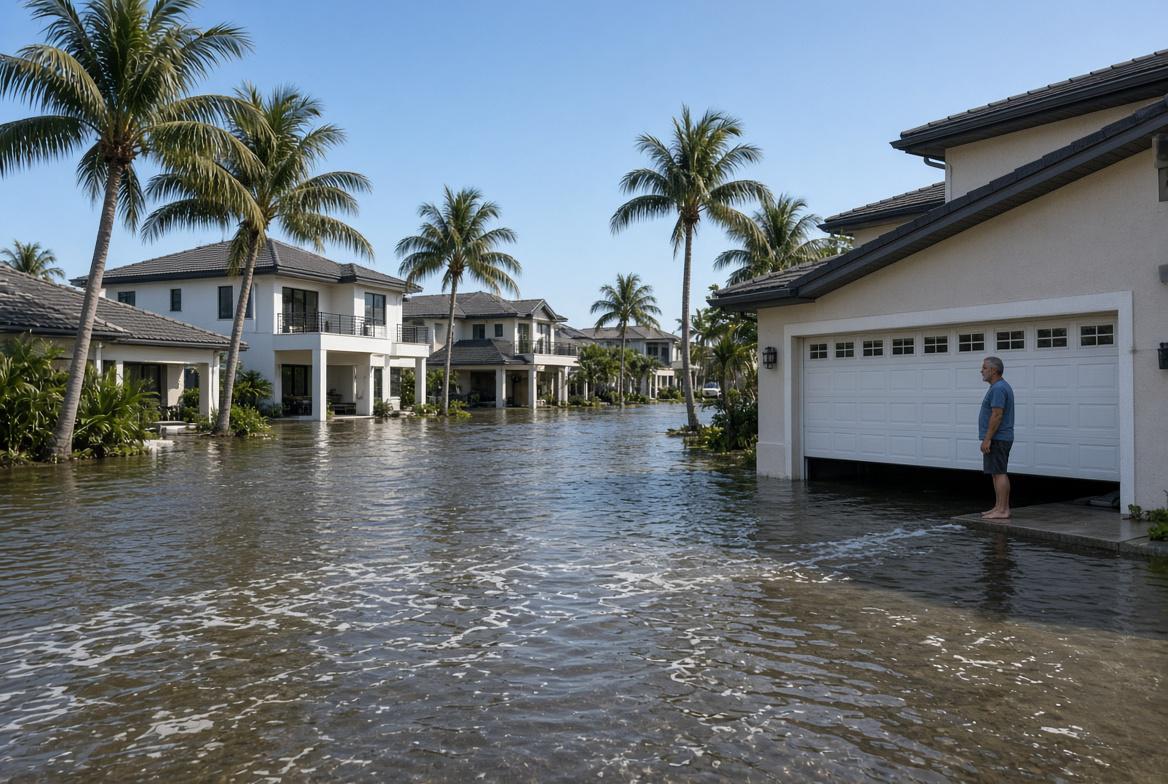
Some of the worst flooding a Broward County homeowner will see this year will arrive on a clear, sunny afternoon with no rain in the forecast.
King tides are the highest predicted tides of the year, and along the Fort Lauderdale coast they push saltwater up through storm drains and over seawalls into streets, driveways, and garages. The City of Fort Lauderdale expects elevated tides on at least 40 days in 2026.
The useful thing about king tides, unlike hurricanes, is that they are predictable. NOAA publishes the dates a year ahead. That gives homeowners something rare in disaster preparation: a calendar.
This guide covers the 2026 dates, which neighborhoods flood first and the geology behind it, why saltwater damages more than rainwater does, what to do during and after an event, and what actually works for long-term protection.
What king tides are and why they peak in the fall
A king tide is an exceptionally high tide produced when the gravitational pull of the sun and moon align, which happens around new and full moons. When that alignment coincides with the moon at perigee, its closest approach to Earth, the effect is amplified further.
Fall is the peak season in South Florida for reasons that stack on top of the astronomy. Ocean water expands as it warms, and Atlantic water temperatures peak in late summer and early fall. Seasonal shifts in the Gulf Stream reduce the current's ability to hold water offshore. Prevailing easterly winds push water toward the coast. Layer those onto an already high astronomical tide and the result is water levels well above anything the drainage system was designed for.
Peak conditions typically last about three hours, with water noticeably elevated for roughly one and a half to two hours on either side of peak.
Predicted 2026 king tide windows for the Fort Lauderdale area:
-
September 9 to 13
-
September 26 to October 1
-
October 7 to 13
-
October 24 to 31
-
November 5 to 11
-
November 22 to 28
-
December 5 to 8
-
December 23 to 27
Peaks vary by location, and actual water levels can exceed predictions when wind, rain, or offshore conditions compound them. The South Florida Water Management District publishes a weekly Tidal Outlook during the season, developed with the University of Miami's Rosenstiel School, that incorporates wind, sea surface temperature, and swell into refined local forecasts. The City of Fort Lauderdale maintains a king tides page with current dates, and Broward County publishes station-specific predictions keyed to the NOAA gauge at South Port Everglades.
One technical note worth knowing: Broward's observed flooding threshold is generally lower than the official NOAA high-tide-flooding threshold for the region. Streets here start taking on water before the official trigger is reached, which means an outlook that does not sound alarming can still put water in your driveway.
Which Broward neighborhoods flood first and why
Tidal flooding concentrates in low-lying areas near the Intracoastal, the New River, and the finger-island canal developments. The neighborhoods that see it first and most often include:
-
The Las Olas isles, including Isle of Capri, Nurmi Isles, Seven Isles, Hendricks Isle, and Riviera Isles
-
Victoria Park
-
Rio Vista
-
Idlewyld and Harbor Beach
-
Sailboat Bend and areas along the New River
-
Coral Ridge and Coral Ridge Country Club Estates
-
Bay Colony
-
Lauderdale-by-the-Sea
-
Low-lying sections of Pompano Beach, Hollywood, and Dania Beach
Three physical factors explain why these areas go first.
Elevation. Much of this housing stock sits only a few feet above sea level, and the finger islands were built on dredged fill in the 1920s through 1950s, before anyone was designing for the water levels we see now.
Gravity drainage that runs backward. The stormwater system relies on gravity outfalls that discharge into canals and the Intracoastal. When tide levels exceed the outfall elevation, water flows the wrong direction and comes up through street drains. This is why flooding appears in the middle of a street on a cloudless day. Fort Lauderdale has installed roughly 50 tidal valves to block that reverse flow, which helps but does not fully solve it.
Porous limestone. This is the part most people miss. South Florida sits on oolitic limestone that water moves through readily. As tide levels rise, groundwater rises with them. Water comes up through the ground, not only over the seawall. That is why a wall alone cannot keep a low-elevation property dry, and why drainage and pumping matter as much as barriers.
Seawall condition is the fourth variable. Many older seawalls sit below current minimum elevation standards, and in Fort Lauderdale seawall maintenance is generally the property owner's responsibility. If yours is original to a mid-century home, its elevation is worth checking against the city's current requirement.
How tidal flooding damages garages, driveways and ground floors
Here is the part that separates tidal flooding from a rain event, and it is the reason a shop vac and a fan are not a sufficient response.
King tide water is seawater, and seawater is Category 3. Under the IICRC S500 standard that professional restorers work from, seawater and rising surface water are classified as grossly contaminated Category 3 water, the same category as sewage. Street flooding also picks up whatever is on the road: petroleum residue, fertilizer, animal waste, and in areas with older infrastructure, occasional sanitary sewer overflow. Porous materials that sit in it do not get dried and saved. They get removed.
The salt stays after the water leaves. This is the single most important thing to understand about saltwater intrusion. Salt is hygroscopic, meaning it attracts and holds atmospheric moisture. When floodwater recedes and the surface looks dry, salt crystals remain inside drywall, concrete, wood, and insulation. They keep pulling humidity out of the air indefinitely, which means the material never fully dries and stays at a moisture content that supports mold growth. In a climate where indoor humidity already runs high, this can keep a wall cavity damp for months. Rinsing with fresh water before drying is a required step in saltwater remediation, and it is one homeowners almost never perform.
Salt is aggressively corrosive. It attacks metal fasteners, appliance components, HVAC coils and condensers, electrical connections, and the steel rebar inside concrete. Rebar corrosion is slow and expensive: as steel oxidizes it expands, cracking the concrete around it, which is what spalling in seawalls, driveways, and garage slabs actually is.
Specific damage patterns to expect:
-
Garages: water wicks into drywall from the slab up, damages anything stored on the floor, corrodes water heaters and appliances, and gets into the bottoms of cabinetry. Vehicles parked in even six inches of saltwater can sustain damage to electronics, brake components, and undercarriage.
-
Driveways and pavers: salt crystallization in concrete pores causes surface scaling and, over repeated exposures, cracking. Paver sand washes out and joints destabilize.
-
Ground floors: water enters at door thresholds and through the slab, wicking upward into drywall. Baseboards, bottom plates, and insulation are commonly affected even when standing water never rose more than an inch or two indoors.
-
Landscaping and irrigation: saltwater kills most non-native plantings and can damage irrigation components.
-
Pool equipment and outdoor mechanicals: pumps, filters, and electrical panels sitting at grade are exposed.
Our water damage restoration cost guide covers what Category 3 remediation runs per square foot, and the sewage backup guide covers the same Category 3 handling protocol.
Steps to take during and immediately after a tidal flood event
Before the window arrives, since you have the dates:
Move vehicles to higher ground or a parking garage. Lift anything stored on garage or ground floors onto shelving or pallets, ideally 12 inches or more. Move irreplaceable items off the ground floor entirely. Check that floor drains and any sump equipment work. Bring in waste carts, which float and end up in canals. Sandbags or reusable water barriers at garage doors and thresholds help when placed before water arrives, not during.
During the event:
Do not drive through flooded streets. Saltwater damages vehicles, hides road hazards, and pushes wakes into neighbors' garages. Where cities post no-wake signs on flooded residential streets, that is why.
Stay out of standing water. It is Category 3, and downed electrical or energized equipment is a real hazard.
Keep power off to any circuit serving equipment sitting in water.
Photograph conditions as the water peaks, from a safe location. Time-stamped documentation matters for any claim.
Immediately after the water recedes, and this is where the saltwater difference shows up:
Rinse affected hard surfaces with fresh water. Driveways, garage slabs, exterior walls, and any metal that got wet should be hosed down to carry salt away before drying. Skipping this leaves salt in place to keep drawing moisture and corroding metal.
Start drying quickly, but understand what drying alone accomplishes. Air movement and dehumidification are necessary and insufficient. Salt-contaminated porous material may need removal rather than drying.
Assume the 48 hour clock is running. Mold growth begins on damp materials within roughly 24 to 48 hours, and South Florida humidity keeps it on the fast end. Our emergency mold guide covers that window in detail, and the Lauderdale-by-the-Sea guide covers coastal-specific mold risk.
Rinse and inspect vehicles that sat in saltwater, particularly the undercarriage and brakes.
Document everything before disposal, including photos of damaged contents and their condition.
Call a restoration professional if water entered the structure at all. Category 3 intrusion into a building is not a DIY scenario, even at an inch.
Our hurricane supply kit guide covers the moisture-control equipment worth keeping on hand, most of which applies to tidal events too.
Long-term protection: barriers, drainage and moisture control
Insurance first, because there is a deadline attached. Homeowners insurance does not cover flood, and tidal flooding is flood. Coverage requires an NFIP policy or private flood insurance. Critically, NFIP carries a 30-day waiting period before a new policy takes effect. Since the king tide calendar is published a year in advance, you can compare the two directly: if you buy today, you are covered starting in early October, not for the September window. Two limitations worth knowing: NFIP generally does not cover contents stored in a garage, and it does not cover vehicles at all, which fall under auto comprehensive coverage instead.
Barriers. Flood barriers at garage doors and entry thresholds, either sandbags or reusable panel and inflatable systems, are effective for the depths typical of tidal events. Automatic flood barriers exist for garage openings. Backflow preventers on sewer laterals stop the other direction of intrusion, which matters when the sanitary system surcharges during tidal events.
Drainage and pumping. Because water rises through limestone as well as over seawalls, drainage matters as much as barriers. Options include French drains and dry wells, sump systems with battery backup, regrading to move water away from the structure, and permeable paving that lets water pass rather than pool. Check that your yard drains and any existing sump equipment actually function before the season, not during it.
Seawall condition. Have yours inspected if you have one. Look for cracking, spalling, exposed rebar, tie-back failure, and voids behind the wall. Elevation matters as much as condition, and older walls frequently sit below current standards.
Elevation. For repeatedly flooded properties, elevating mechanical equipment, electrical panels, HVAC condensers, pool equipment, and water heaters above expected flood levels is the highest-value structural change short of elevating the building. FEMA and some local programs offer mitigation grants worth investigating.
Moisture control after the fact. Because salt keeps drawing moisture, properties that have taken saltwater benefit from ongoing humidity monitoring in affected areas. A hygrometer in the garage costs about fifteen dollars. Readings that stay above 60 percent long after an event suggest salt is still holding moisture in the materials. Our summer humidity guide covers what those numbers mean and how to bring them down.
Sign up for alerts. The SFWMD weekly Tidal Outlook, City of Fort Lauderdale notifications, and Broward County resilience updates all provide advance warning. Fort Lauderdale also posts expected high tide times on social media during the season.
Frequently asked questions
When are the 2026 king tides in Fort Lauderdale? Predicted windows run September 9 to 13, September 26 to October 1, October 7 to 13, October 24 to 31, November 5 to 11, November 22 to 28, December 5 to 8, and December 23 to 27. Peaks vary by location, and conditions can exceed predictions. Check the City of Fort Lauderdale king tides page or the SFWMD weekly Tidal Outlook for current forecasts.
Does homeowners insurance cover king tide flooding? No. Tidal flooding is flood, which standard homeowners policies exclude. You need NFIP or private flood coverage, and NFIP has a 30-day waiting period, so it cannot be purchased in response to an approaching event.
Is saltwater flooding worse than rainwater flooding? For building materials, generally yes. Seawater is classified as Category 3 contaminated water, and salt remains in materials after the water dries, continuing to attract moisture and corrode metal and rebar. A saltwater event of the same depth typically causes more lasting damage than a freshwater one.
Can I just let my garage dry out on its own? Not if saltwater entered. Surfaces should be rinsed with fresh water to carry salt away before drying begins, and porous materials that absorbed saltwater often need removal rather than drying. Passive drying leaves salt in place to keep the material damp.
Why does my street flood when there is no rain? Stormwater outfalls drain by gravity into canals and the Intracoastal. When tide levels rise above the outfall elevation, flow reverses and seawater comes up through the drains. South Florida's porous limestone also lets groundwater rise with the tide, pushing water up through the ground.
Will a seawall stop king tide flooding? It helps but rarely solves it alone, because water also rises through the limestone beneath the property. Effective protection usually combines seawall elevation and condition with drainage, pumping, and barriers at openings.
Is my car covered if it floods in the driveway? Not under flood insurance or homeowners. Vehicle flood damage falls under the comprehensive portion of an auto policy. If you carry liability only, a flooded vehicle is generally not covered.
How soon does mold start after tidal flooding? The same 24 to 48 hour window applies as with any water intrusion, and residual salt extends the risk well past the initial event by keeping materials from fully drying.
Getting help
King tides are the one flood risk in South Florida that arrives on a published schedule. That makes the preparation straightforward: know your dates, move what can be moved, get barriers in place beforehand, and confirm your flood coverage far enough ahead that the waiting period has run.
If water does get into the structure, the response differs from a rain event. Rinse before drying, treat it as Category 3, and do not assume dry surfaces mean dry materials.
AdvantaClean of Fort Lauderdale provides flood and water damage restoration across Broward County, including Fort Lauderdale, Deerfield Beach, Plantation, and Pompano Beach, with experience in the saltwater intrusion patterns specific to coastal and Intracoastal properties. Our Pompano Beach flooding guide covers that area specifically. To schedule an assessment or request emergency response, call (754) 218-8070 or visit our local team page.