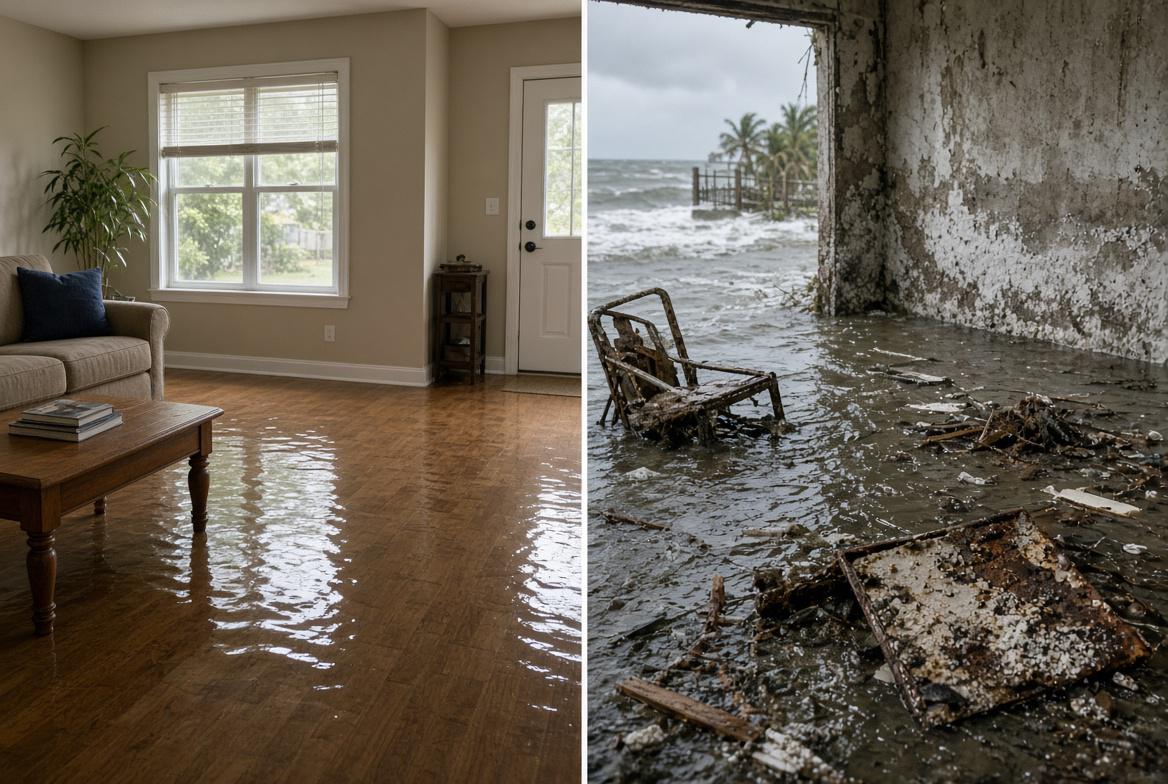
Two houses on the same Fort Lauderdale street take on eleven inches of water in the same week. One from a burst supply line upstairs that ran overnight. One from storm surge pushing up the canal.
Same depth, same materials, same drying equipment. Six months later the first house is fine. The second has corroded outlets, a failing air handler, drywall that reads damp on a meter despite two rounds of drying, and mold behind a wall that was supposedly remediated in week one.
The difference is not how much water arrived. It is what the water left behind.
The water leaves. The salt stays.
Freshwater damage follows a logic most people already understand. Water gets into materials, you extract what you can, you run dehumidifiers and air movers until the moisture content matches unaffected areas of the building, and the problem is over. Once it is dry, it is dry.
Saltwater does not work that way, because the salt does not evaporate. When seawater soaks into drywall, concrete, wood framing, or insulation and the water phase evaporates, sodium chloride crystals stay behind inside the material.
Those crystals are hygroscopic, meaning they actively pull moisture out of the surrounding air. In a wall cavity in Broward County, where indoor humidity routinely sits above 60 percent, salt-loaded gypsum will keep drawing atmospheric moisture indefinitely. The material never reaches the dryness the drying equipment was supposed to deliver, because the salt keeps resupplying it.
This is why a saltwater-affected wall can pass a visual inspection, feel dry to the touch, and still support mold growth three months later. The moisture source was never fully removed. It was converted from standing water into a permanent moisture magnet embedded in the material.
There is a second problem running in parallel. Chloride ions are aggressively corrosive to metal, and they do not stop working once the building is dry.
|
Freshwater flooding |
Saltwater flooding |
|
|
IICRC category |
Category 1 to 3 depending on source and elapsed time |
Category 3 from the outset; seawater is classified as grossly contaminated |
|
After drying |
Material is dry and stable |
Salt remains in material and continues attracting moisture |
|
Corrosion |
Limited, mostly surface rust on exposed steel |
Ongoing attack on fasteners, electrical, HVAC, appliances, and rebar |
|
Drying targets |
Standard equilibrium moisture content applies |
Salt lowers the humidity at which material stays damp; standard targets are unreliable |
|
Moisture readings |
Meters read accurately |
Pin-type meters read artificially high because salt conducts |
|
Required steps |
Extract, dry, verify |
Extract, rinse with fresh water, dry, verify moisture and chlorides |
|
Removal thresholds |
Cut above the visible waterline |
Cut higher, because salt wicks above the waterline |
|
Verification timing |
At drying completion |
At completion plus extended monitoring |
|
Long-term risk |
Low once dried and verified |
Recurring moisture, delayed mold, progressive corrosion |
|
Insurance |
Often covered as sudden and accidental |
Flood; excluded from homeowners, requires NFIP or private flood |
What the corrosion actually reaches
Chloride corrosion is slower and quieter than water damage, which is why it is usually discovered after the restoration invoice has been paid.
Electrical systems. This is the most serious category. Standard industry guidance, including from NEMA, is that electrical equipment submerged in floodwater should be replaced or factory reconditioned rather than dried and returned to service. Saltwater makes that guidance close to absolute: chlorides remain inside breakers, panels, outlets, switches, and conductor terminations, and they keep corroding contact surfaces long after the visible water is gone. The failure mode is not always immediate. Degraded connections generate heat under load, which is a fire risk that can develop months later. Any submerged electrical component needs evaluation by a licensed electrician, and replacement is usually the answer.
HVAC. Condenser coils, evaporator coils, and the metal cabinet are all vulnerable. Coastal HVAC equipment already fails early from ambient salt exposure. Direct saltwater contact accelerates that considerably. If ductwork or the air handler took saltwater, the system needs professional assessment before it runs again, both for corrosion and because running it distributes contamination.
Appliances. Water heaters, washers, dryers, refrigerators, and pool equipment all combine metal housings with electronic controls. Even where the appliance still runs after drying, salt in the control board and motor windings shortens service life substantially.
Structural fasteners and connectors. Hurricane straps, joist hangers, nail plates, and anchor bolts are galvanized rather than stainless in most residential construction. Galvanizing sacrifices zinc to protect steel, and chlorides consume that coating faster. This matters in a region where those connectors are the wind-resistance system.
Concrete and rebar. The slow, expensive one. Chlorides migrate through concrete pores to the reinforcing steel, break down the passive layer that normally protects it, and start corrosion. Corroding rebar expands to several times its original volume, which cracks the surrounding concrete from the inside. That is what spalling in seawalls, balconies, and garage slabs actually is. In a post-Surfside regulatory environment, this is not a cosmetic concern for multifamily buildings.
Metal finishes throughout. Door hardware, hinges, window tracks, plumbing fixtures, cabinet hardware, and any exposed metal will show accelerated pitting and staining.
Why the sequence reverses
In freshwater restoration, extraction is followed immediately by drying. Adding water to a wet building would be absurd.
In saltwater restoration, that is exactly what has to happen.
Fresh water rinse comes before drying. Salt has to be flushed out of and off of materials while it is still dissolved and mobile. Once the water evaporates, the salt crystallizes in place inside the pore structure and becomes far harder to remove. Hard surfaces, structural elements, concrete, masonry, and any metal that will remain in service get rinsed with clean water first. Only then does drying begin. Homeowners who extract and immediately set up fans, which is the correct instinct for freshwater, lock the salt into the material.
Moisture meters lie in salt-contaminated material. Pin-type meters work by measuring electrical resistance between two probes. Dissolved salts are conductive, so salt-loaded material reads as significantly wetter than it actually is. A technician working from pin readings alone can chase a number that will not come down, over-dry the assembly, and still not know the real moisture content. Pinless meters, which use capacitance or radio frequency, are less affected but not immune. On saltwater losses, readings need interpretation against reference materials and, ideally, corroboration with a different measurement method.
Chloride testing verifies what moisture readings cannot. Salt contamination is measured directly using chloride test kits or strips on surface samples. This is the only way to confirm that the rinse actually worked. A material can be dry and still be loaded with chlorides, which means it will not stay dry. Skipping this step is the most common reason saltwater jobs come back.
Removal thresholds go higher. Standard practice on a Category 3 freshwater loss is a flood cut somewhere in the range of twelve to twenty-four inches above the visible waterline. Saltwater wicks upward through capillary action and deposits salt above the line the water visibly reached, so cuts generally need to go higher than the same loss would warrant in freshwater.
Verification extends past the job. Because salt draws moisture from the air over time, a saltwater property benefits from humidity monitoring in affected areas for weeks after the crew leaves. Readings that climb back up after equipment is removed indicate residual salt rather than a new water source.
Our water damage restoration cost guide covers what Category 3 work runs per square foot, and the restoration timeline guide covers how these extra steps affect schedule.
What survives and what does not
The honest version of this list is shorter on the salvage side than most homeowners expect.
|
Material |
Freshwater, caught fast |
Saltwater |
|
Drywall |
Often dried in place |
Removed |
|
Fiberglass or cellulose insulation |
Sometimes dried |
Removed |
|
Carpet and pad |
Pad removed, carpet sometimes cleaned |
Both removed |
|
Particleboard or MDF cabinetry |
Usually removed |
Removed |
|
Solid wood cabinetry |
Often salvageable |
Sometimes, with rinsing and slow drying |
|
Hardwood flooring |
Sometimes salvageable |
Rarely |
|
Tile and stone |
Salvageable |
Usually salvageable if substrate is sound |
|
Concrete and masonry |
Salvageable |
Salvageable after rinsing, with long-term rebar monitoring |
|
Submerged electrical components |
Evaluate, sometimes salvageable |
Replace |
|
HVAC equipment |
Often serviceable |
Professional evaluation, frequently replaced |
|
Appliances |
Often serviceable |
Shortened life even when functional |
|
Upholstered furniture and mattresses |
Removed if Category 3 |
Removed |
|
Clothing and textiles |
Launderable |
Usually launderable, though salt sets some stains |
|
Glass, ceramics, hard non-porous goods |
Salvageable |
Salvageable after rinsing |
|
Documents and photographs |
Freeze-drying possible |
Freeze-drying possible, act quickly |
The pattern is simple enough to state in one line: porous materials that absorbed saltwater come out, non-porous materials get rinsed and stay, and anything with metal or electronics inside it needs an expert opinion regardless of whether it still appears to work.
The practical upshot
If your building took storm surge, tidal flooding, or any seawater intrusion, three things follow.
The estimate will not look like a freshwater estimate for the same depth of water, and the reason is the rinse phase, the higher removal thresholds, the corrosion assessment, and the extended verification, not padding.
Anything electrical that was submerged should be evaluated by a licensed electrician before it is energized, and expect replacement rather than drying.
If the drying was done without a fresh water rinse, or without chloride verification, treat the job as incomplete regardless of what the moisture readings said. Salt left in the material will keep it damp, and the mold that follows will arrive weeks or months after everyone assumed the problem was solved. Our emergency mold guide covers what that looks like when it surfaces.
For homeowners in coastal and Intracoastal neighborhoods where this is a recurring rather than one-time risk, our king tides guide covers the seasonal calendar and what to do before the water arrives.
AdvantaClean of Fort Lauderdale handles flood and storm surge restoration across Broward County, including the saltwater-specific protocols described here. If you are trying to work out whether a completed job was done correctly, or you are looking at an estimate and want to understand what should be in it, call (754) 218-8070 or reach the local team here.