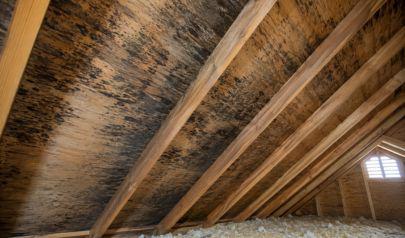
Roofers find it. Home inspectors find it. HVAC contractors doing a system replacement find it. Attic mold in Marietta has a way of being discovered by whoever happens to be up there for some other reason, often after it has been growing undisturbed for a year or two. By that point, the colony is usually extensive, spread across broad sections of the roof deck, and the homeowner is hearing about it for the first time, with a contractor standing in their living room explaining what needs to happen.
That gap between when attic mold starts and when it gets found is not a mystery. Most homeowners go into their attics once or twice a year, typically to swap out holiday decorations or check the depth of the insulation. The inspection is not thorough, the lighting is poor, and nobody is looking at the underside of the roof deck where the mold actually grows. The problem runs quietly in the background until someone with a reason to look closely up there notices it.
Three Reasons Marietta Attics Grow Mold That Others Do Not
Attic mold is not uniformly distributed across all housing stock in all climates. Marietta has some specific conditions that make it a recurring problem here in ways it is not in drier parts of the country.
Georgia's humidity is the foundation of it. Relative humidity in Marietta during summer regularly exceeds 80 percent outdoors, and that air finds its way into attic spaces through every gap and unsealed penetration in the ceiling below. Recessed light fixtures, attic access hatches, gaps around plumbing stacks, and the seams between drywall and framing all act as pathways. Warm, moisture-laden air rises into the attic space, contacts the comparatively cooler roof deck, and deposits moisture on it. The roof deck stays damp. Damp wood in summer temperatures grows mold.
The tree canopy that defines Marietta's neighborhoods adds another layer. Shaded roofs dry more slowly after rain and dew than roofs in full sun. A roof that stays moist between weather events does not give the wood decking time to dry out, and the cumulative effect over a summer is a roof deck that is wet more often than it is dry.
When the Bathroom Fan Is the Problem
One of the most common causes of concentrated attic mold growth in Marietta homes is bathroom exhaust fans that terminate in the attic rather than being routed to the exterior. The building code requires these fans to vent to the outside. In practice, a lot of them do not, particularly in homes where the fan was replaced or added without a permit, or where older flex duct simply disconnected from the exterior vent over time.
Every shower, every bath, every steam-generating bathroom activity sends a burst of warm, heavily saturated air through that fan. If the duct ends in the attic insulation, all of that moisture goes directly into the space. Do it daily for a few years, and you will have mold concentrated heavily above the bathroom, often in a visible pattern that makes the source obvious once someone looks for it.
Slow Roof Leaks That Hide Well
Marietta's storms are hard on roofs, and the debris they generate is, too. Leaves and small branches accumulate in valleys and around penetrations, hold moisture against the roofing material, and accelerate deterioration of flashing details and vent boots. A small breach that admits water during a hard rain may not drip noticeably inside the attic. It may just wet the roof deck around the entry point, dry partially between events, and wet again the next time it rains. That cycle, repeated over months, produces mold on the deck and surrounding framing without ever creating the ceiling stain that would alert anyone inside the home.
What Proper Attic Mold Remediation Involves
The mold on the roof deck is the visible part of a problem that has a cause, and remediation that does not address the cause is a temporary measure. Before any cleaning begins, the source of moisture must be identified and corrected. Bathroom fans need to be rerouted to the exterior. Roof penetrations need to be repaired. Soffit vents blocked by insulation that was blown in without proper baffles need to be cleared so the ventilation path through the attic actually works.
With the source addressed, the next step is mechanical removal of mold from wood surfaces. Mold on the roof deck is removed by scrubbing and HEPA-vacuuming, which captures loose spores rather than dispersing them into the attic air. For large affected areas, soda blasting cleans the wood surface efficiently and leaves it intact. After mechanical removal, an antimicrobial treatment addresses residual growth. In some cases, an encapsulant is applied over the treated surface, sealing the wood and any remaining staining once the mold has been removed.
If blocked or inadequate ventilation contributed to the problem, correcting it is part of completing the job. Installing baffles to protect soffit vent pathways, adding ventilation capacity, or, in some cases, reconfiguring the attic from a vented to a conditioned space are solutions depending on what the inspection reveals.
Frequently Asked Questions
Does attic mold affect the air inside my home?
It can. Attics are less directly connected to living spaces than crawl spaces, but penetrations around recessed lights, the attic access hatch, and HVAC equipment located in the attic all create pathways for spore migration into the home. Homes with an air handler in the attic are particularly at risk of distributing attic air throughout the living space when the system runs.
How do I know if my attic has mold without going in?
A musty smell in upper-floor rooms or closets, particularly one that is stronger in the morning when the house has been closed up overnight, is a consistent indicator. Water staining on ceilings suggests roof-deck moisture, which may be accompanied by mold. Any home with a bathroom fan that was not specifically verified to exit through the roof or soffit is worth checking.
Is painting over attic mold an acceptable fix?
No. Paint applied over mold covers visible growth without stopping it. The colony continues underneath. Encapsulant products used in mold remediation are different; they are applied after the mold has been removed as a final sealing step, not as a substitute for removing it.
If your Marietta home has any of the risk factors described here, an attic inspection is a reasonable step. AdvantaClean of Marietta handles attic mold assessments and remediation throughout Cobb County and understands what to look for in the local housing stock and climate conditions. See what other homeowners have said on Google, or reach the team at (470) 819-2077.