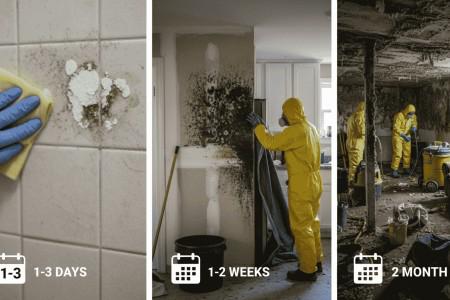
Discovering mold in a home or business almost always brings the same urgent question: how long will this take to fix? The answer is rarely straightforward. Mold remediation does not move at a single speed because every property, moisture problem, and level of contamination is different. Some projects are completed in a matter of days, while others require more than a week of careful work.
What truly determines the timeline is not how fast a crew can clean visible mold, but how thoroughly they can identify and correct the underlying moisture problem, remove contaminated materials, and verify that the indoor environment is safe again. Rushing any of these steps often leads to recurring mold, additional repairs, and higher costs down the line.
This article breaks down typical remediation timelines based on severity, explains what happens during each stage, and clarifies why professional remediation consistently outperforms quick consumer devices such as air purifiers that claim to control mold.
What actually affects the remediation timeline
Mold remediation is more than surface cleaning. The schedule depends on several practical factors that vary from property to property.
The extent of contamination plays a major role. A small, localized patch of mold behaves very differently from widespread growth inside walls or ceilings. The more area affected, the more time is needed for containment, removal, and drying.
The type of materials involved also matters. Porous materials like drywall, insulation, and carpeting cannot be reliably cleaned once mold has penetrated them, so they usually must be removed and replaced. This step alone can add days to a project.
Finding and stopping the moisture source is just as important as removing the mold. If a hidden leak, roof issue, or humidity problem remains unresolved, mold will return no matter how thoroughly surfaces are cleaned. Many South Florida properties face exactly these challenges, which is why proactive maintenance such as keeping Pompano Beach properties steady after winter water damage is often crucial.
Accessibility is another key factor. Mold in open, visible areas is faster to treat than mold hidden in crawl spaces, attics, or behind cabinetry, where additional inspection and demolition may be required.
Typical remediation timelines by severity
The following estimates reflect common professional projects in residential and commercial settings. Actual timelines can be shorter or longer depending on site conditions.
Low-level mold contamination
Typical timeline: one to two days
Low-level mold usually involves small, isolated patches, such as minor growth under a sink, in a bathroom corner, or on a section of drywall exposed to past moisture.
In these cases, professionals typically begin with a focused inspection, followed by containment of the affected area to prevent spores from spreading. Contaminated porous materials are removed when necessary, and remaining surfaces are cleaned and treated with antimicrobial products. Industrial dehumidifiers and air movers are then used to ensure proper drying.
Even at this level, professional oversight is important. Many homeowners rely on consumer devices instead of remediation, yet independent testing shows that air purifiers for mold do not actually solve the problem or eliminate the underlying moisture that allows mold to grow.
Moderate mold contamination
Typical timeline: three to five days
Moderate mold problems usually involve multiple affected areas or hidden growth behind walls, baseboards, or cabinets. These situations require more extensive containment, often including negative air machines with HEPA filtration to protect the rest of the building.
Technicians may need to remove several sections of drywall, inspect wall cavities, and treat larger surface areas. Drying also takes longer because moisture has often penetrated deeper into building materials. This stage is critical, since incomplete drying is one of the most common reasons mold reappears after remediation.
Severe mold contamination
Typical timeline: one to two weeks or more
Severe cases typically occur when water damage has gone unnoticed for a long time or when a property has experienced significant flooding. Mold may be present in multiple rooms, inside structural components, or within insulation and flooring.
Remediation at this level is more involved. Large amounts of contaminated material may need to be removed and replaced. Plumbing, roofing, or ventilation problems often require separate repairs before restoration can be completed. Drying and verification testing take longer because technicians must confirm that spore levels have returned to normal indoor ranges.
Commercial properties, such as restaurants, can face especially complex timelines due to health regulations, business interruption concerns, and the need for structural repairs. The considerations outlined in restaurant water damage and what owners need to know explain why these projects often require careful coordination.
What happens during professional remediation
Most certified remediation projects follow a similar sequence, regardless of severity.
The process begins with a detailed inspection to identify both visible mold and hidden moisture sources. Technicians then establish containment using plastic barriers and negative air equipment to prevent cross-contamination.
Next comes source removal. Instead of attempting to kill mold in place, professionals physically remove contaminated porous materials. This is important because dead mold spores can still trigger allergic reactions.
Remaining non-porous surfaces are cleaned and treated with specialized products, followed by thorough HEPA vacuuming to capture residual spores. Industrial dehumidifiers and air movers are then used to bring the space to proper dryness.
Finally, verification confirms that remediation was successful. Depending on the case, this may include visual inspection or air sampling. This level of rigor is especially important in situations involving potentially dangerous species of mold, such as those discussed in whether black mold is a serious problem in Plantation homes.
Why timelines sometimes change
Even with experienced professionals, schedules can shift. Hidden moisture sources occasionally emerge only after walls are opened. Repairs to plumbing or roofing may need to be completed before drying can finish. South Florida’s humidity can also slow down the process, particularly in poorly ventilated spaces.
Clear communication between property owners and remediation teams helps minimize delays. The sooner access is granted and necessary repairs are approved, the smoother the project tends to move forward.
A realistic perspective on speed and quality
Mold remediation is ultimately about restoring safety, not achieving the fastest possible turnaround. Projects that move too quickly often leave behind moisture, spores, or damaged materials that require additional work later.
A careful, methodical approach may take several days or even weeks in serious cases, but it offers far better protection for both health and property. When done properly, remediation should provide lasting results rather than temporary relief.
Get a precise timeline for your property
If you want an accurate estimate rather than a general range, the best first step is a professional assessment. Certified technicians can evaluate the extent of contamination, locate the moisture source, and outline a clear remediation schedule tailored to your situation.
Request a service evaluation from AdvantaClean to receive a detailed plan, timeline, and next steps for your property. Request service here: https://www.advantaclean.com/request-service/