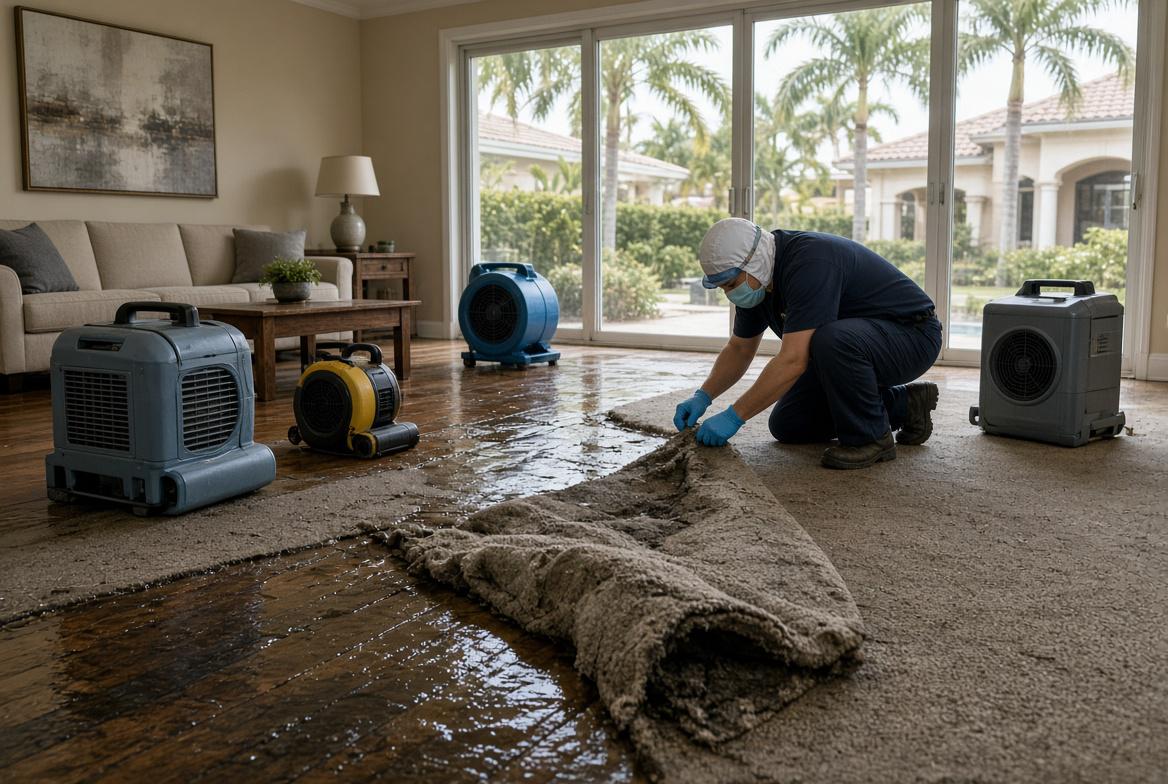
Most people searching this have water on the floor right now, or an estimate in hand they are trying to sanity-check.
The short answer: national 2026 data puts the average residential water damage restoration at roughly $3,870, with most projects landing between about $1,400 and $6,400. Minor isolated leaks caught immediately can come in near $450. Severe flooding with structural damage and mold runs past $16,000.
But that range is so wide it is nearly useless on its own, and the reason it is wide is that "water damage restoration" describes two different kinds of work priced on completely different scales. Understanding that split is the difference between reading an estimate correctly and being blindsided halfway through the job.
This guide covers what the work actually costs, why the water category drives the number more than anything else, why delay reprices the job, what Florida adds to the bill, and how to read an estimate well enough to compare two of them.
Mitigation versus reconstruction: the split that surprises most homeowners
A water damage project has two phases, and they are priced roughly an order of magnitude apart.
Mitigation is the emergency phase: extraction of standing water, removal of unsalvageable materials, and structural drying with commercial dehumidifiers and air movers until materials reach dry standard. Nationally this runs about $3.00 to $7.50 per square foot of affected area.
Reconstruction is putting the building back: drywall, insulation, flooring, trim, cabinetry, paint. This runs roughly $20 to $37 per square foot.
That gap is the single most common source of estimate confusion. A homeowner receives a $2,800 mitigation quote for a flooded bathroom, approves it, and then discovers that replacing the drywall, subfloor, vanity, and tile is a separate project costing several times more.
Neither number is wrong. They price different work. But a quote that stops at "passed dry standard" is describing half the job, and some companies are clearer about that than others.
When comparing bids, the first question is always the same: does this number include putting the room back, or does it end when the equipment comes out? Two quotes that look wildly different are usually pricing different scopes rather than the same scope at different rates.
How the water category drives the price
The IICRC S500 standard, which is the reference document professional restorers work from, classifies water losses by contamination level. This is the biggest single driver of per-square-foot cost.
Category 1, clean water: about $3.00 to $4.00 per square foot. Water from a broken supply line, a failed water heater, a faucet left running, or an overflowing tub with nothing in it. Restoration is extraction, drying, and dehumidification. Materials can often be dried in place rather than removed. Caught quickly, this is the cheapest scenario by a wide margin.
Category 2, grey water: about $4.00 to $6.50 per square foot. Water carrying chemical or biological contamination that can cause illness. Washing machine overflow, dishwasher discharge, toilet overflow containing urine but no solids, aquarium water. Restoration adds antimicrobial treatment, and porous materials like carpet pad and affected drywall generally have to come out rather than be dried.
Category 3, black water: about $7.00 to $7.50 and up per square foot. Sewage backup, rising groundwater, storm surge, or any Category 2 water that has sat long enough to grow serious contamination. This is the most expensive scenario per square foot, roughly two to two and a half times clean water, because biohazard handling adds 25 to 40 percent to labor rates and virtually all porous material in contact with the water must be removed and replaced. A single-bathroom sewage backup commonly runs $3,000 to $7,000.
There is a second axis. The IICRC also assigns a class, from 1 to 4, describing how much material absorbed water and how hard it will be to dry. Category tells you how dirty the water was; class tells you how deeply it soaked in. A small clean-water leak that wicked into wall cavities, under hardwood, or through insulation can cost more than a larger spill sitting on tile. This is why a company cannot quote accurately over the phone.
For more on what each phase involves and how long it takes, see our water damage restoration timeline guide. The blog's restoration versus remediation explainer covers the terminology difference.
Why waiting reprices the job
Water damage is one of the few home repairs where the price changes materially depending on how long you wait, and the reason goes beyond the obvious point that damage spreads.
The category escalates. Category 1 clean water does not stay Category 1. As bacteria multiply in standing water and wet materials, a clean-water loss can reclassify to Category 2 within 24 to 48 hours, and continue from there. That is not a judgment call by the contractor; it is how the standard works. A loss that would have been priced at $3.50 per square foot on day one gets priced at $5.25 or higher by day three, on what is now likely a larger affected area.
Salvageable becomes unsalvageable. Drywall, insulation, subfloor, and cabinetry that could have been dried in place on day one usually have to be removed by day four. Removal converts a mitigation line item into a reconstruction line item, which is the expensive scale.
Mold becomes a second project. Past roughly 48 to 72 hours, mold growth on damp materials is the realistic expectation, and in South Florida humidity the fast end of that window is common. That adds an entirely separate scope with its own licensing requirements and its own insurance sublimit. Our mold remediation cost guide covers what that adds.
Put together, a $3,000 extraction and drying job addressed on day one can become a $12,000 restoration-plus-remediation project by week two. That is not a scare tactic, it is arithmetic on category escalation plus material loss plus a second trade.
Our emergency mold response guide covers what to do in the first 24 hours to stay on the cheap side of this curve.
What South Florida adds to the bill
National averages assume a temperate climate, wood-frame construction, and a normal-paced insurance market. Broward County has none of those.
Humidity extends the drying phase. Ambient indoor humidity running 65 to 75 percent means dehumidifiers work harder and longer to pull moisture out of materials. Drying that takes three days in a dry climate often takes five here. Equipment is billed per unit per day, so extra drying days translate directly into cost.
The escalation clock runs faster. Warm, humid conditions accelerate bacterial growth in standing water and mold growth on damp materials. The 24 to 48 hour category escalation window and the 48 to 72 hour mold window both compress here. Delay is more expensive in Fort Lauderdale than the national guidance implies.
Concrete block construction dries slowly. CBS with stucco is standard across much of South Florida, and concrete holds water in its cores well after wood framing would have dried. More drying days again.
Storm season creates demand surges. From June through November, a named storm can generate thousands of simultaneous claims across Broward, Miami-Dade, and Palm Beach. Contractor availability tightens, adjusters fall behind, and regional pricing firms up for weeks afterward. Our post-storm restoration guide covers what that period looks like operationally.
Condo work carries coordination overhead. Association notification, access restrictions, sometimes restricted work hours, and occasionally a requirement to use pre-approved vendors. Our condo water damage guide covers how responsibility and cost typically divide between the unit owner and the association.
What insurance covers and what it doesn't
Water damage coverage is generally broader than mold coverage, but it has firm boundaries.
Sudden and accidental losses are typically covered. A burst supply line, a failed water heater, a dishwasher hose that lets go. This is the core of what homeowners insurance is for.
Gradual damage generally is not. A slow leak under a sink that went unnoticed for months, deterioration from deferred maintenance, or long-term seepage will usually be denied on the grounds that it was not sudden and accidental. This is the single most common denial reason in water claims.
Flood is excluded entirely. Rising groundwater and storm surge require a separate NFIP flood policy or excess flood coverage. A hurricane can produce both wind-driven rain damage, which the homeowners policy handles, and flood damage, which it does not, and allocating between them is a frequent source of dispute.
Mold has its own separate, much lower cap. Even when the water loss is fully covered, the resulting mold remediation is typically capped at a sublimit of $5,000 to $10,000 unless a mold endorsement was purchased before the loss. This catches people off guard, because the water side may be covered generously while the mold side is not.
You have a duty to mitigate. Florida requires policyholders to take reasonable steps to prevent further damage. Documenting that you called for mitigation promptly, started drying, and opened the claim protects coverage. Delay gives the carrier grounds to reduce payment.
Deductibles in Florida are substantial. Standard deductibles of $2,500 to $10,000 are common, and hurricane deductibles are typically calculated as a percentage of the dwelling limit rather than a flat amount. On smaller losses it is worth calculating whether the claim exceeds the deductible enough to be worth filing.
Timing is set by statute. Under Florida Statute 627.70131, carriers must acknowledge a claim within 14 days of notice and pay or deny within 60 days of receiving proof of loss.
How to read and compare a water damage estimate
A comparable estimate has specific properties.
Confirm the scope boundary. Does this quote end at verified dry standard, or does it include reconstruction? This one question explains most of the variance between competing bids.
Look for itemization. A real estimate breaks out extraction, equipment (usually per unit per day), antimicrobial application, material removal, disposal, monitoring visits, and moisture verification. A single line reading "water damage restoration" tells you nothing and cannot be compared.
Check the affected square footage. Per-square-foot pricing applies to the affected area, not your home's total size. If one company scoped 180 square feet and another scoped 400, you are looking at two different assessments of the same loss, and the difference is worth asking about before it is worth choosing on price.
Ask how many equipment days are assumed. Drying is billed by equipment unit per day. An estimate assuming three days in a climate where five is realistic will grow.
Ask whether moisture verification is included. Materials should be confirmed dry against unaffected reference areas before anything closes up. Skipping this is how mold problems surface weeks later.
Ask about insurance billing. Companies that bill carriers directly and estimate in Xactimate, which is what most adjusters work in, reduce friction considerably.
Treat unusually low quotes as information. Water mitigation requires commercial extraction equipment, LGR or desiccant dehumidifiers, and enough air movers to cover the actual affected square footage. A bid well below the others generally reflects less equipment, fewer drying days, or no verification step, and you find out which one later.
Frequently asked questions
What is the average cost of water damage restoration? National 2026 data puts the average around $3,870, with most residential projects between roughly $1,400 and $6,400. Minor incidents can run about $450; severe flooding with structural damage and mold exceeds $16,000.
How much does water damage restoration cost per square foot? Mitigation, meaning extraction and structural drying, runs about $3.00 to $7.50 per square foot depending on water category. Reconstruction is priced separately at roughly $20 to $37 per square foot. These apply to the affected area, not your home's total square footage.
Why is sewage cleanup so much more expensive? Category 3 water requires full personal protective equipment, biocide treatment, biohazard disposal, and removal of essentially all porous material it contacted. Biohazard handling adds 25 to 40 percent to labor rates, and per square foot the work runs roughly two to two and a half times clean-water restoration.
Does homeowners insurance cover water damage? Sudden and accidental losses are typically covered. Gradual damage from slow leaks or deferred maintenance usually is not. Flood damage is excluded entirely and requires separate NFIP coverage. Resulting mold is generally capped at a $5,000 to $10,000 sublimit.
Will my costs go up if I wait a few days? Yes, and by more than most people expect. Clean water reclassifies to grey water as bacteria multiply, typically within 24 to 48 hours, which raises the per-square-foot rate. Materials that could have been dried in place become removal-and-replace items. Past 48 to 72 hours, mold becomes a separate project. In Florida heat and humidity these windows compress.
Does the mitigation quote include repairing the room? Often not. Many mitigation quotes end at verified dry standard. Drywall, flooring, trim, paint, and cabinetry are usually a separate reconstruction scope on a much higher per-square-foot scale. Always confirm which you are looking at.
Should I file a claim for a small water loss? Compare the likely restoration cost against your deductible, which in Florida is commonly $2,500 to $10,000. On smaller losses the claim may not exceed the deductible meaningfully, and filing has other considerations. Larger losses, and anything involving Category 2 or 3 water, generally warrant a claim.
Why do two quotes for the same job differ so much? Almost always because they scope differently: one includes reconstruction and the other stops at drying, or they assessed different affected square footage, or they assumed different numbers of equipment days. Compare the scopes side by side before comparing the totals.
Getting help
The most reliable way to keep a water loss on the cheap end of these ranges is speed. Same-day extraction and drying keeps the water in Category 1, keeps materials salvageable, and keeps mold from becoming a second project with its own budget and its own insurance cap.
AdvantaClean of Fort Lauderdale provides 24/7 water damage restoration across Broward County, including Fort Lauderdale, Deerfield Beach, Plantation, and Pompano Beach. To request an on-site assessment and a written, itemized scope you can compare against other bids, call (754) 218-8070 or visit our local team page.