Most household water damage announces itself. A supply line lets go and you hear it. A roof leaks and you see the ceiling stain. An appliance fails and there is water on the floor.
A slab leak does none of that. It is a pressurized pipe failing underneath several inches of concrete, releasing water into soil you cannot see, in a location you cannot reach, often for months before anything surfaces. By the time most homeowners realize they have one, the water has been running long enough to have soaked the subgrade, wicked up into wall assemblies, and started mold in places nobody has looked.
The good news is that slab leaks give off signals well before they cause visible damage. They are just quiet ones.
Why your pipes are under concrete in the first place
South Florida builds on slab-on-grade for reasons that come down to geology. The water table here sits only a few feet below the surface in much of Broward County, and the ground beneath is porous oolitic limestone. Digging a basement means digging into groundwater, so essentially nobody does. Homes sit on a concrete slab poured directly on prepared fill.
That construction method puts the plumbing in an awkward place. In most slab-built homes, supply lines run either within the slab or in the soil directly beneath it, entering the house from below and rising up inside walls to reach fixtures. Drain lines run beneath the slab as well.
Three things make those lines fail here more than they should:
Copper reacts badly to its surroundings. Copper supply line in direct contact with concrete or with certain soil chemistries develops pitting corrosion, which eventually produces pinhole leaks. Much of the Broward housing stock built between the 1950s and the 1980s has original copper still in service, well into the range where this starts happening.
Thermal cycling causes abrasion. Pipes expand and contract as hot water moves through them. A line resting against concrete or aggregate rubs slightly with each cycle, and over decades that wears through the pipe wall. This is why hot water lines fail disproportionately, and it is the reason the classic slab leak symptom is a warm patch on the floor rather than a cold one.
High pressure accelerates everything. Municipal supply pressure above roughly 80 psi stresses joints and thins pipe walls faster. A pressure regulator is inexpensive and many homes either lack one or have one that failed years ago.
Newer construction increasingly uses PEX, which does not corrode the same way, and often routes supply lines overhead through the attic rather than under the slab. If your home is newer and repiped that way, most of this does not apply to you.
The signs, roughly in the order they appear
Slab leaks progress predictably. Knowing where you are in that sequence tells you how urgent the situation is.
Earliest, and easiest to miss:
A water bill that climbs without explanation. Not a dramatic spike, usually. A steady creep of ten or twenty percent that persists month over month with no change in household usage. This is often the first measurable evidence, and it typically shows up before anything is visible or audible.
The sound of running water when nothing is on. Faint, continuous, most noticeable at night. People routinely attribute it to a neighbor's irrigation or a toilet running.
A drop in water pressure at fixtures throughout the house.
Once the leak has been running a while:
A warm or hot spot on the floor. This is the signature sign, and it means a hot water line. Walk the house barefoot; the spot is usually distinct and localized, and it will be in a place where a supply line runs, typically along a path between the water heater and a bathroom or kitchen.
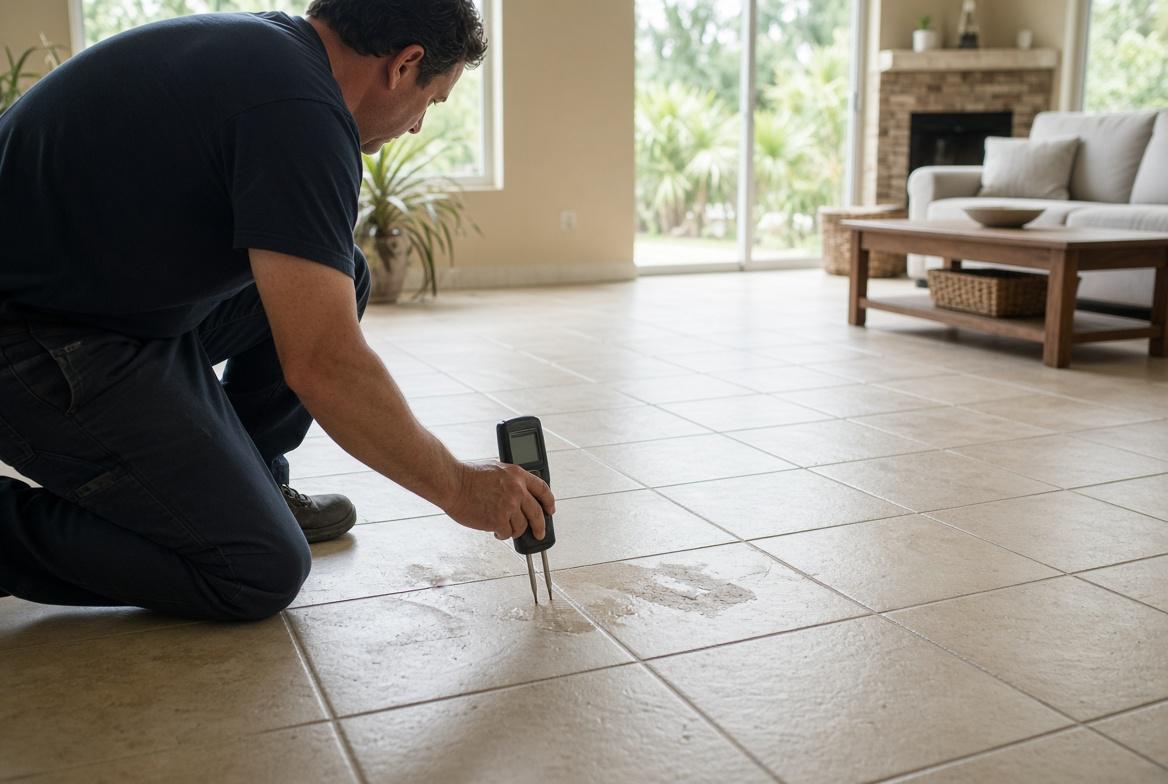
Flooring that behaves oddly in one area. Tile that sounds hollow when tapped, grout that cracks or discolors along a line, laminate that cups at the seams, wood that lifts, or carpet that feels damp in a patch that keeps coming back.
A musty smell with no visible source. This one matters, because it means the moisture has been present long enough to support biological growth.
Later, when the damage is established:
Visible mold or dark staining at the base of walls or on baseboards.
Baseboards that separate from the wall, or drywall that feels soft near the floor.
Cracks in flooring, walls, or the slab itself as saturated subgrade shifts.
Standing water or persistently soggy ground outside near the foundation.
The meter test
Before calling anyone, there is a diagnostic that costs nothing and takes half an hour.
Turn off every water-using fixture and appliance in the house, including irrigation and the ice maker. Go to your water meter and look at the leak indicator, usually a small triangle or dial that spins with even minimal flow. Note the reading, wait thirty to sixty minutes with all water still off, and check again.
If the indicator moved, water is leaving the system somewhere. That does not confirm a slab leak specifically, since it could be a toilet flapper or an irrigation valve, but it separates "something is actually leaking" from "I might be imagining this," which is worth knowing before you spend money on detection.
Why the mold arrives before the evidence does
Here is the part that makes slab leaks a restoration problem rather than only a plumbing problem.
Water escaping under a slab does not stay put. It saturates the subgrade, spreads laterally along the path of least resistance, and rises. Concrete is porous enough to transmit moisture upward by capillary action, so water that entered the soil three feet from a wall can end up in the bottom plate of that wall, in the drywall above it, and in the insulation of the cavity.
That process is slow and invisible. What it produces is exactly the condition mold needs: a continuously damp organic material in a warm, enclosed, poorly ventilated space. In South Florida, where ambient indoor humidity gives materials no help drying out, growth in a wall cavity fed by a slab leak can develop for months without a single visible sign in the room.
By the time a homeowner smells something musty or sees discoloration at a baseboard, the affected area is usually considerably larger than it looks. Our guide to the signs of hidden mold covers what else to check once you suspect this, and our summer humidity guide covers why materials here dry so reluctantly.
This is also why fixing the pipe is only half the job. Repairing the leak stops the water. It does nothing about the moisture already distributed through the slab and the wall assemblies above it.
How it is found without breaking the floor
Locating a leak under concrete is a specialized job, and the whole point is to determine exactly where to open the slab rather than guessing. Several methods are used together.
Acoustic listening. Ground microphones and amplified listening equipment pick up the sound of pressurized water escaping through a small opening. In a quiet house, an experienced technician can localize a supply leak to within a small area this way.
Thermal imaging. Infrared cameras read surface temperature differentials. A hot water line leaking under the slab warms the concrete above it in a pattern that shows up clearly, which is why this method works particularly well given how often hot lines are the culprit.
Pressure isolation testing. The hot and cold systems are isolated and pressurized separately to determine which one is losing pressure, and how fast. This narrows the search considerably before anyone starts listening for sounds.
Tracer gas. An inert gas mixture, usually helium or a hydrogen-nitrogen blend, is introduced into the drained line. It escapes at the leak, migrates up through the slab, and is picked up by a sensitive detector at the surface. This is the most precise method available and is typically reserved for leaks the other techniques cannot pin down.
Video inspection. For drain line problems rather than supply leaks, a camera run through a cleanout shows breaks, offsets, and root intrusion directly.
Moisture mapping. Meters and thermal imaging map how far moisture has spread through the slab and into walls, which defines the restoration scope rather than the repair location.
One critical step before any concrete gets cut: if your home has a post-tension slab, it has to be scanned first. Post-tension construction uses steel tendons under high tension running through the slab, and cutting one is both physically dangerous and very expensive to repair. Ground-penetrating radar locates the tendons so the cut can be placed safely. Any contractor proposing to jackhammer a slab without establishing whether it is post-tension is a contractor to decline.
Repair paths
There are three realistic approaches, and which one makes sense depends on the age and condition of the whole system rather than just this one leak.
|
Approach |
What it involves |
Best when |
Trade-offs |
|
Spot repair |
Cut through the slab at the leak, repair the pipe, patch the concrete and flooring |
Single leak, newer plumbing otherwise sound, accessible location |
Cheapest option; destructive to finished flooring; does nothing to prevent the next leak elsewhere in the same aging line |
|
Reroute |
Abandon the failed under-slab section, run a new line overhead through walls and attic |
One or two leaks on a specific run |
No slab demolition; that run never leaks under the slab again; some drywall work; visible only if soffits are needed |
|
Whole-house repipe |
Replace the entire supply system, typically overhead in PEX or CPVC |
Multiple leaks, original copper past its service life, homes generally 40 or more years old |
Highest upfront cost; ends the problem permanently; usually the right answer once you have had two or more |
The decision usually turns on a simple question: is this an isolated failure or the first of several? Copper that has begun failing from pitting corrosion in one location is typically the same age and in the same conditions everywhere else. Homeowners who spot-repair a second or third leak often end up repiping anyway, having paid for the repairs and the flooring damage in between.
What comes after the repair, and the insurance problem
Once the plumbing is fixed, the water that already got in has to come out. This is a slower process than drying a burst-pipe event upstairs, because concrete releases moisture reluctantly and the affected assemblies are at floor level where air movement is poorest.
Restoration typically involves lifting affected flooring, removing baseboards and often the lower portion of drywall to open wall cavities, extended structural drying with dehumidification aimed at the slab and the wall bases, mold remediation where growth has established, and moisture verification against unaffected reference areas before anything is closed back up. Our restoration cost guide covers what that work runs, and our emergency mold guide covers the remediation side.
The insurance situation deserves a straight answer, because slab leaks sit precisely on the line where claims get denied.
Most Florida homeowners policies cover water damage that is sudden and accidental, and generally exclude the failed component itself. In practice that often means the resulting damage to flooring, drywall, and contents may be covered while the pipe repair is not. Many policies also cover the cost of tearing out and replacing the slab to reach the leak, though this varies and is worth confirming in your specific policy language.
The complication is that a slab leak is rarely sudden. It is usually weeks or months of slow release, and many policies contain explicit exclusions for constant or repeated seepage over a period of fourteen days or more. Carriers do deny slab leak claims on exactly that basis. Whether a specific claim is treated as a sudden failure or as long-term seepage often comes down to documentation and to how quickly the homeowner acted once signs appeared.
Which is the practical argument for taking the early signs seriously. A water bill that crept up two months ago and a warm floor spot noticed last week are both easier to defend as prompt action than a wall full of mold discovered after a year.
Frequently asked questions
What does a slab leak feel like underfoot?
Usually a distinct warm or hot patch on the floor, since hot water lines fail most often. The area is typically localized and repeatable, and it will sit somewhere along the run between the water heater and a fixture.
Can I confirm a slab leak myself?
You can confirm that something is leaking. Shut off all water in the house, then watch the leak indicator on your water meter for thirty to sixty minutes. Movement means water is escaping somewhere in the system. Pinpointing it under concrete requires acoustic, thermal, or tracer gas equipment.
How long can a slab leak run before I notice?
Frequently months. The early signs are a gradually rising water bill, faint running water sounds, and reduced pressure, all of which are easy to attribute to something else. Visible damage generally arrives well after mold has started.
Does insurance cover slab leak repair?
Typically the resulting water damage may be covered while the pipe repair itself is excluded, and many policies include tear-out coverage to access the leak. However, policies commonly exclude seepage continuing over fourteen days or more, which is a frequent basis for denying slab leak claims. Check your policy language and act promptly on early signs.
Should I repair the leak or repipe the house?
If it is an isolated failure in otherwise sound plumbing, spot repair or a reroute is reasonable. If you have had multiple leaks, or the home still has original copper and is forty or more years old, repiping usually costs less than the sequence of repairs and flooring replacements that follows the alternative.
Why does mold appear before I see any water?
Water under the slab spreads through the subgrade and rises into wall bases by capillary action rather than pooling on the floor. Growth develops inside wall cavities where nothing is visible from the room until it reaches a baseboard or produces an odor.
If you have a warm spot on the floor, an unexplained water bill, or a musty smell you cannot trace, the sequence worth following is: run the meter test, call a leak detection specialist to locate it, then have the moisture damage assessed separately from the plumbing repair. The two are different jobs and the second one is the one that gets skipped.
AdvantaClean of Fort Lauderdale handles moisture assessment, structural drying, and water damage restoration after slab leak repairs across Broward County. For water entering at the slab edge from outside rather than from beneath, our guide on storm damage that starts outside your walls covers that mechanism. To schedule an assessment, call (754) 218-8070 or reach the local team here.